Space weekly recap, October 3 - October 10: Key stories you may have missed
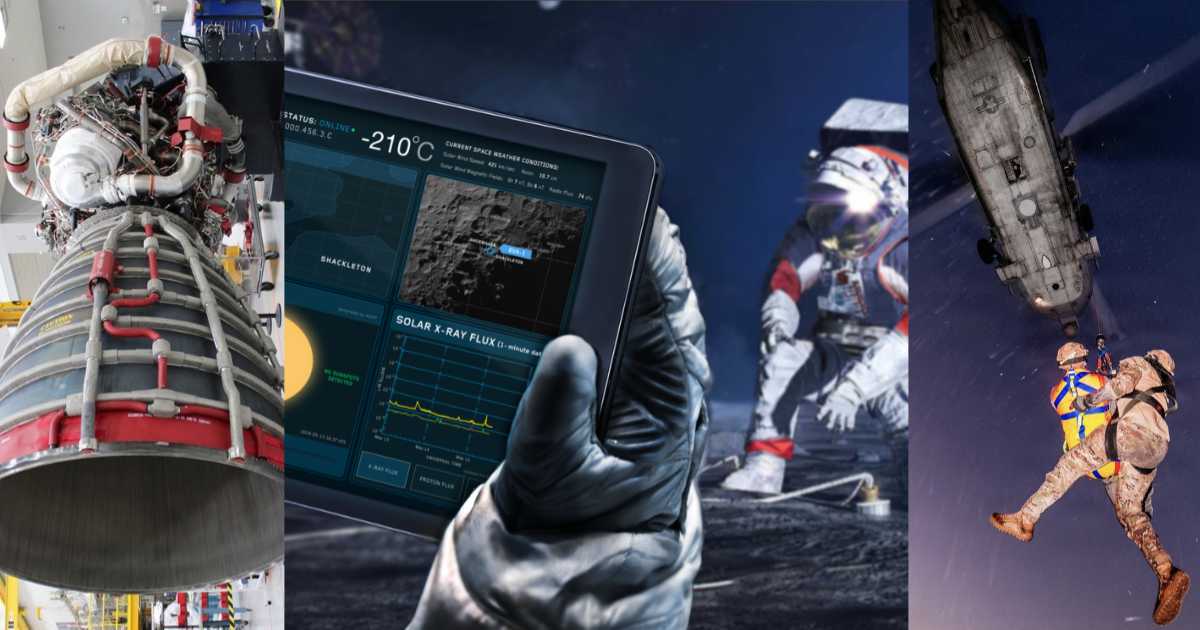
This week produced many notable developments in space-related domains. While some news, such as Crew-12's return from the International Space Station (ISS) grabbed headlines, others slipped under the radar. A case in point is astronauts participating in recovery training ahead of the Artemis III mission next year. Artemis IV, which will mark the return of humans to the Moon in 2028, saw a significant step forward in mission development as well, with the unveiling of NASA's Space Launch System (SLS) rocket engines. Elsewhere, in the field of astronomy, physicist Francis Halzen was awarded the Nobel Prize in Physics for groundbreaking work done in the discovery of high-energy IceCube neutrinos from space. Following are the stories you may have missed:
1) Artemis III crew members practice being hoisted up during recovery training
The Artemis III crew and @USNavy teams recently practiced hoist operations in San Diego as part of recovery training. Training during the day and at night helps the crew become familiar with the wind, noise, and sea spray they will experience during splashdown and recovery. https://t.co/FGgWwLfIBI
— NASA Artemis (@NASAArtemis) October 6, 2026
A team of NASA and ESA astronauts selected for Artemis III recently underwent training in San Diego, California, for their rescue after they return from space, NASA announced on Tuesday. The four members—Commander Randy Bresnik, European Space Agency Pilot Luca Parmitano, and Mission Specialists Andre Douglas and Frank Rubio—were made to go through the procedures to demonstrate the actual rescue operations, including being hoisted up by helicopters. The training took place in darkness as well to cover all bases for what will be a critical Earth-orbit mission before NASA and its partners embark for the Moon.
2) NASA outlines how Moon Base communications and navigation will look like in the near future
Mission by mission, step by step, NASA is building toward an enduring human presence on the Moon. A new NASA white paper outlines how communications, navigation, timing, and lunar surface observation capabilities are expected to expand as the Moon Base develops and exploration activity increases, including opportunities for industry to contribute.
— NASA Moon Base (@NASAMoonBase) October 6, 2026
NASA recently shared a white paper highlighting how it expected lunar infrastructure to expand alongside the development of its Moon Base. Besides high-speed connectivity for communication, ways of navigation and positioning, and the establishment of a Coordinated Lunar Time (LTC) are also discussed in the paper. The document indicates the creation of up to three lunar sites during phase one by the end of 2028, before expansion to over five sites in phase three beyond 2033. To keep all the Moon Base sites connected, infrastructure needs and connectivity speeds are also specified. The agency communicated this as a part of its Space Communications and Navigation (SCaN) market research efforts and public solicitations.
3) NASA chief says Artemis IV SLS RS-25 engines ready
These are the engines that will help return American astronauts to the surface of the Moon, and they’re ready for Artemis IV. https://t.co/edIZFQHFrk
— NASA Administrator Jared Isaacman (@NASAAdmin) October 6, 2026
Jared Isaacman, NASA administrator, shared pictures of the engines that will launch the first humans towards the lunar surface in over five decades. In an X post from October 6, Isaacman declared that the RS-25 engines, to be used in its SLS, are ready. Meanwhile, a developmental RS-25 engine numbered 10001 was also recently installed on the Fred Haise Test Stand at the agency's Stennis Space Center for a static fire test to prepare for future, post-Artemis IV flights. Four of these engines are installed on the SLS rocket's core stage, which fires through the initial minutes of a lunar mission and puts the upper stage into space.
4) Blue Origin CEO issues fresh updates about LC-36 rebuild after catastrophic explosion
LC-36's skyline keeps rising, one module at a time. Module 5 is now placed with four more to go. [edit: original image] https://t.co/EpKo8Ybpwh
— Dave Limp (@davill) October 6, 2026
Dave Limp, Blue Origin's CEO, shared footage from Launch Complex 36 where a new launch tower is being built on a second launchpad. The launch tower is composed of nine parts, with Limp announcing that five had been put in place so far as of October 6, 2026. The rebuild is being done based on a new ConOps (Concept of Operations) that will involve the launch of the Jeff Bezos-owned company's New Glenn rocket. The opportunity for a redesign of the pad arose after a catastrophic explosion forced Blue Origin to take an approach that accounts for a higher launch cadence for its lunar and Earth-orbit ambitions. The company also recently unveiled plans for Constellation Park, which will be a 1.3-million-square-foot complex about 35 miles northeast of Austin, Texas, to support its satellite programs like TeraWave.
5) SpaceX postpones SDA's Tranche 1 data transport mission launch again, now set for October 10
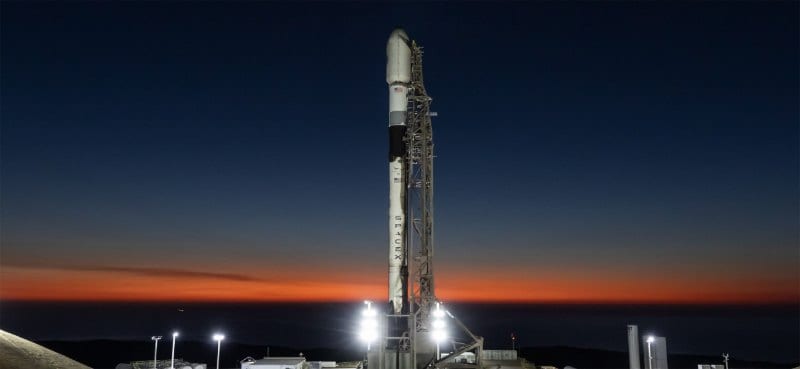
SpaceX, on October 7, postponed the launch of the Space Development Agency’s (SDA) fourth Tranche 1 data transport mission for the second time. The defense mission is now planned to launch at 12:29 am PDT on Saturday, October 10. The launch was about to proceed in the early hours of Monday, but a last-minute abort call forced a postponement. The scrub came 58 seconds before the liftoff of the Falcon 9 rocket during its terminal count. The launch will occur from Space Launch Complex 4 East (SLC-4E) at Vandenberg Space Force Base in California, with a backup window reserved for Sunday. Saturday's planned launch is to be the fourth of nine Tranche 1 missions by the SDA, which is a wing of the U.S. Space Force under the Department of Defense.
6) SpaceX gets FCC green light for 15,000 Starlink Mobile (direct-to-cell) V2 satellites
We announced an agreement to acquire a nationwide low-band spectrum license portfolio that will pave the way for @Starlink to become a major mobile carrier in the US. With this new spectrum and our Gen2 constellation, Starlink Mobile can ensure Americans have access to high-speed mobile broadband no matter where they are → https://t.co/1Uaf48v5pm
— SpaceX (@SpaceX) October 8, 2026
The Federal Communications Commission (FCC) has given its approval to SpaceX for the deployment of 15,000 Starlink Mobile 2nd-generation satellites, the aerospace leader announced on October 8. These new satellites will provide over 100 times the bandwidth of SpaceX's current mobile constellation. This will bring high-speed service directly to unmodified devices anywhere in the world. Earlier this week, the company also announced an agreement to acquire a nationwide low-band spectrum license, which will make Starlink Mobile a major mobile carrier in the U.S.
7) Europe's own reusable rocket undergoes wet dress rehearsal
As a reusable launcher, Themis is designed to touchdown on land within an area of just 20 x 20 square metres. There, robots will move towards the launcher and connect to it, draining any remaining fuel and oxidiser. https://t.co/wDrUvO9Qi1
— ESA Space Transport (@ESA_transport) October 7, 2026
The European Space Agency (ESA) highlighted this week that it had successfully completed two wet dress rehearsals of its reusable Themis rocket at the Esrange Space Center in Sweden. Themis, which the ESA has described as its 'flagship' rocket, is powered by the Prometheus engine, which runs on liquid oxygen and methane fuel. The second rehearsal took place on September 29 after the first was carried out in July 2026. The wet dress rehearsal let ArianeGroup engineers practice countdown procedures as the prototype was filled with liquid nitrogen at minus 200°C to test how the entire system holds up under extreme conditions.
8) ESA and Vast to collaborate in future commercial opportunities in Low Earth Orbit
We’re strengthening our cooperation with @vast to help shape Europe’s future in low Earth orbit and opening new opportunities for European astronauts, research and technology. #IAC2026 🔗https://t.co/Kgh6LWNPCS https://t.co/BIe8Q8dz8X
— European Space Agency (@esa) October 6, 2026
ESA signed a Memorandum of Understanding with the company Vast Space on October 5, 2026 for what will be a collaboration in Low Earth Orbit in the future. This has been decribed as the European agency’s global preparatory work for life in the aftermath of the retirement of the International Space Station at the end of the decade. The agreement was signed during the 77th International Astronautical Congress in Antalya, Turkey by CEO of Vast, Max Hoat and Daniel Neuenschwander, Director of Human and Robotic Exploration at ESA. The latter stated, "To ensure Europe’s future in Low Earth Orbit, we need to anticipate and ensure our readiness once the great cooperation on ISS comes to an end".
ESA signed a Memorandum of Understanding with the company Vast Space on October 5, for what will be a collaboration for low Earth orbit missions in future. This has been described as the European agency’s global preparatory work for the post-ISS era. The agreement was signed during the 77th International Astronautical Congress in Antalya, Turkey, by Vast CEO Max Hoat and Daniel Neuenschwander, Director of Human and Robotic Exploration at ESA. The latter stated, "To ensure Europe’s future in Low Earth Orbit, we need to anticipate and ensure our readiness once the great cooperation on ISS comes to an end."
9) Nobel Prize awarded to physicist for discovery of high-energy neutrinos from space
BREAKING NEWS The Royal Swedish Academy of Sciences has decided to award the 2026 #NobelPrize in Physics to Francis Halzen “for decisive contributions to the IceCube Neutrino Observatory and the discovery of high-energy neutrinos of astrophysical origin.” https://t.co/UcPBWk0RiK
— The Nobel Prize (@NobelPrize) October 6, 2026
Belgian physicist Francis Halzen has won the Nobel Prize in Physics for his contributions to an observatory that detects high-energy neutrinos originating from deep sky objects. The observatory is called IceCube and is located under the Amundsen-Scott South Pole Station in Antarctica. It consists of 86 strings of photo-detectors which have been installed under about 1.5 miles of ice for making observations that need to be highly sensitive. Neutrinos are highly elusive and are therefore sometimes referred to as ghost particles.
10) Researchers using ESA's Solar Orbiter study magnetic switchback of solar winds on the Sun
Solar Orbiter tracks the origin of the Sun's mysterious magnetic switchbacks ☀️ Back in 2022, Solar Orbiter spotted a kink in the solar wind’s magnetic field known as a ‘switchback’ and confirmed it to be S-shaped: something scientists had predicted but not seen directly. 1/2 https://t.co/f8lHBKeFXe
— ESA Science (@esascience) October 8, 2026
Using measurements from ESA's Solar Orbiter, scientists may have found the reason for a hitherto unexplained phenomenon observed on the Sun. Called switchbacks, these are found in the continuous stream of charged particles known as solar wind, and are embedded with magnetic field lines. These field lines fold back on themselves at sharp angles, which are essentially what magnetic switchbacks are. According to the study, published on October 8, the switchback of plasma happens due to closed-loop structures in the solar corona. This is the Sun's outermost layer. These structures could be studied thanks to the Solar Wind Analyser instrument (SWA) on Solar Orbiter, which orbits at roughly half the distance between the Sun and Earth.
11) NASA's TESS and CHEOPS missions may have helped scientists find a hot-water exoplanet

Using data gathered by NASA's TESS (Transiting Exoplanet Survey Satellite) space telescope and ESA's CHEOPS (CHaracterising ExOPlanet Satellite), scientists have been able to characterize an Earth-like exoplanet. The super-Earth is officially called TOI-2211 b, and has a diameter about 45 per cent wider than our planet. It orbits a K-type star and is about 2.69 times more massive than Earth. Although the presence of an atmosphere and water have not been confirmed yet, the scientists call this exoplanet "a promising hot-water world candidate". In a paper submitted on October 6, the researchers state that the world joins a small but growing sample of low-density super-Earths, which are interesting targets for testing existing planet formation and evolution theories.
12) A gas exoplanet may be orbiting an ultracool dwarf
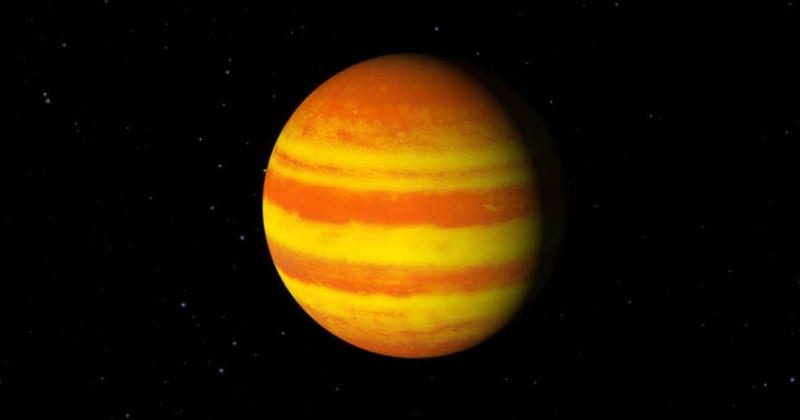
Astronomers using data from the Very Large Telescope (VLT) in Chile and FORS2 (FOcal Reducer/low dispersion Spectrograph 2) have found a new exoplanet candidate that may be orbiting an ultracool dwarf. Named PALTA-1 b, the exoplanet has a mass less than that of Jupiter and orbits the star DENIS-P J1253108-570924 (DE1253-57). The star is categorized as an early-L dwarf and is located at a distance of just over 55 light-years from us. If this discovery is confirmed, PALTA-1 b would be one of only a few instances of a giant planet orbiting a nearby ultracool dwarf. The study targeted 20 nearby ultracool dwarfs and has already found three new ultracool binary systems.
Here are our five most-viewed space stories from this week
SpaceX shares first picture of Starlink V3 satellite deployment by Starship on debut orbital flight
Inside Sunbird: Pulsar Fusion's nuclear spacecraft that can cut travel time to Mars in half
Don't miss Draconid and Orionid meteor showers this October: Here are peak timings and viewing tips
SpaceX says preparations are going ‘super well’ for first Starship launch from Florida