ESA's Hera spacecraft captures spooky infrared image of Didymos-Dimorphos asteroid pair
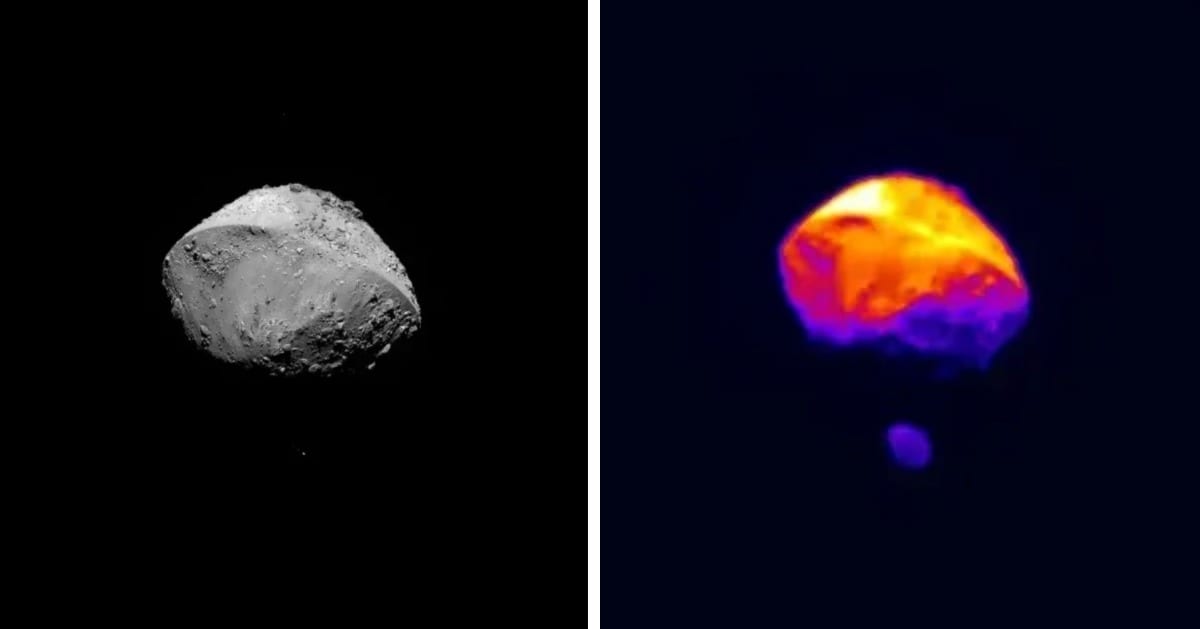
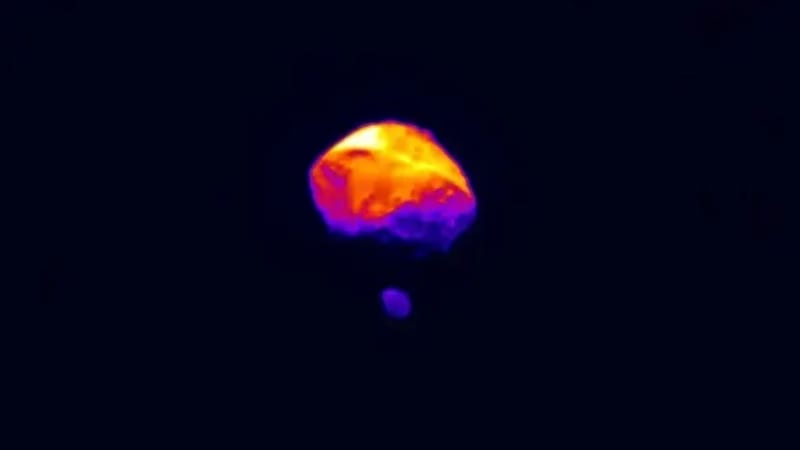
The European Space Agency (ESA) has shared new pictures of the Didymos-Dimorphos asteroid system amid the ongoing survey by its Hera spacecraft. The new pictures were taken by Hera’s different cameras and in different wavelengths from a distance of 17.7 miles (28.5 km) as part of a campaign that began earlier this month. In the pictures taken by the spacecraft’s Asteroid Framing Camera and the HyperScout H, Dimorphos—the smaller of the two asteroids—is almost entirely in shadow, with only a tiny speck catching sunlight. Dimorphos, however, is visible in the image by the Thermal Infrared Imager (TIRI), which highlights the hot (red) and cool (blue) regions on the rocks.
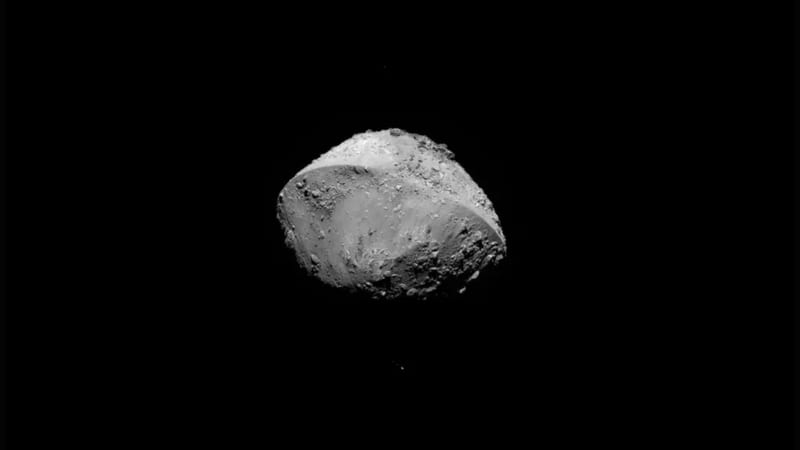
Patrick Michel, Hera’s Principal Investigator, stated that the pictures reveal “the variety of surface features across the spinning-top-shaped Didymos, with boulder-rich area as well as clearer regions and traces of what might be landslides towards its central ridge.” Michel also said that the clearly visible ridge may have formed after material migrated toward it due to Didymos’s rapid spin every 2.2 hours. While Dimorphos measures 495 feet (151 m) across, Didymos is significantly bigger at 2,559 feet (780 m).
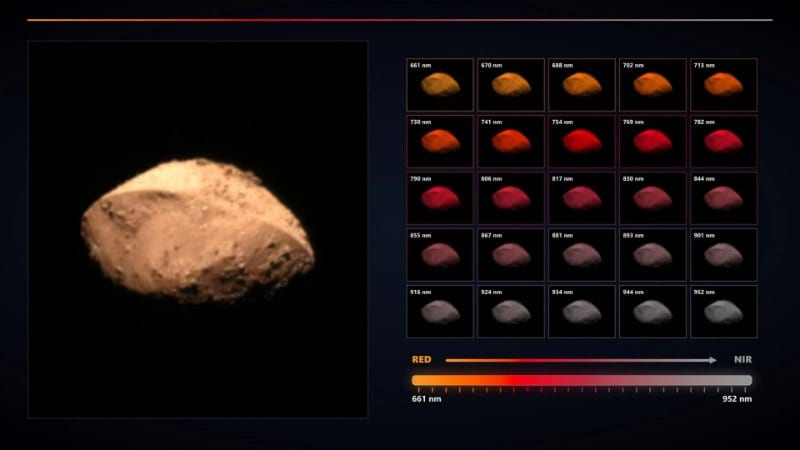
Thanks to the HyperScout H, scientists are able to study Didymos in 25 different hues. Sunlight is reflected differently in different wavelengths across these colors, and this could help scientists determine what Didymos is made of. In the third image, Didymos is visible as a ghostly orb with its top half glowing in a mix of red and orange. The colors represent the heat emanating from the asteroid; the smaller Dimorphos is visible in bright purple, and it suggests that its unlit surface is significantly cooler. According to ESA, mapping temperatures across the asteroids’ surfaces will help determine whether they are made of solid, porous, or broken rocks.
Over the next few months, Hera will get closer to the binary pair and release two CubeSats for more extensive observations. These CubeSats will undertake a riskier approach to the mission and eventually land at the end of the survey. The main target of the survey is Dimorphos, the moonlet that was smacked by NASA’s DART spacecraft in 2022 as part of a planetary defense mission. After the crash, NASA confirmed that DART shortened Dimorphos’s orbital period around Didymos by around 33 minutes and produced a plume of debris across 6,214 miles (10,000 km) of space. Alongside the CubeSats, Hera will study Dimorphos’s mass, composition, and structure in work that will ultimately boost efforts to save Earth from hazardous asteroids.
Hera is currently flying in ‘rectangular orbits’ around the asteroids because of their weak gravity, which makes circular orbits infeasible. The mission is in the ‘early characterization phase’ right now, and Hera will soon enter the ‘detailed characterization phase,’ performing repeated flybys of the asteroids in hyperbolic arcs. The next phase will bring Hera within approximately 12.5 miles (20 km) from the rocky pair. Launched in October 2024, the mission is likely to end in June 2027, with a possible extension.
More on Starlust
ESA’s Mars Express images 8-km-tall Martian volcano that has a dramatic past