Mountain-sized asteroid approaching Earth in 2027: Will 1999 AN10 strike our planet? What to know

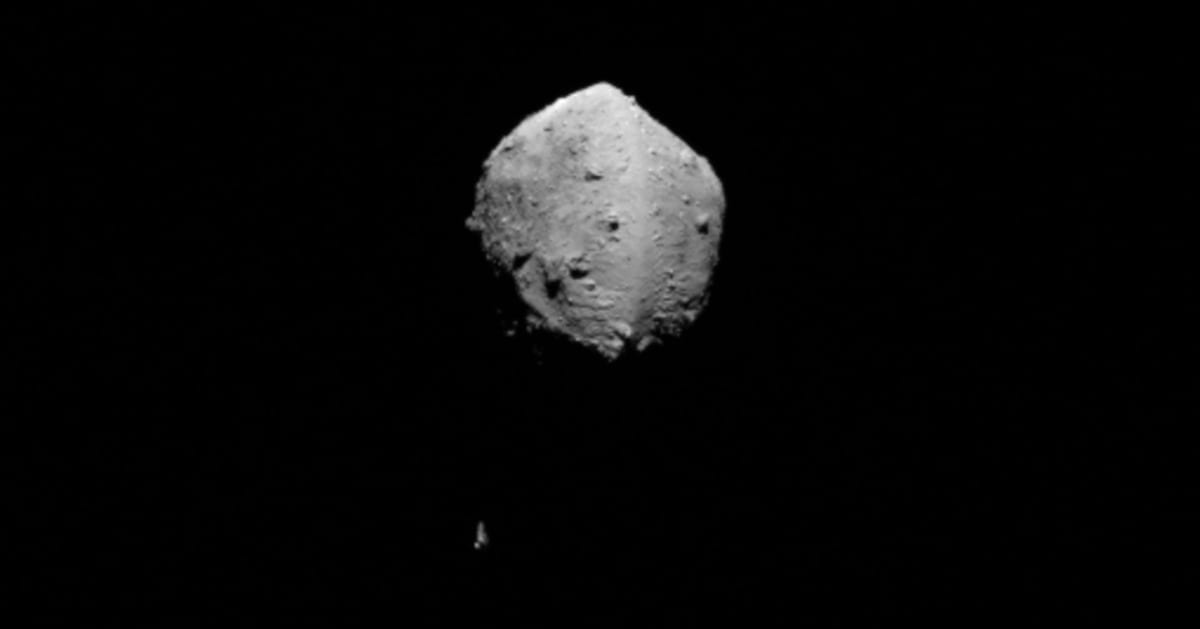
A mountain-sized asteroid, approximately 800 to 1,800 meters wide, is set to make a close approach to Earth on August 7, 2027, according to NASA, giving astronomers the chance to study a large space rock up close. Designated 1999 AN10, the asteroid will approach Earth at an approximate separation of 389,855 kilometers, which is around the same distance as that of the Moon. This will be the nearest flyby by an asteroid of this size that has been identified in advance, and also the closest approach by an object this big since 1918, when the near-Earth asteroid 2011 MD5 came within 349,700 kilometers of Earth. 1999 AN10 will not impact our home planet next year, even though it has been classified as a potentially hazardous asteroid by NASA.

The good news for skywatchers is that they will be able to spot the gigantic asteroid with a pair of binoculars or a telescope. As the object traverses the night sky over North and South America, it will peak at a magnitude of 7.3 and move through the constellations Taurus, Aries, Pisces, and Pegasus. The close approach to Earth is expected around 7:11 UTC, or 2:11 a.m. CDT, on August 7, 2027, and this flyby will offer a rare chance to perform detailed radar imaging due to its extremely close approach. High quality images, with a resolution of up to 2 meters per pixel, are expected to be acquired during the flyby, which can help scientists identify the surface features, shape, and other physical properties of the asteroid, features that cannot usually be observed using basic optical telescopes.

After it peaks in brightness, the asteroid will be at an angle greater than 100 degrees from the Sun and will be brighter than 16th magnitude during August 7–18. This will offer scientists a good opportunity to perform light-curve observations to determine spin, visible- and infrared-light spectroscopy to identify surface minerals, and infrared radiometry to measure 1999 AN10's heat output. Given this opportunity, observatories across the world are likely to keep a close eye on 1999 AN10 during the flyby window.
Although 1999 AN10 will not strike Earth during its 2027 flyby, it is still categorized as a potentially hazardous asteroid, which is defined as a space rock with a diameter of greater than 140 meters whose orbit passes within 0.05 astronomical units (roughly 4.6 million miles) of Earth. The potentially hazardous label has been assigned because there is a possibility that 1999 AN10, after a gravitational push from a planet or an interaction with another moving object in the future, could undergo a change in its orbit, putting it on a collision course with Earth. That said, NASA's current orbital calculations confirm that there is no possibility of 1999 AN10 hitting Earth during its flyby in 2027.
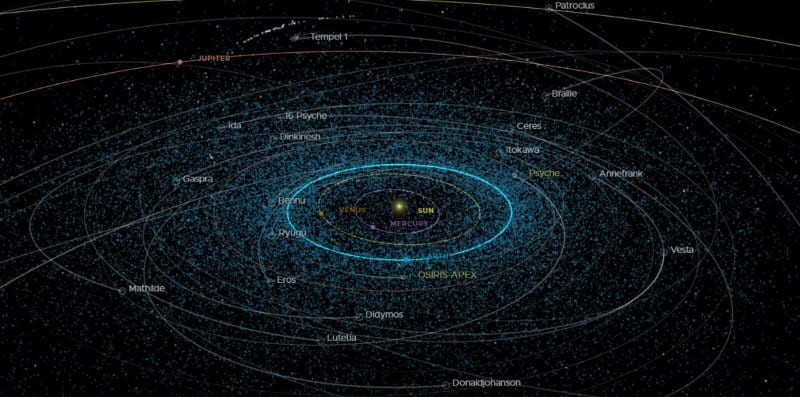
1999 AN10 was first detected by the Lincoln Near-Earth Asteroid Research (LINEAR) project in New Mexico on January 13, 1999. The asteroid has an absolute magnitude of 18.05—a measure of its intrinsic brightness—and observations point to an estimated diameter of at least 800 meters. The physical characteristics of the 1999 AN10 are not well known at the moment, with only limited information available, such as its rotation period of 5.04 hours. Following 1999 AN10's discovery, there were concerns about a potential impact with Earth in 2039, but further studies and archival measurements have ruled out that possibility, with no impact risk expected from the space rock in the foreseeable future.
More on Starlust
Asteroid impacts shaped the early Earth's surface, creating conditions conducive for life