Scientists trace mysterious radio flashes to a bizarre pair: A dead star and its Sun-like companion
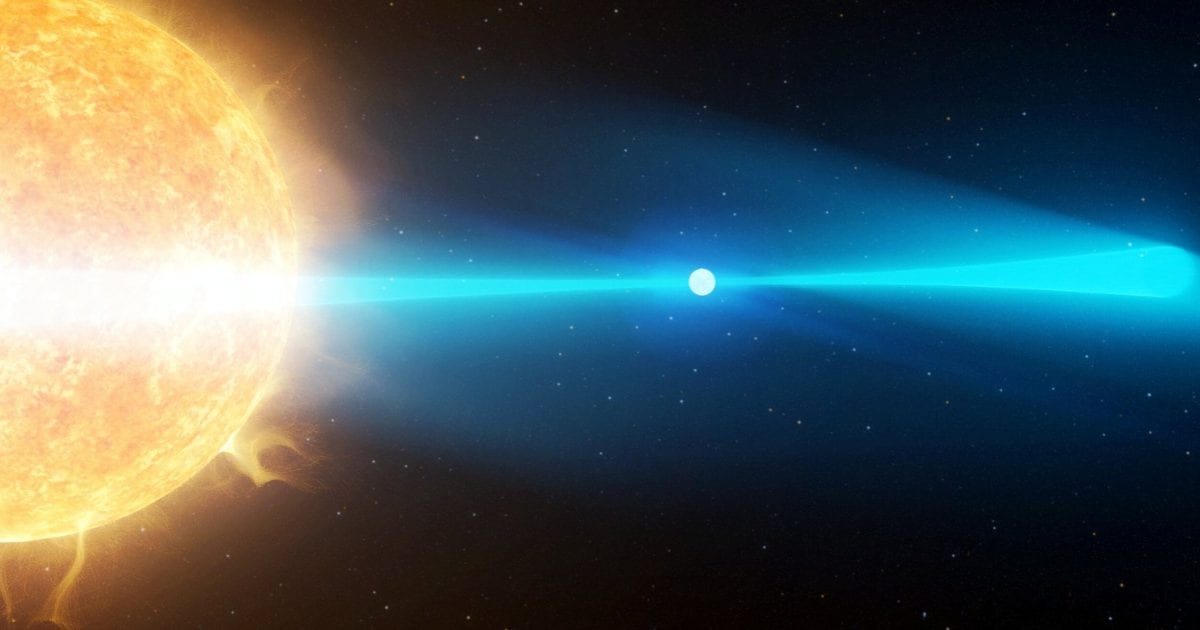
A research team from the Curtin University node at the International Centre for Radio Astronomy Research (ICRAR) has traced mysterious radio pulses to a bizarre stellar pairing: a white dwarf (or dead star) that spins every 8 minutes and its Sun-like companion. The study, published in Nature Astronomy, describes the first-ever detection of radio pulses from a white dwarf that circles a star similar to our Sun. Astronomers had earlier observed such radio pulses in systems involving cooler and smaller red dwarf stars that orbit a white dwarf.
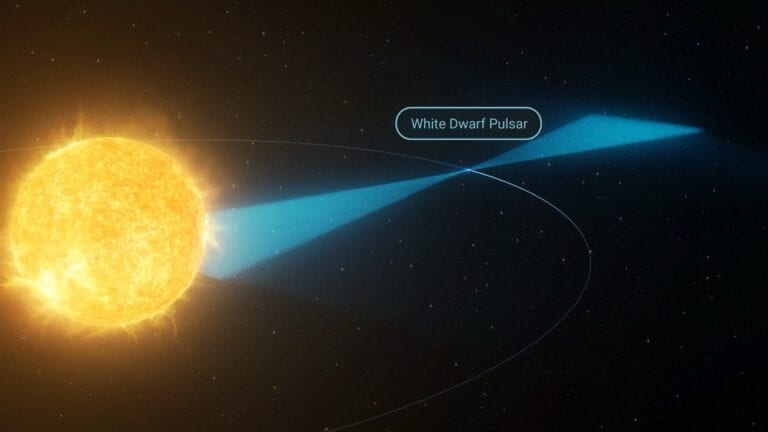
This unique stellar pairing, designated GPM J071507−114153, can be categorized as a long-period transient (LPT)—objects that generate radio waves at regular intervals that range from a few minutes to hours. Since the first such LPT was detected by the ICRAR in 2021, about a dozen LPTs have been identified so far. The initial discovery of these LPTs puzzled scientists, and after ruling out aliens as an explanation, they considered other possibilities, such as slow-spinning neutron star pulsars, the collapsed cores of gigantic stars that emit recurrent radio signals. "But in theory a neutron star spinning that slowly shouldn’t produce radio waves, so the answer had to be something else," wrote Associate Professor and co-author of the paper Natasha Hurely-Walker for The Conversation. Eventually, a breakthrough was made when one of the repeating signals being tracked led to a red dwarf star that was, in all likelihood, orbiting a white dwarf. And that had been the pattern for the few LPTs whose sources could be identified. Until now.

The research team spotted the mysterious radio flashes in question while performing observations of the Milky Way using the Murchison Widefield Array. The team applied a surveying technique devised by doctoral candidate Csanád Horváth and detected brief bursts of radio emissions emerging every 7.9 minutes. However, these emissions stopped all of a sudden, with nothing being seen for some weeks. However, the team noticed a specific pattern: the waves occurred in a six-hour window, followed by a gap of 26 hours when nothing was observed. Based on this, the researchers concluded that the system could be a binary—two stars that orbit each other every 32 hours. The emitted radio waves were only being detected when these stars were in favorable alignment.
To investigate the source, the team used the MeerKAT telescope in South Africa to pinpoint a dimly lit star and subsequently used the W.M. Keck Observatory in Hawaii to determine the spectrum of the star. And instead of finding a red dwarf as they had expected, they found a G-type star about the same mass and temperature as our Sun.

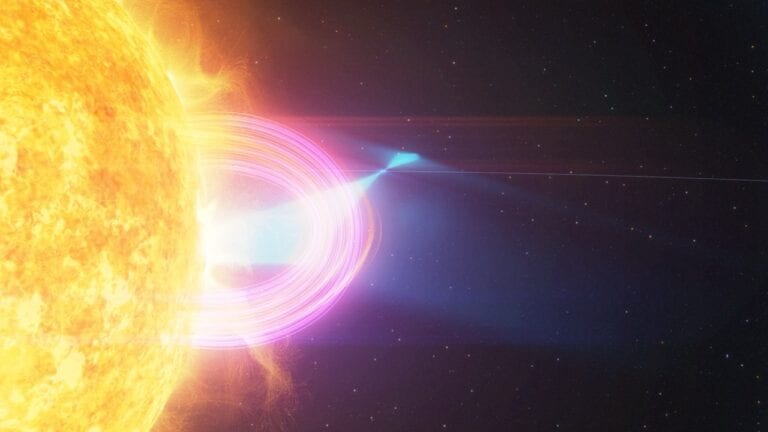
“This is the first time the pulses are clear enough to see the white dwarf moving in its orbit around its companion, so we know that the pulsations are coming from a region close to the white dwarf, or possibly even from the white dwarf itself,” said study lead author Sam McSweeney, a scientist with the Square Kilometre Array Observatory, per the ICRAR press release. To further verify the results and investigate the orbital motion of the white dwarf, the researchers studied more than 100 hours of radio detections at the Pawsey Supercomputing Research Centre.

As for the origin of the bizarre pair, the team suggests that the star, before transitioning into a white dwarf, first transformed into a giant, swallowing up its companion star, which traveled inward and reduced the orbit before the ejection of the giant's outer layers. The team is of the opinion that radio signals can help in detecting white dwarfs even though they are shielded by the light from their companion star. Researchers, hence, are hopeful that they can discover more such white dwarfs in these systems using next-generation radio telescopes, such as the SKA radio telescope. Detecting these celestial bodies around various types of stars can provide a picture of the life-and-death cycle of Sun-like stars.
More on Starlust
Four dead stars discovered not too far from Earth stun scientists
Dead stars, big appetites: Scientists gain new insights into how white dwarfs devour metals