New telescope image confirms interstellar comet 3I/ATLAS is growing a bright ion tail
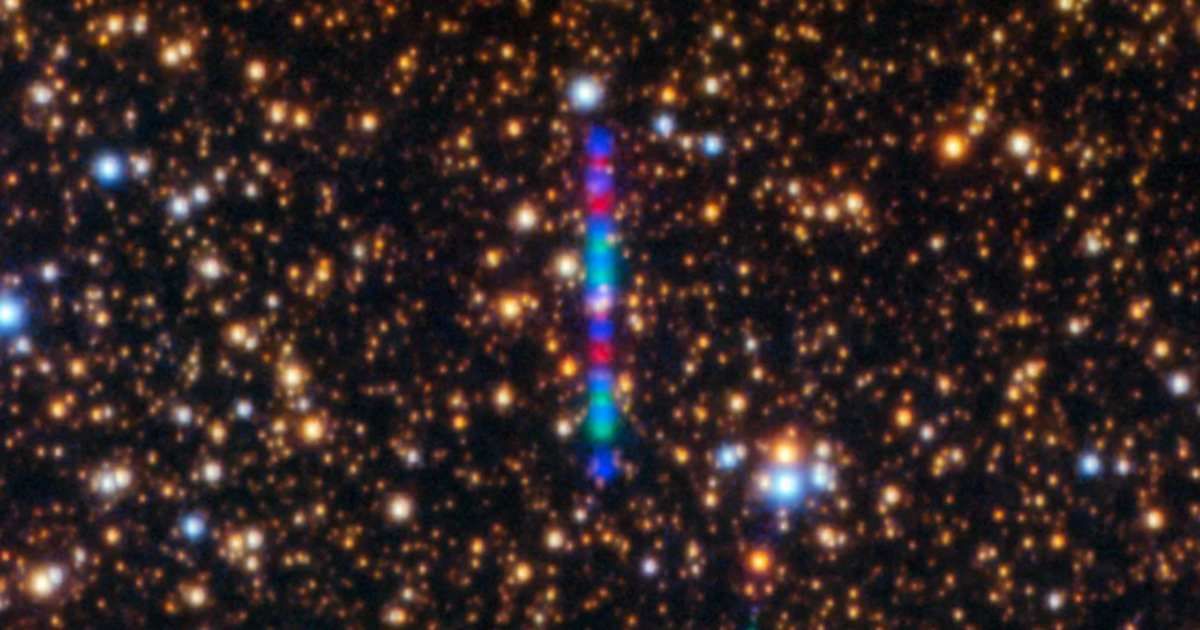
New observation of the interstellar comet 3I/ATLAS (aka C/2025 N1 ATLAS) shows that its ion tail has become significantly brighter and longer, according to recent data provided by the Virtual Telescope Project.
⚠️ Interstellar comet #3IATLAS shows a nice ion tail! We spotted it a few hours ago!https://t.co/zmKMxgJFkO
— Virtual Telescope (@VirtualTelescop) November 11, 2025
Taking advantage of clear seasonal viewing conditions, the Virtual Telescope Project managed to capture an image that reveals a much more evolved structure of the comet than we had seen before. The latest image was taken with the ARTEC250+Paramout ME+C3Pro61000EC robotic unit in Manciano, Italy, and consists of 18 exposures, each lasting 120 seconds.
Interstellar comet #3IATLAS shows its coma in this recent image we’ve just captured! pic.twitter.com/oNSDgEEliB
— Virtual Telescope (@VirtualTelescop) November 7, 2025
"Exploiting the unusual good weather of this season, we imaged the interstellar comet 3I/ATLAS (C/2025 N1 ATLAS) again, recording a much more developed ion tail," said Gianluca Masi, Virtual Telescope Project founder and astronomer. "Looking at the picture, we see how the ion tail of 3I/ATLAS is clearly showing better and better." The image shows an ion tail that is more well-defined than ever, stretching no less than 0.7 degrees in the NE direction, and a faint anti-tail pointing towards ESE. As for the comet's position, it was 14 degrees above the eastern horizon, with a bright (phase: 61%) Moon at about 70 degrees from it.
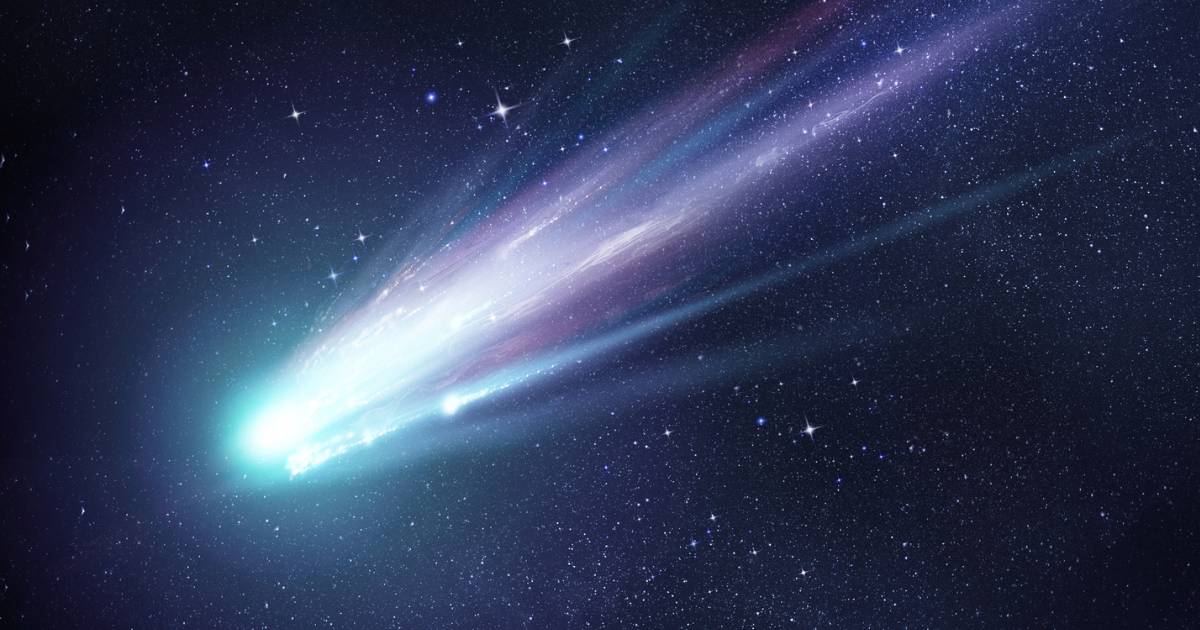
The comet's striking bluish ion tail forms when the sun's ultraviolet rays ionize the gas molecules released from its core. Those charged particles get swept away instantly by the solar wind, a steady stream of charged particles flowing from the Sun, creating a bright tail that always points away from our star, no matter what direction the comet's moving. This tail is different from the yellowish-white dust tail, which tends to curve along the comet's orbit, according to Space.com.
As the tail gets longer and brighter, it hints that more volatile materials like carbon dioxide ice, and dust are rapidly sublimating and being pushed into space. Early observations suggest that 3I/ATLAS has a significant amount of carbon dioxide ice, which might give us some amazing insights into the conditions that existed in the distant planetary system where it came from.
Being only the third confirmed interstellar object ever spotted, after 1I/'Oumuamua in 2017 and 2I/Borisov in 2019, 3I/ATLAS holds a special place in our observations. Unlike the previous ones, this comet is bright enough for ground-based telescopes to study it in detail, giving astronomers a unique opportunity to see how an interstellar comet behaves as it interacts with our Sun's environment.

While discourse about the interstellar object has repeatedly involved hypotheses about alien technology or "motherships," new radio evidence has taken a big step towards establishing the object's identity as a natural comet. In this case, radio absorption lines produced by the hydroxyl radicals (OH molecules) in this object were successfully detected using the MeerKAT radio telescope of the South African Radio Astronomy Observatory. According to D.J. Pisano and colleagues on The Astronomer’s Telegram, this finding confirms the object is undergoing natural outgassing processes because the detection occurred at the 1665 MHz and 1667 MHz lines, characteristic of regular cometary activity. Experts are keeping tabs on the trajectory of the comet; its closest approach to Earth is expected on December 19, 2025.
Correction in the article published on November 13, 2025: Comet 3I/ATLAS is the third confirmed interstellar object, not the third confirmed interstellar comet, after 1I/'Oumuamua and 2I/Borisov. It is the second confirmed interstellar comet. The correction has been made and is reflecting now.
More on Starlust
Massive tail and anti-tail jets reveal unexpected structure of interstellar comet 3I/ATLAS