First-ever radio signal from 3I/ATLAS detected—confirming typical comet activity

Conspiracy theories can be put to rest as new evidence from the MeerKAT radio telescope has emerged.
A deep image of interstellar Comet 3I/ATLAS captured by the Gemini Multi-Object Spectrograph (GMOS) (Cover Image Source: International Gemini Observatory/NOIRLab)

There has been much talk about the possibility of the interstellar comet 3I/ATLAS being an alien mothership or alien technology. However, the MeerKAT radio telescope, operated by the South African Radio Astronomy Observatory, came out with new evidence confirming that the object showed typical comet activity. Radio absorption lines by hydroxyl radicals, namely OH molecules, were detected from the interstellar object 3I/ATLAS. "OH absorption was detected on the 1665 MHz and 1667 MHz lines," explained a report by D.J. Pisano and collaborators posted on The Astronomer’s Telegram, revealing the detection.

A view of comet 3I/ATLAS, as seen by NASA’s SPHEREx, which observed the interstellar object from 7–15 August 2025. (Image Source: NASA | Photo by NASA / SPHEREx)

This signal was unlike spacecraft transmissions and was a radio-frequency pattern detected by 64 antennas, each with a 13.5-meter diameter. Lines of radio absorption by hydroxyl radicals, or OH molecules, are a pattern consistent with usual comet activity. Per WIRED, the lines appeared as absorption because 3I/ATLAS was very close to the sun, an observation vantage that favored absorption over emission. At the closest distance from the Sun, sublimation ejected more ice into space, receiving greater radiation, an aspect that also led to a change in its trajectory.
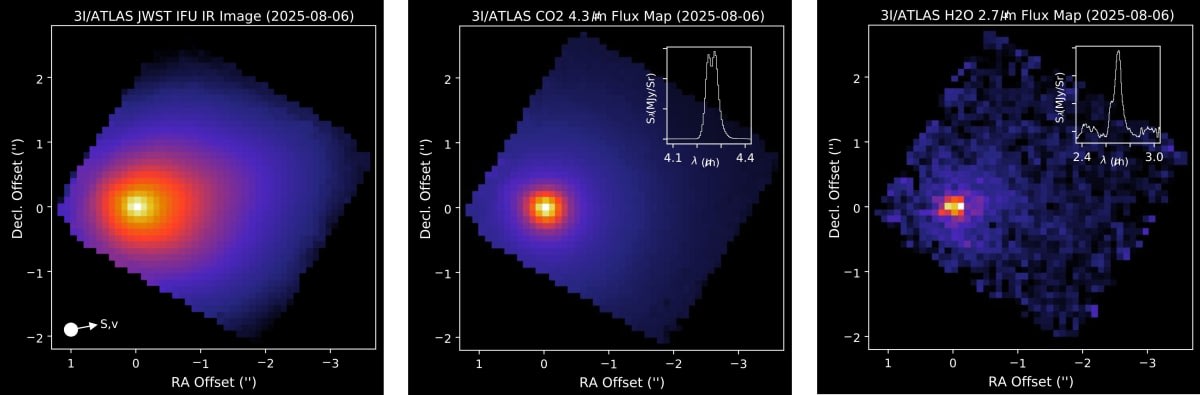
NASA’s Webb Space Telescope's image of Comet 3I/ATLAS.
(Image Source: NASA | James Webb Space Telescope.)
NASA’s Webb Space Telescope's image of Comet 3I/ATLAS. (Image Source: NASA | James Webb Space Telescope.)

The hydroxyl radical (OH) is capable of absorbing or emitting radiation at particular frequencies from a transition in energy levels. In this case, the 1665 and 1667 MHz lines. OH spectral lines “glow” brightly under conditional radio frequencies and helped map star and water-born regions. These spectral lines have been previously detected in nebulae, comets, and star-forming regions. 

Interstellar comet 3I/ATLAS going past a dense star field  (Image credit: International Gemini Observatory/NOIRLab/NSF/AURA/K. Meech (IfA/U. Hawaii). Image processing: Jen Miller & Mahdi Zamani (NSF NOIRLab))
Interstellar comet 3I/ATLAS going past a dense star field (Image Source: International Gemini Observatory/NOIRLab/NSF/AURA/K. Meech (IfA/U. Hawaii). Image processing: Jen Miller & Mahdi Zamani (NSF NOIRLab))

The observation by MeerKAT was made on October 24, 2025, when the angular separation of 3I/ATLAS from the Sun was 3.76 degrees. Attempts to detect these lines with the telescope were previously unsuccessful on September 20 and 28, 2025. On October 21, 2025, a few days before the observation, the object was close to the orbital plane of the Earth around the Sun, putting it at a solar conjunction relative to Earth. 
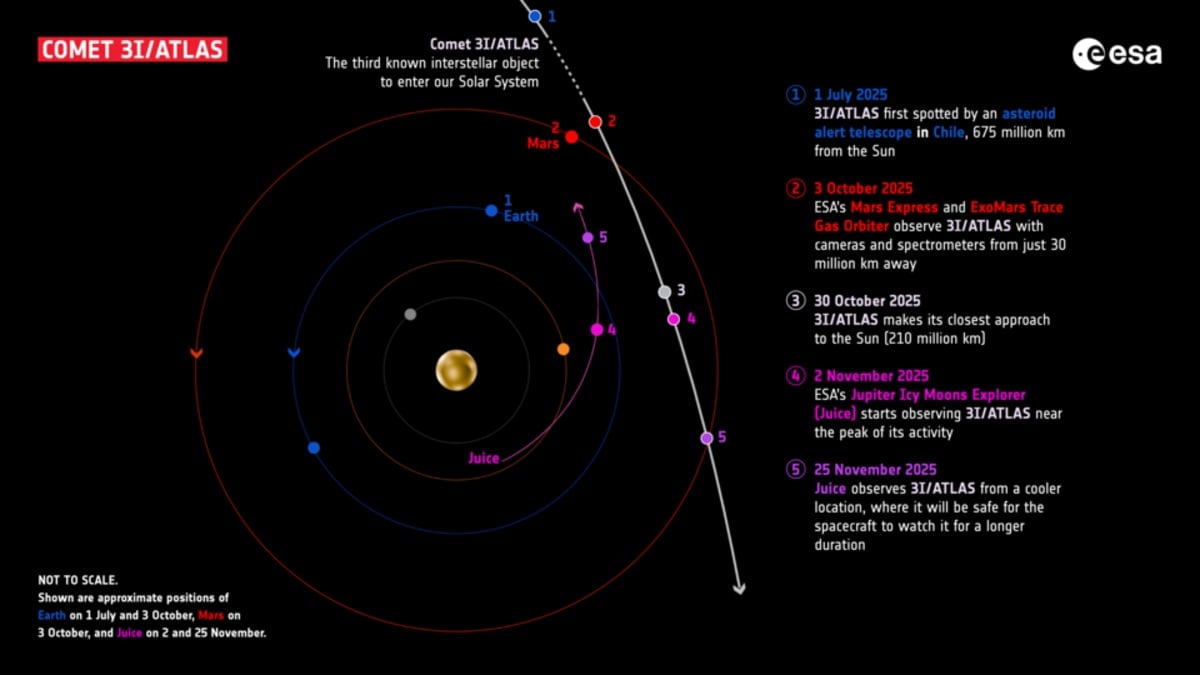
ESA’s Mars and Jupiter missions observe comet 3I/ATLAS (Image Source: ESA)

“Five weeks ago, I encouraged radio observatories like MeerKAT to search for radio emission from 3I/ATLAS, given that the arrival direction of 3I/ATLAS coincided to within 9 degrees with the arrival direction of the Wow! Signal detected in 1977 at a frequency of 1.4204556 gigahertz,” Harvard astronomer Loeb mentioned in his Medium blog. “In response, I was assured that 3I/ATLAS will be monitored by radio observatories like MeerKAT,” he added. Continued monitoring of the object will identify whether the OH production is constant or intermittent.
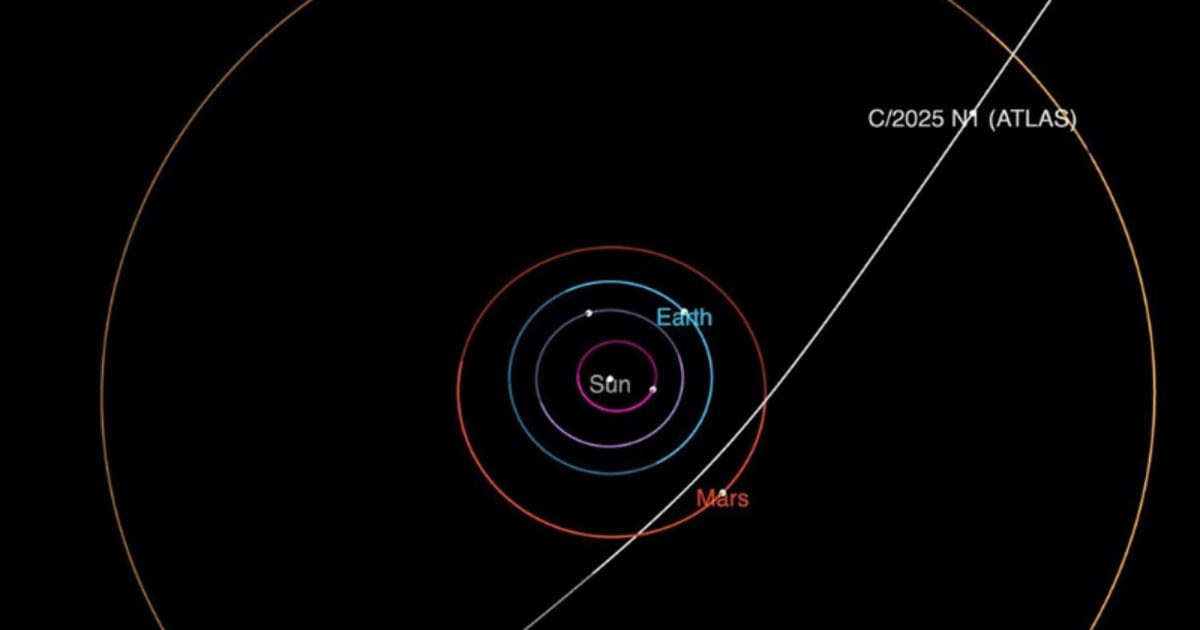
Image shows the trajectory of comet 3I/ATLAS as it passes through the solar system (Image Credit: NASA | JPL-Caltech)
Image shows the trajectory of comet 3I/ATLAS as it passes through the solar system (Image Source: NASA | JPL-Caltech)

There has been no other signal detected apart from the OH absorption signal, and the nature of this is also dependent on other factors. The extent and structure of the tail could be one such aspect, given its formation and reaction to radiation. The trajectory of the comet is being closely studied by experts, and on December 19, 2025, it will be at its closest point to Earth.

More on Starlust

Massive tail and anti-tail jets reveal unexpected structure of interstellar comet 3I/ATLAS
A 'nearly interstellar' object has just been discovered. Harvard astronomer clarifies possible link to comet 3I/ATLAS

There's a 30 percent chance Interstellar object 3I/ATLAS does not have 'natural origin,' says Harvard astronomer

MORE STORIES

Growing levels of light pollution due to satellites is obscuring our view of the universe.
1 day ago
The Moon can fill a critical frequency gap that remains out of reach for both ground and space-based observatories.
1 day ago
"This observation is expected to be key for planning sustainable space operations in the future."
2 days ago
Ice is key for long-term survival on the Moon and this pushes us closer to realizing a lunar base.
3 days ago
JSWT's direct observation of LHS 3844 b's surface is a massive stepping stone for exoplanet geology.
3 days ago
It is likely to trigger damage like the Chelyabinsk object that injured 1,500 people in Russia.
4 days ago
While searching for life outside of planet Earth, we might not have to go beyond our solar system, as there is a chance that celestial bodies in our own neighborhood may host life.
May 1, 2026
570MP DECam image unveils giant halo, star stream, and clues to ancient galactic collision.
Apr 30, 2026
The study may help predict dangerous solar storms and protect satellites and power grids.
Apr 30, 2026
Back in 2006, the International Astronomical Union (IAU) shocked the world by denying Pluto its planetary status.
Apr 29, 2026