Our third interstellar visitor, comet 3I/ATLAS, has a largely carbon dioxide-infused 'coma'
![Hubble captured this image of the interstellar comet 3I/ATLAS on July 21, 2025, when the comet was 277 million miles from Earth. [Cover Image Source: NASA, ESA, David Jewitt (UCLA); Image Processing: Joseph DePasquale (STScI)]](https://d3hedi16gruj5j.cloudfront.net/772320/uploads/d98a6860-88da-11f0-a25f-85fcabad7be5_1200_630.jpeg)
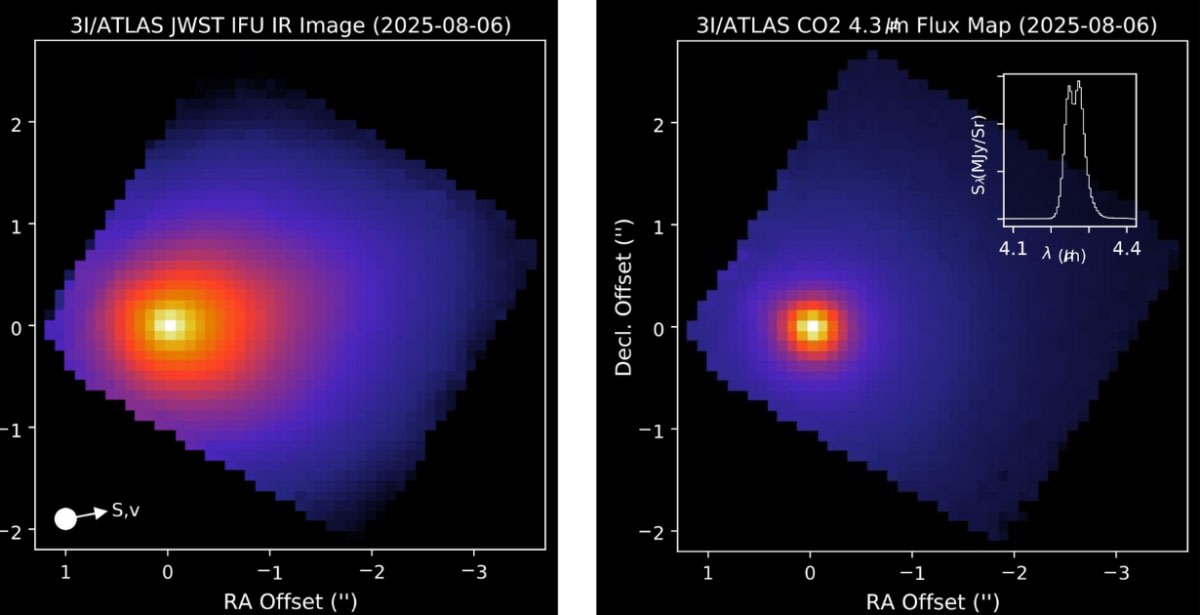
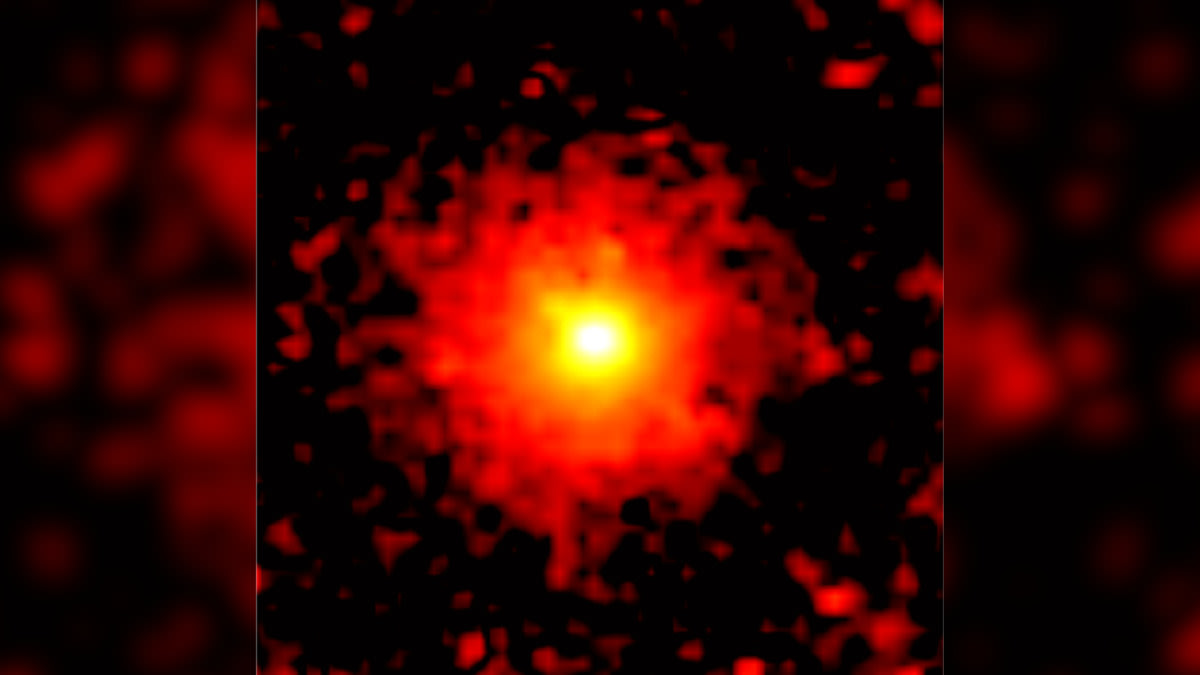
The third confirmed interstellar object to visit our solar system, comet 3I/ATLAS, has garnered the attention of several observatories. Within its short window of visibility, the James Webb Space Telescope (JWST) probed into the comet’s coma — a temporary atmosphere of gas and dust enveloping its icy nucleus as it approaches the Sun. The details were recorded in a paper published in an arXiv pre-print, authored by Martin Cordiner of NASA's Goddard Space Flight Center. The 'coma' of comet 3I/ATLAS revealed an unexpected ratio of contents, being primarily made up of carbon dioxide (CO2). It also included water, carbon monoxide, and carbonyl sulfide, which were typically found inside a comet.
However, the ratio of carbon dioxide to water was 8 to 1, which is six standard deviations above the typical value and the highest recorded in a comet. The carbon monoxide to water ratio is 1:4, which remains within typical standards consistent with previous observations. According to Universe Today, JWST used its NIRSpec infrared camera to observe 3I/ATLAS on August 6, 2025, and detect these chemicals in the coma.
The James Webb Telescope images of 3I/Atlas are finally available.
— Bruce R. Fenton (@GeologicalSETI) August 26, 2025
The biggest finding is that such a high CO2/H2O ratio has never before
been observed in a comet at this distance. An unusually CO2-rich nucleus is suspected.
Pre-print paper linked in comment below. pic.twitter.com/JtlqV2APuk
The space telescope observed the comet when it was around 3.32 AU (astronomical units) from the Sun. It also found that the coma is surrounded by scattered particles of dust and water. A higher concentration of dust particles faces the Sun, usually for higher outgassing in the region heated by the Sun. Another interesting aspect is the ratio between two types of carbon isotopes, Carbon-12 and Carbon-13, which was found to be similar to that on Earth. This indicates that the material within the comet could be traced to origins in an environment that had similar carbon species to our planet.
There are some identifiable aspects that may have occurred due to the imbalance in the CO2/H2O ratio in the comet. One is the extremely high levels of ultraviolet radiation in the host star system from which it originated. Another is its creation beyond the CO2 “ice line,” the point where carbon dioxide ice is present far more than water. Other aspects included how heat affected the nucleus of the comet.
Further observations will be needed to confirm all these aspects noted about our interstellar visitor. The comet 3I/ATLAS is the third confirmed visitor after ‘Oumuamua' and '2I/Borisov,' and is of great interest to astronomers who cannot wait to gain new insights. Given that the scientific community had a small window to observe the comet before it became obscured, every technology at hand was pointed at it. The comet will briefly be too close to the sun to be visible for study in early October, but it will remerge later this year in December for some final probing before it goes on its way to another system.

Learning about an interstellar object and understanding its origins could lead us to new worlds resembling our planet. Scientists on Earth are hard at work on various papers about the visitor to spread knowledge about its existence. From its first detection in early July to the present day, astronomers have dedicated countless hours to expanding our knowledge on the subject.
More on Starlust
NASA’s new SPHEREx mission makes historic observation of interstellar comet 3I/ATLAS
NASA’s Hubble Space Telescope captures sharpest-ever picture of interstellar comet 3I/ATLAS