ESA lays the foundation for its best-ever 3D map of the Universe, with over 900 million galaxies
In a latest update, the first major release of data from the Euclid space telescope has been announced by the European Space Agency (ESA). The batch, named DR1-Foundation, was released on November 12, 2026, and includes around 13 months of observations and 1.7 million gigabytes of data. The collection brings together light from over a billion objects across a vast stretch of sky, which is equivalent to the area covered by 9,500 full Moons. Beyond its other findings, this release will help Euclid put together its most extensive 3D picture of the universe yet.
Our Euclid space telescope has released its largest dataset yet, revealing over 900 million galaxies! Covering an area of sky equivalent to 9500 full Moons, the data lays the foundation for an unprecedented 3D map of the Universe. Read more: https://t.co/EonhHowm2W https://t.co/LLrl2S3Lbi
— European Space Agency (@esa) November 12, 2026
As per the official release, DR1-Foundation covers over 900 million galaxies and over 60 million quasar candidates (the bright cores of distant galaxies). And this is only a start. More is yet to come, as this dataset covers only about 14% of the total sky area Euclid is expected to survey. Commenting on this, ESA’s Director of Science, Prof. Carole Mundell, said, “These are far more than beautiful pictures; today marks a scientific milestone in our study of the cosmos.”
He further added, “This major Euclid data release represents the largest space-based survey of its kind, laying the foundation of future discovery in a new regime for astronomy and demonstrating the excellence of European technology, science and international collaboration."
Up ahead, the full Data Release 1 is expected to be made public in mid-2027, and it will build on it with weak lensing observations. The data will complement the strong-lensing findings and help researchers build a clearer picture of how galaxies and galaxy clusters fit into the universe's larger structure. Speaking about DR1-Foundation, ESA’s Euclid project scientist Valeria Pettorino said, “It will be used to map the large-scale structure of the Universe in unprecedented detail. So much discovery is yet to come.”
🕵️ The #DarkUniverse detective just dropped its biggest case file yet 📁 Observations of more than one billion objects. Today's data release lays the foundation for @ESA_Euclid ’s best-ever 3D map of the Universe 👉https://t.co/9y7XHPSmC6 1/15 https://t.co/XSvGSYz5xN
— ESA Science (@esascience) November 12, 2026
The largest strong lens catalog yet
The lens catalog is among the most notable parts of the new release. Strong gravitational lenses are extremely rare. And they form when light from a distant galaxy passes by a closer galaxy and gets significantly distorted along the way. This release lists around 15,000 strong lensing candidates, making it the largest strong lens catalog ever, even bigger than all previous catalogs combined.
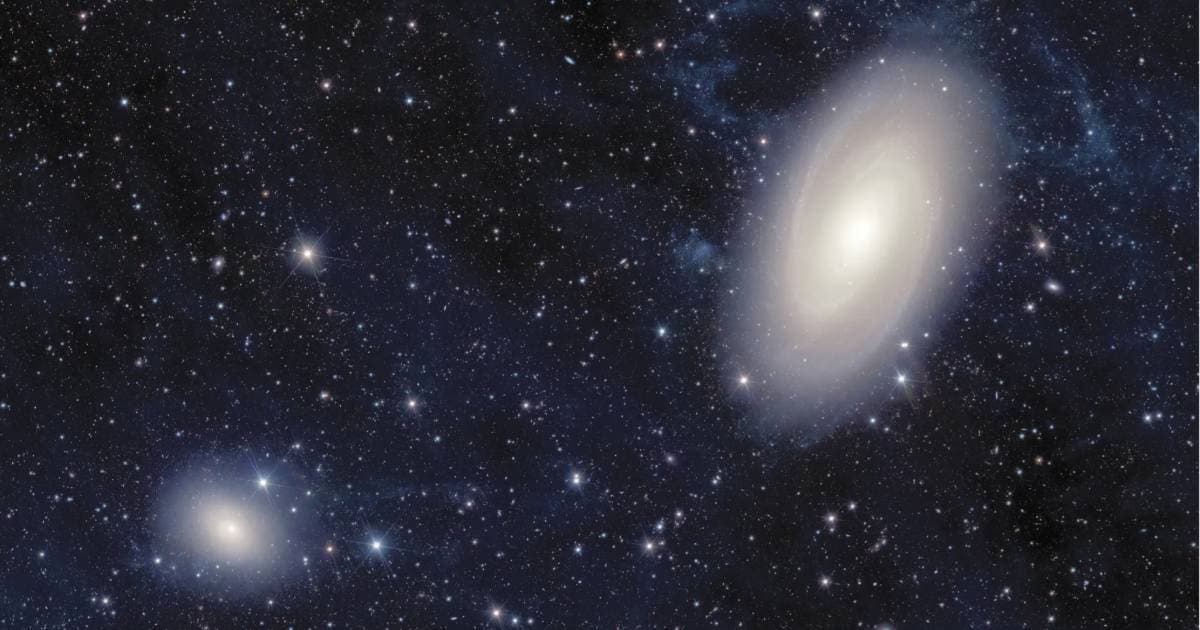
The haze on the right side of the frame is the star-filled disc of Messier 81, demonstrating Euclid’s full resolution. The loose collection of blue stars on the left is a dwarf irregular galaxy known as Holmberg IX. Let's now travel south. 5/15 https://t.co/h6CZkMJOp3
— ESA Science (@esascience) November 12, 2026
Explaining the significance of the images, Natalie Lines of the University of Portsmouth, a Euclid Consortium member, said, “Strong lensing provides unique insight into the dark Universe, allowing us to ‘weigh’ individual galaxies, including their invisible dark matter, and explore how the Universe is expanding.”
How will Euclid build its 3D map of the universe?
As per ESA, the data shared by Euclid will be used to create the biggest-ever 3D map of the universe. To create it, Euclid measures how far away galaxies are through spectroscopy, which splits a galaxy’s light into a ‘rainbow’ that reveals its distance. And once scientists know those distances, they can place galaxies within the universe’s structure and connect them to the cosmic map.
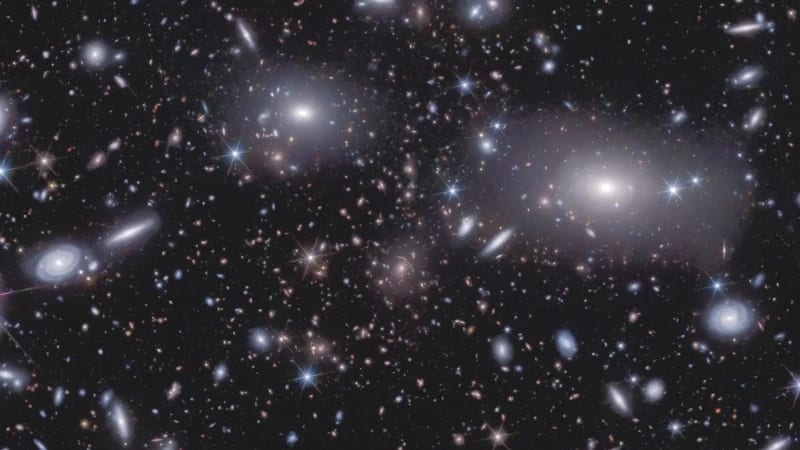
Hundreds of galaxies, and one cosmic magnifying glass 🔍 The rich galaxy cluster Abell 3128 is home to whirling spirals and fuzzy ellipticals. At its centre sits a strong gravitational lens. One of many more. 9/15 https://t.co/63suP8ngcG
— ESA Science (@esascience) November 12, 2026
Barbara Sartoris of the JL Lagrange laboratory in Nice, France, a Euclid Consortium member, explained, “This gives us an unprecedented view of large samples of ancient galaxy clusters that were previously out of reach. We will explore these in the coming months to learn how these giants grew, and decipher what they reveal about the dark Universe.”