Dual solar wind streams from two giant coronal holes could reach Earth on October 3
These events are known to trigger geomagnetic storms and enhance aurora displays.
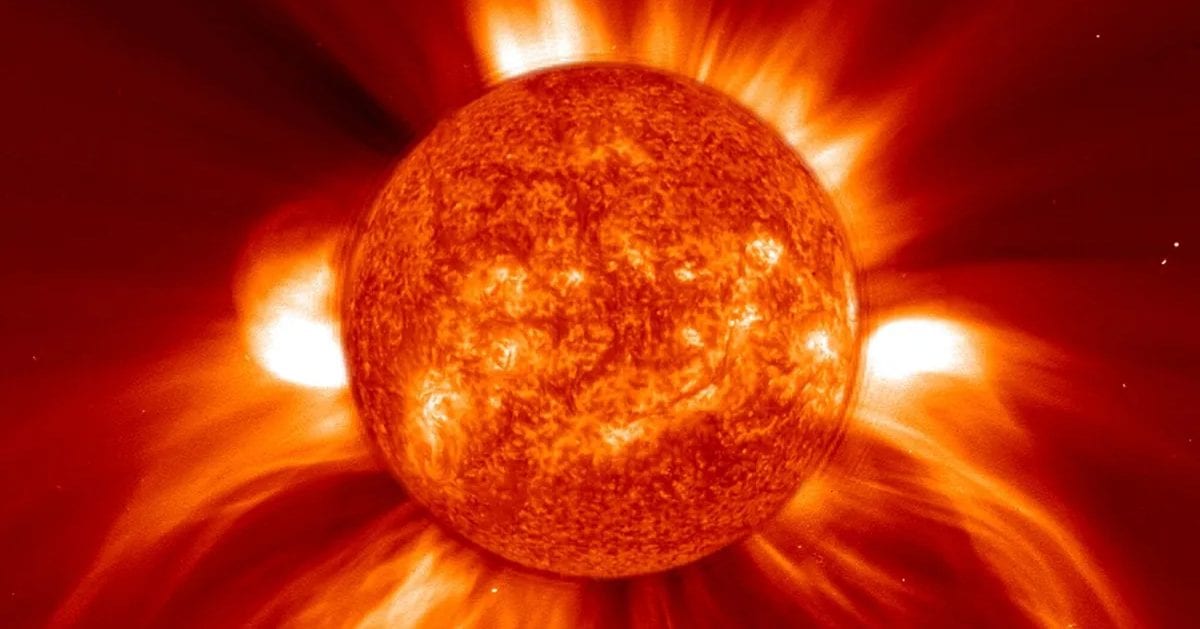
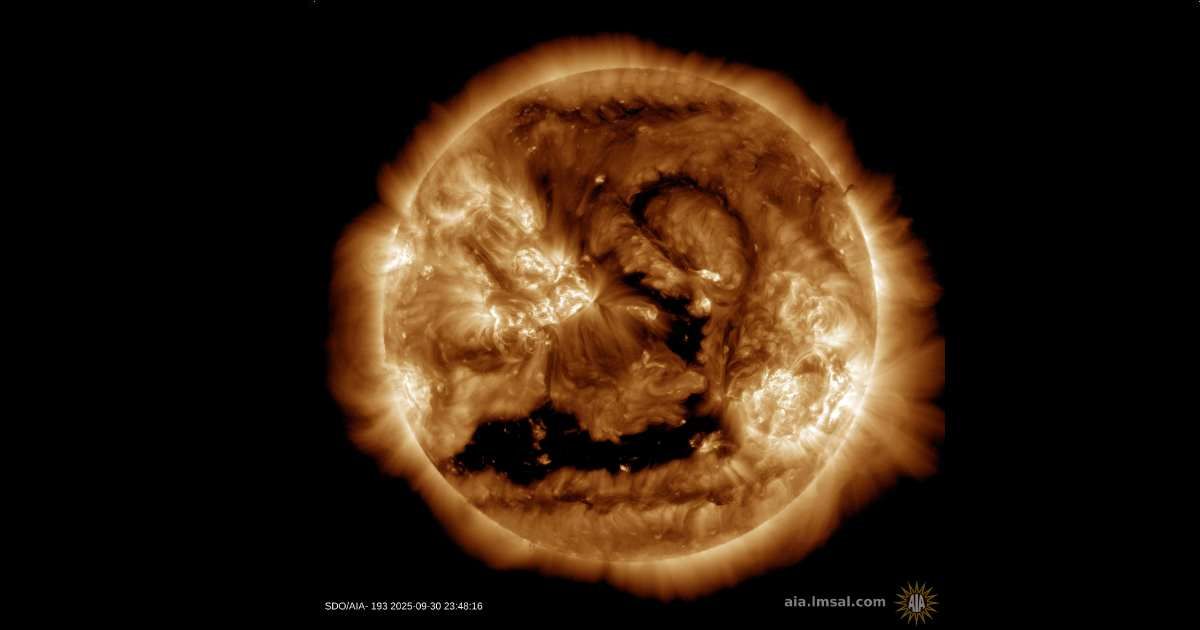
Two coronal holes on the outer atmosphere of the Sun, as well as the cooler dense plumes of plasma. Cover Image Source: Solar Dynamics Observatory (SDO)/NASA/Atmosperic Imaging Assembly (AIA) and Helioseismic and Magnetic Imager (HMI) science teams

Space weather analysts are tracking a potential double-barreled stream of high-speed solar wind, originating from two colossal holes in the sun's corona, that might impact Earth as early as October 3, as per Space Weather

Illustration of a coronal mass ejection emanating from the Sun. These events are powerful releases of solar charged particles and magnetic field, travelling on solar wind. (Representative Cover Image Source: Getty| MARK GARLICK/SCIENCE PHOTO LIBRARY)
Illustration of a coronal mass ejection emanating from the Sun. These events are powerful releases of solar charged particles and magnetic field, travelling on solar wind. (Representative Image Source: Getty| MARK GARLICK/SCIENCE PHOTO LIBRARY)

The incoming solar material stems from two coronal holes, which are currently funneling solar wind toward our planet, per data by SDO's Atmospheric Imaging Assembly (AIA) - a coordinated effort led by the Lockheed Martin Solar and Astrophysics Laboratory (LMSAL). These events are known to trigger geomagnetic storms and enhance aurora displays. However, the forecast is complicated by a recent solar eruption. On September 29, the sunspot region AR 4232 (N05E46) unleashed an M3.6-class solar flare followed by a Coronal Mass Ejection (CME). It started at 01:37 UTC and stopped at 01:47 UTC. The peak time was 01:45 UTC. 
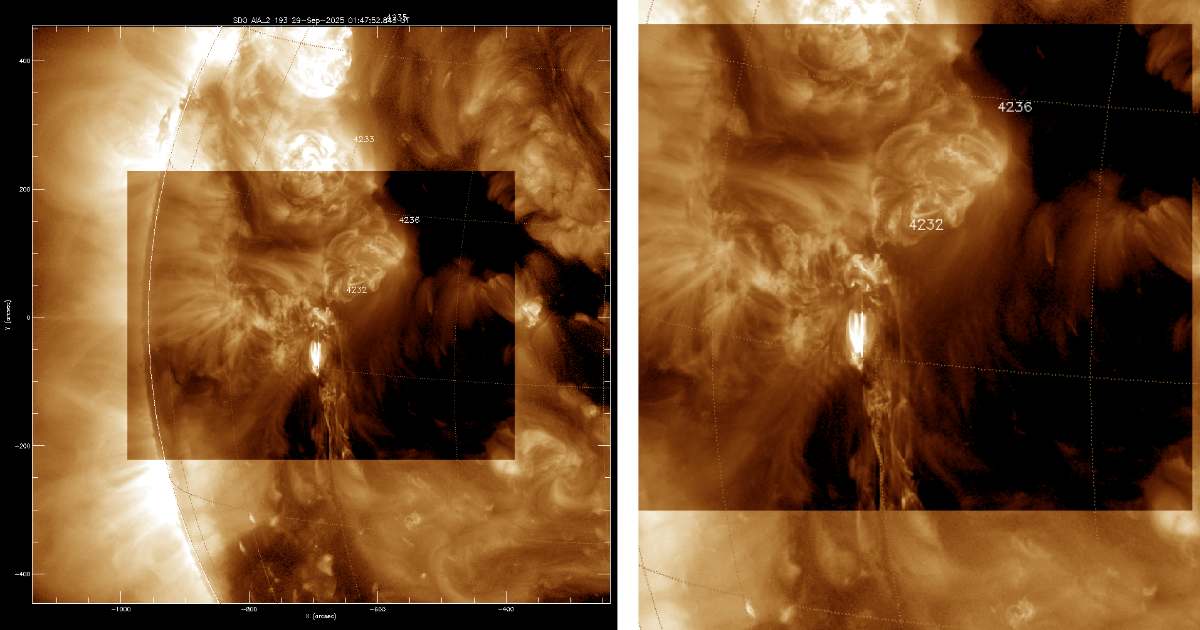
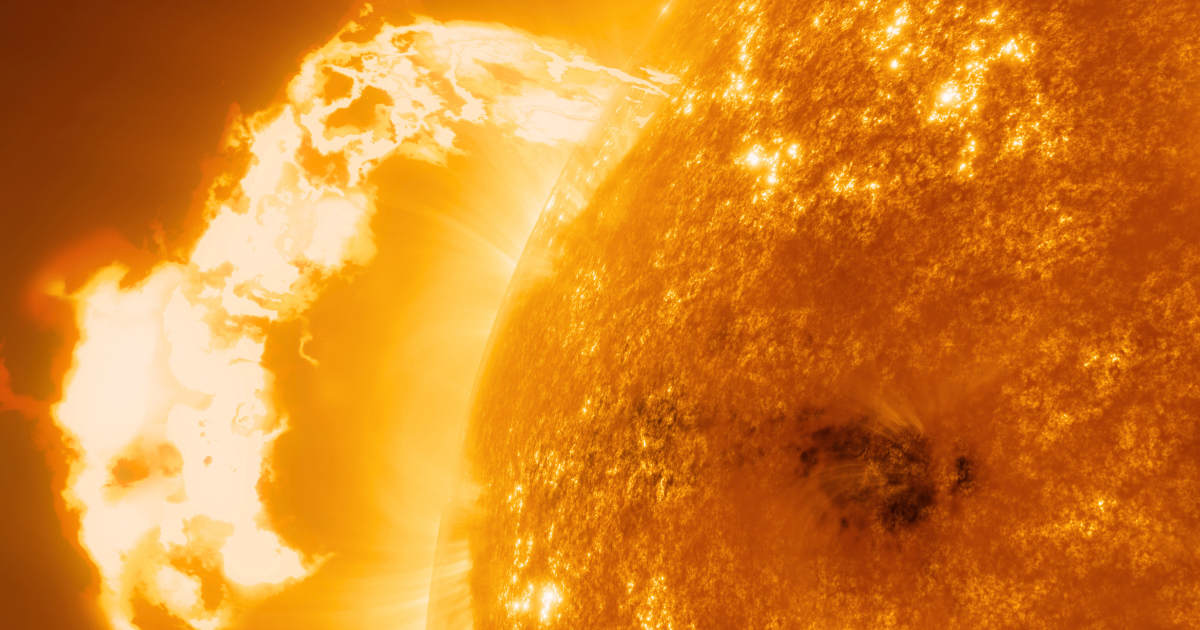
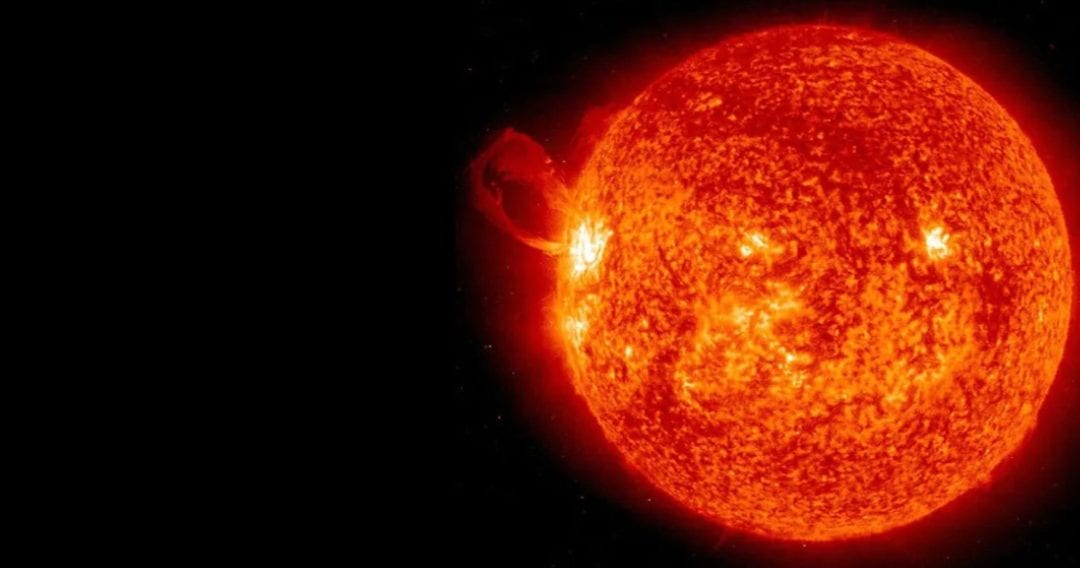
Solar flare erupting from the designated position N05E46 ( 4232 ) on the surface of the Sun. (Image Source: SDO/NASA/AIA/HMI)
(R)Solar flare erupting from the designated position N05E46 ( 4232 ) on the surface of the Sun on September 29, 2025. (L) A close-up of the solar flare. (Image Source: SDO)/NASA/Atmosperic Imaging Assembly (AIA) and Helioseismic and Magnetic Imager (HMI) science teams)

As per space weather enthusiast Christopher Mathews' Facebook post, these coronal holes, designated CH 83 and CH 84, are "spewing high speed solar wind into space in our general direction." He uploaded a clip of the CME moving away from the Sun and added, "Those winds will probably push the bulk of the CME away from us, but some part of it may be swept up in the turbulent regions at the edge of the stream. Our magnetic field should start to feel wind gusts from the two holes by Thursday or Friday."
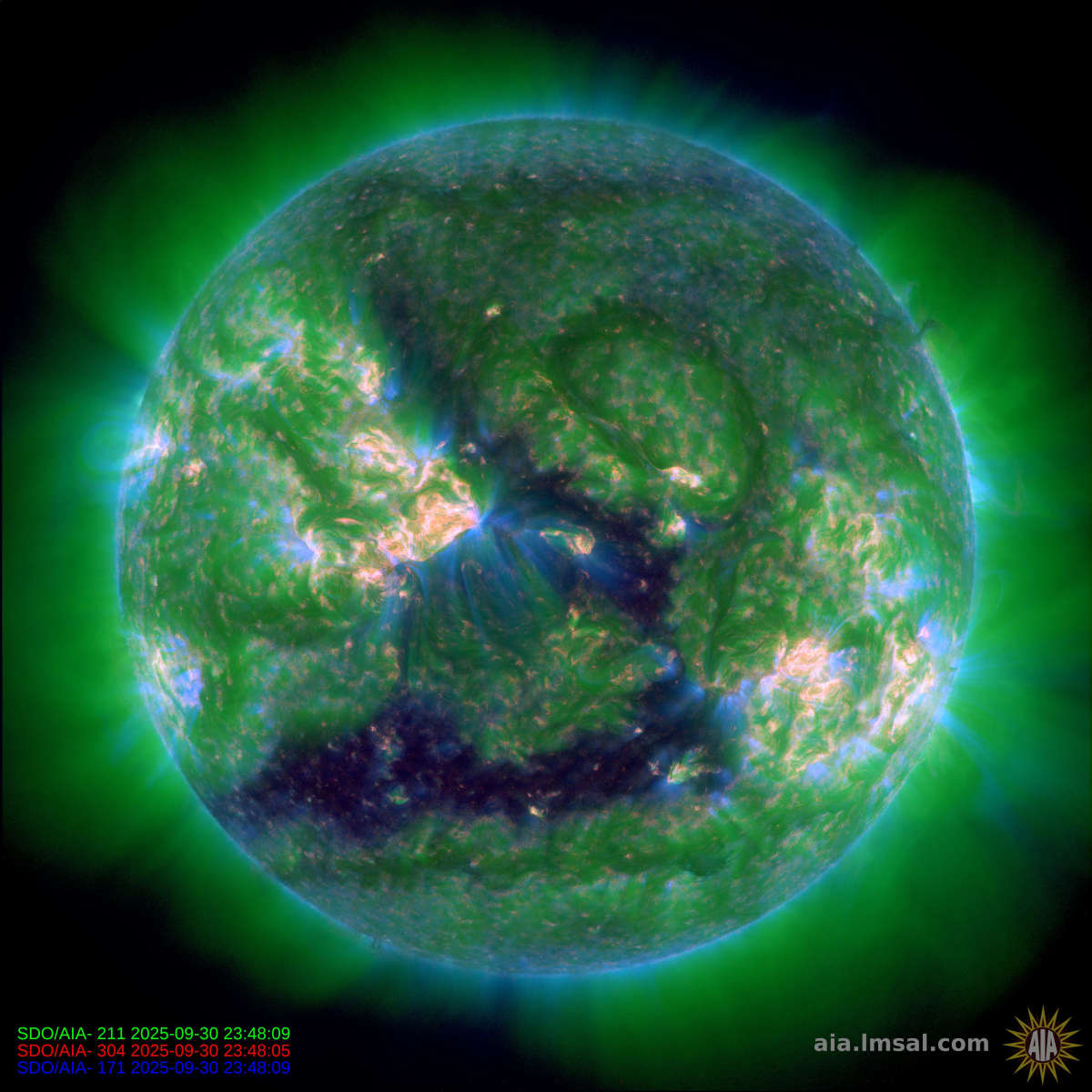
Solar flares erupting from the Sun as recorded on September 30, 2025.
Solar flares erupting from the Sun as recorded on September 30, 2025. (Image Source: Solar Dynamics Observatory (SDO)/NASA/Atmosperic Imaging Assembly (AIA) and Helioseismic and Magnetic Imager (HMI) science teams)

Earth's magnetosphere is anticipated to begin feeling the initial "wind gusts" from the dual coronal holes by October 3, setting the stage for a period of heightened geomagnetic activity. According to CACTUS, data confirms a Coronal Mass Ejection (CME), cataloged as #0034, erupted on September 30 at approximately 09:36 UTC, with a projected median velocity of 427 kilometers per second. 
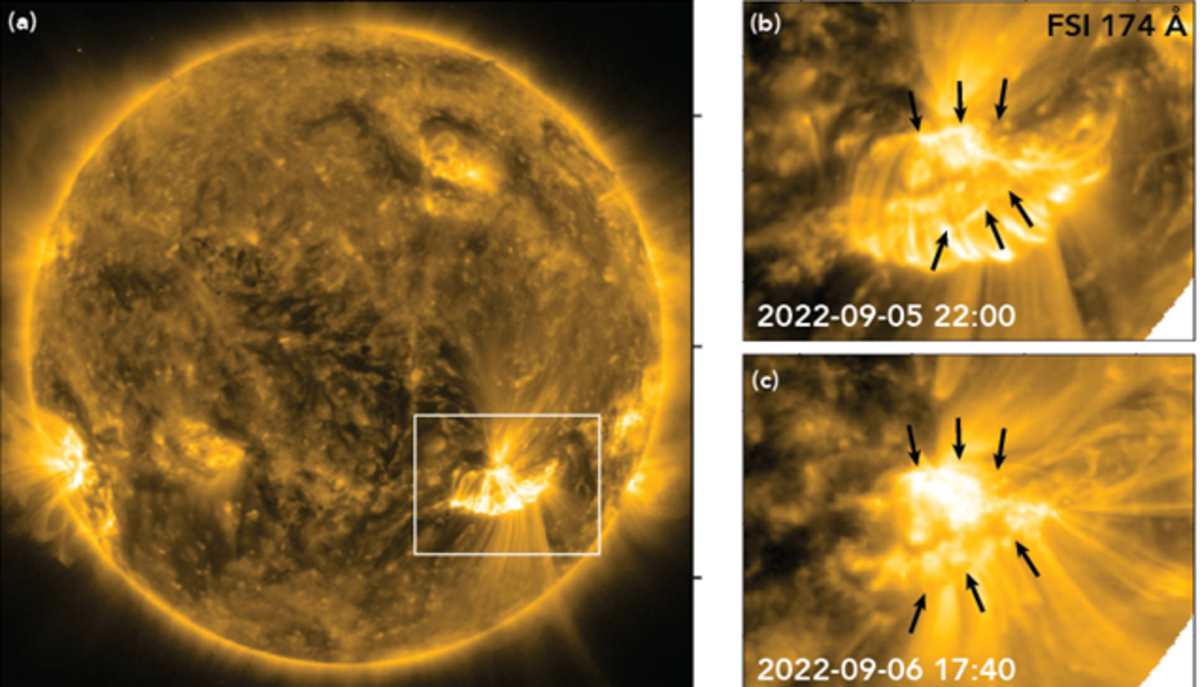
An SwRI-led study of the Sun confirms decades-old theoretical models about solar magnetic reconnection (Image Source: Southwest Research Institute)
An SwRI-led study of the Sun confirms decades-old theoretical models about solar magnetic reconnection (Representative Image Source: Southwest Research Institute)

The source of the impending solar wind is the pair of coronal holes, which are visually identifiable as dark, cooler patches on the Sun when viewed in extreme ultraviolet (EUV) or soft X-ray light, per the Space Weather Prediction Center of NOAA. These regions are fundamentally areas where the Sun's magnetic field lines are open and extend directly into space. This unique structure acts like a funnel, allowing solar material to escape far more easily than in surrounding areas. The result is a High-Speed Stream (HSS) of solar wind.

While coronal holes are a perpetual feature, particularly at the Sun's poles, the structures responsible for the current forecast have either developed independently or grown from an existing polar extension. These persistent holes are consistent generators of fast solar wind. As this faster stream rushes through space, it slams into the slower, ambient solar wind ahead of it, creating a compressed region known as a Co-rotating Interaction Region (CIR). Earth is expected to feel the effects of this compressed, turbulent region just before the main HSS arrives.
More on Starlust

Butterfly-shaped hole in the Sun's atmosphere stuns scientists—potential effects on Earth on September 14

NOAA's SWFO-L1 satellite launches September 24 to enhance early warning of solar storms impacting Earth

MORE STORIES

A new study, published in the journal Physical Review Letters, suggests that some of the highest-energy cosmic rays could contain atomic nuclei heavier than iron.
15 hours ago
Knowledge of oxygen abundance may shed light on the evolutionary history of the Sun and other stars.
18 hours ago
Growing levels of light pollution due to satellites is obscuring our view of the universe.
3 days ago
The Moon can fill a critical frequency gap that remains out of reach for both ground and space-based observatories.
3 days ago
"This observation is expected to be key for planning sustainable space operations in the future."
4 days ago
Ice is key for long-term survival on the Moon and this pushes us closer to realizing a lunar base.
5 days ago
JSWT's direct observation of LHS 3844 b's surface is a massive stepping stone for exoplanet geology.
5 days ago
It is likely to trigger damage like the Chelyabinsk object that injured 1,500 people in Russia.
6 days ago
While searching for life outside of planet Earth, we might not have to go beyond our solar system, as there is a chance that celestial bodies in our own neighborhood may host life.
May 1, 2026
570MP DECam image unveils giant halo, star stream, and clues to ancient galactic collision.
Apr 30, 2026