Europa Clipper predicted to intercept charged material stream from comet 3I/ATLAS
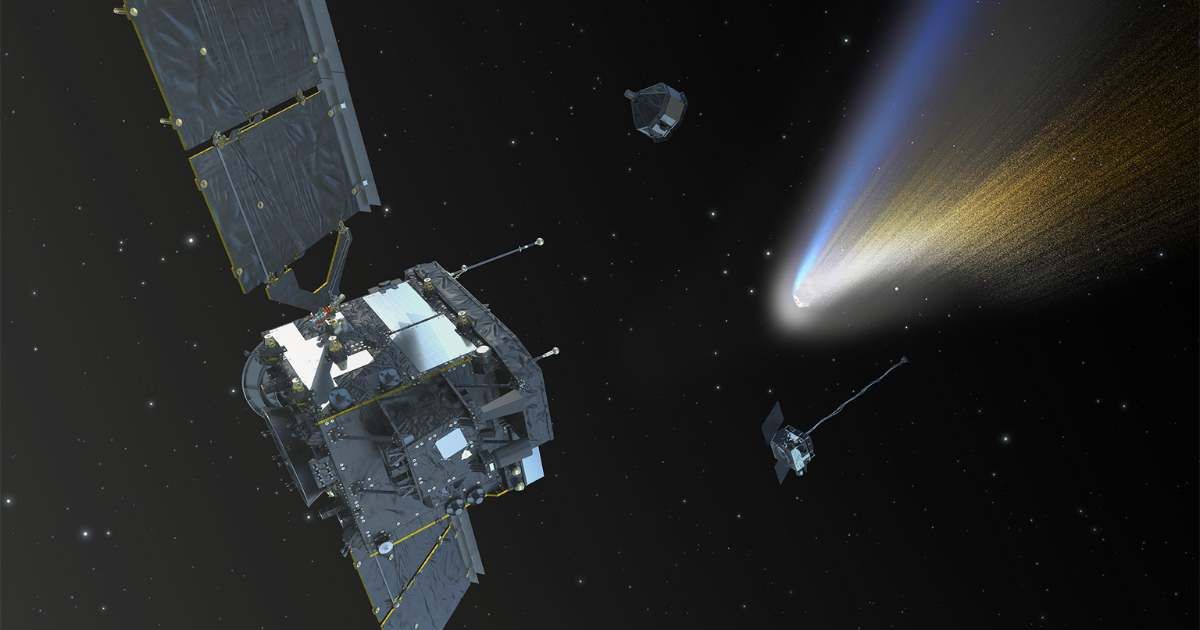
The Europa Clipper spacecraft, en route to Jupiter, is projected to soon pass through a stream of charged particles originating from the interstellar comet 3I/ATLAS. This unusual alignment, detailed in a new study from European researchers, presents a rare opportunity to directly sample material from an object that originated outside of our solar system. The prediction of the ion tail crossing by Finnish Meteorological Institute's Samuel Grant and the European Space Agency's Geraint Jones is reported in a pre-print posted to the arXiv pre-print paper repository.
![Hubble captured this image of the interstellar comet 3I/ATLAS on July 21, 2025, when the comet was 277 million miles from Earth. [Image Source: NASA, ESA, David Jewitt (UCLA); Image Processing: Joseph DePasquale (STScI)]](https://de40cj7fpezr7.cloudfront.net/c49eeb4e-e60a-46c0-b39f-68fbb2ee9297.jpeg)
The forthcoming particle shower, predicted to occur between October 30 and November 6, is forecasted by a new computer model dubbed "Tailcatcher," according to Space.com. Developed by Grant and Jones, the code accurately pinpoints when spacecraft align with a comet's ion tail and the Sun.
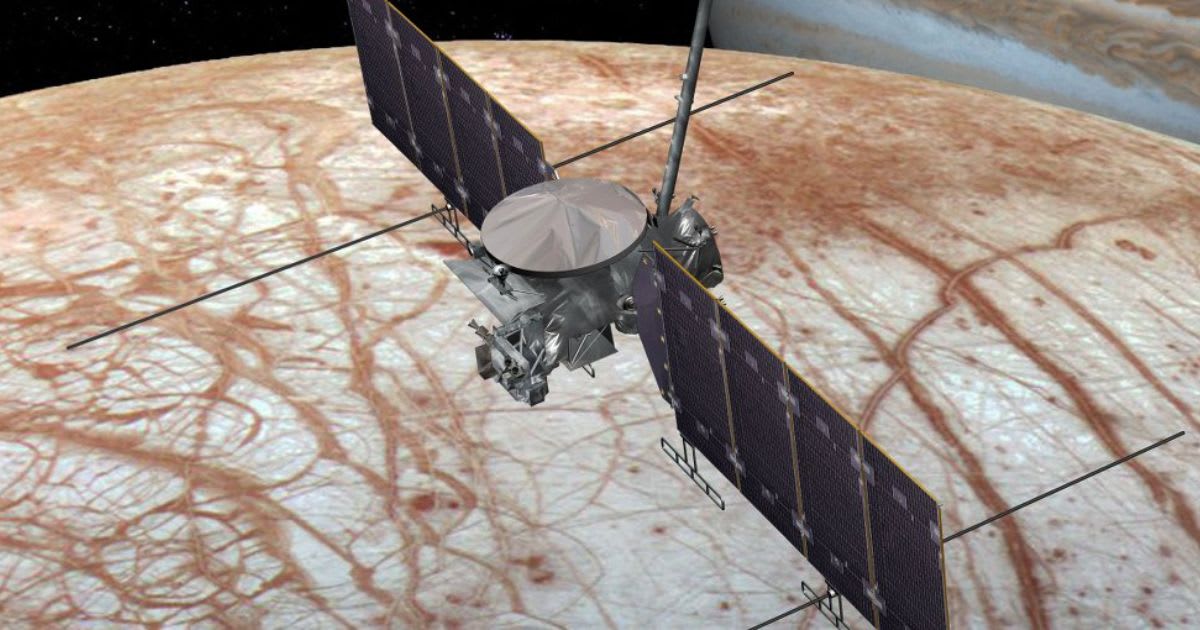
According to Grant, who led the research, the event provides scientists with the closest achievable method to analyze material from an interstellar comet directly. This would offer unprecedented insight into the composition and formation of celestial bodies from a different region of the galaxy. "We have virtually no data on the interior of interstellar comets and the star systems that formed them," Grant told Space.com. "Sampling the tail in this way is the closest we can currently get to a direct sample of such an object, and thus a different part of the galaxy."
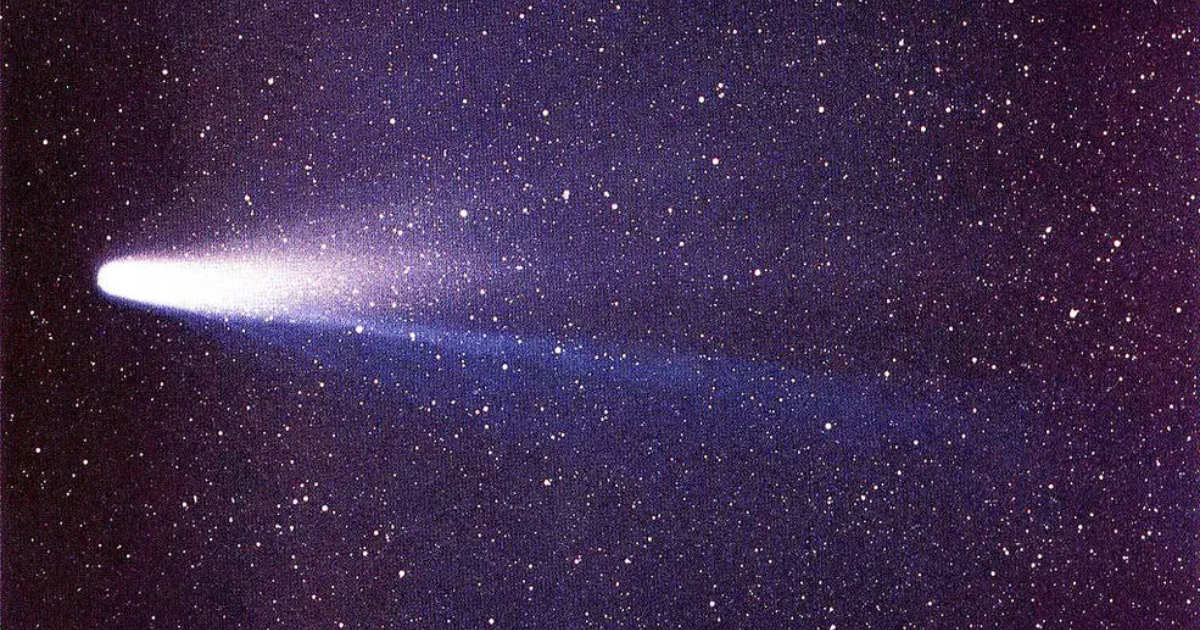
The ion tail is formed when gases, or "water-group ions," are ejected from the comet's surface as it approaches the Sun. These ions are then swept away by the solar wind, forming a tail that always points away from the Sun. The researchers believe Europa Clipper could intercept these ions, allowing for a chemical comparison between our own comets and this unique interstellar visitor. Scientists can differentiate the comet ions from the Sun's solar wind by looking for heavier elements and a resulting general slowing of the solar wind's flow.
Despite the scientific significance, the window for this unique observation may be missed. The U.S. government shutdown remains an active threat to data collection. Europa Clipper is currently in cruise mode, and many of its specialized instruments, designed to study Jupiter's magnetic and radiation environment, are currently deactivated. If the shutdown is not resolved before the projected intercept period, it remains uncertain whether mission scientists will be able to awaken the necessary instruments to capture the measurements.
The success of the mission also relies on the properties of the solar wind being strong and directional enough to carry the heavier cometary ions the more than 300 million kilometers to the spacecraft. Fortunately, 3I/ATLAS is nearing its perihelion, its closest approach to the Sun, on October 29, which is expected to maximize its activity and broaden the ion tail, increasing the likelihood of interception. While the European Space Agency's Hera spacecraft will also be in a position to encounter the particles, it lacks the necessary instruments to make the required measurements. Ultimately, Grant and Jones have no official control over the Europa Clipper's operations, deciding to attempt the observation solely up to the NASA mission team.
More on Starlust
Keck Observatory detects rare 'anti-solar tail' on interstellar comet 3I/ATLAS