Astronomers find a 5.5 million light-years-long 'galaxy filament' connecting 14 galaxies
Remarkable discoveries in galaxies and cosmic structures happen regularly. Each one shows how dynamic and awe-inspiring the universe is. Recently, Astronomers have found a new rotating galaxy filament by analyzing data from the MeerKAT International Giga-Hertz Tiered Extragalactic Exploration (MIGHTEE-HI) survey. Stretching 5.5 million light-years in length and connecting 14 galaxies, the newly discovered filament was reported on August 18 on the pre-print server ArXiv.
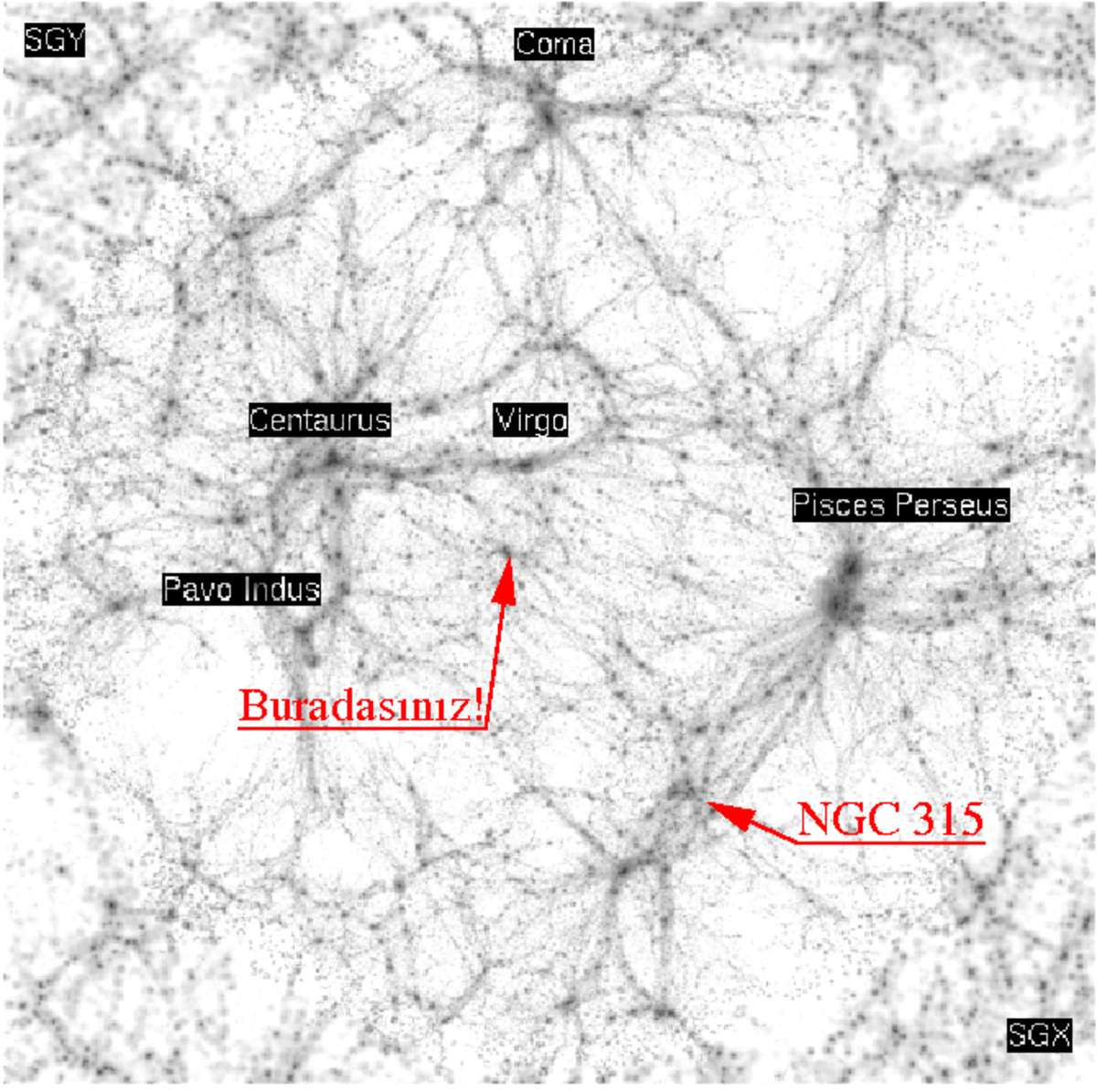
Galaxies are not spread at random across the universe, as per NASA's findings. They not only form clusters but also organize themselves into large interconnected structures, with huge empty spaces in between. This "cosmic web" begins as a loose formation and grows clearer over time as gravity pulls matter together. These filaments supply gas to dense nodes, which house galaxies, allowing them to evolve and transform. Researchers have recently discovered large filamentary structures through observations of neutral atomic hydrogen (HI).
Studying the cold HI gas in galaxy filaments fosters understanding of the connection between the low-density gas in the cosmic web and how it helps in the evolution of galaxies that exist in it, noted Phys.org. A team of astronomers led by Madalina N. Tudorache from the University of Cambridge in the UK has now reported the detection of a series of HI galaxies from the MIGHTEE-HI survey "at z = 0.03 in the COSMOS field, which form a filamentary-like structure," in their paper.
The 14 galaxies are not far from each other, and lie within a "small range of recessional velocity between 9,230 and 9,700 km/s," reported Phys.org. They are arranged in a line inclined at about 30 degrees north-west on "the celestial sphere" — a conceptual tool in astronomy where celestial bodies are projected on an imagined sphere surrounding the Earth. This linear structure is roughly 5.5 million light-years long and about 117,000 light-years wide. The observations suggest that this galaxy filament is part of a much larger cosmic web that stretches at least 49 million light-years. This cosmic web filament seems to be between 2.6 and 3.3 million light-years thick, and observations showed that the 14 HI galaxies are strongly aligned with the cosmic web filament.
#A rotating galaxy filament spanning 5.5 million #LightYears and connecting 14 galaxies has been detected, marking one of the largest spinning structures observed in the #CosmicWeb to date. @arxiv https://t.co/oyn90GXV8y https://t.co/s348CdUkL7
— Phys.org (@physorg_com) August 26, 2025
The findings have proved that the angular momentum of these galaxies is closely linked to the larger filamentary structure, i.e., the galaxies rotate around the "spine" of the filament, per Phys.org. Tudorache's team was also able to obtain key information confirming that they had captured an early stage of the galaxy filament's evolution, stating, "The abundance of HI galaxies along the filament and the low dynamical temperature of the galaxies within the filament indicates that this filament is at an early evolutionary stage where the imprint of cosmic matter flow on galaxies has been preserved over cosmic time." These findings have made history as one of the largest spinning structures to have ever been discovered in the cosmos. Recently, scientists also uncovered a potential answer to where the Universe's "missing matter" goes, and it has everything to do with long strings of gas that connect the densest pockets of space — galaxy filaments.