Astronomers combine X-ray and radio data to unveil a magnificent hand-shaped nebula
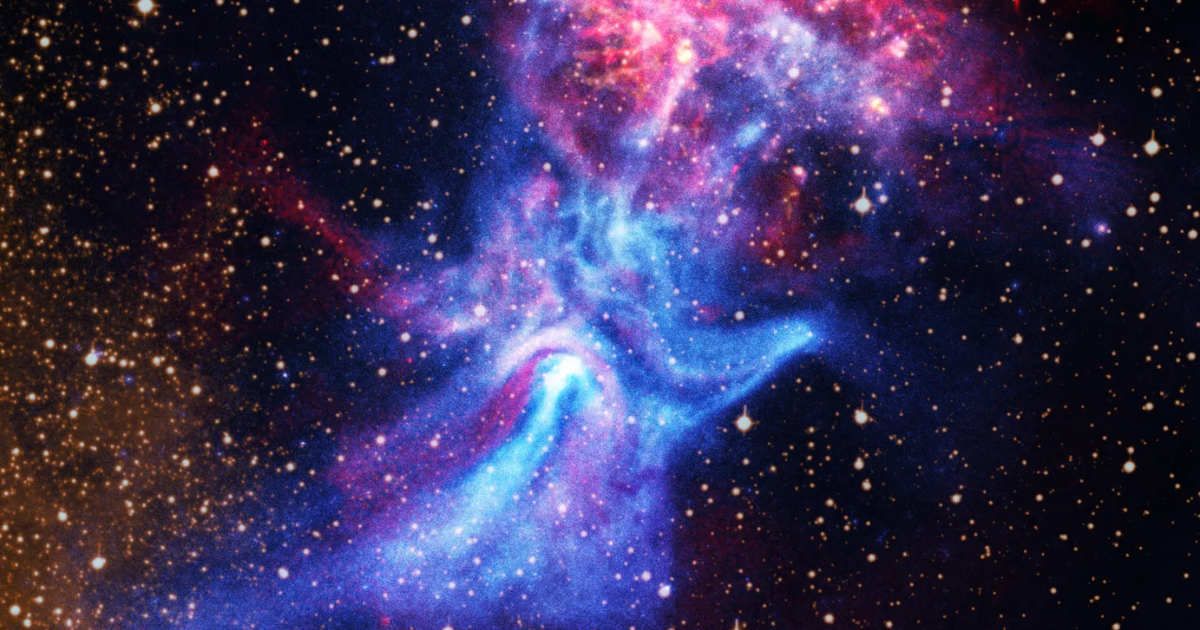
A mesmerizing celestial object resembling a giant hand has been revealed in unprecedented detail, with a new composite image that merges data from NASA's Chandra X-ray Observatory with fresh radio observations. Astronomers have combined X-ray and radio data to create a fresh view of the MSH 15-52 nebula, offering new insights into the peculiar properties and shape of this intriguing cosmic structure, as per NASA.
X-ray & radio light go "hand in hand" in this new image of MSH 15-52. Nicknamed "the hand of god" in popular culture, new data are providing us with a fresh view of this exploded star, its environment, and its peculiar properties. More: https://t.co/kgGic1J3ml 🤝 pic.twitter.com/zpsVKTLkZf
— Chandra Observatory (@chandraxray) August 20, 2025
At the heart of the "hand" lies the pulsar B1509-58, a rapidly spinning neutron star only about 12 miles in diameter. This dense remnant of a collapsed star acts as a powerful electromagnetic generator. Spinning nearly seven times per second with a magnetic field 15 trillion times stronger than Earth's, the pulsar unleashes a torrent of high-energy particles that create the vast nebula, which spans over 150 light-years. The nebula’s bizarre shape, with its "palm" and extended "fingers," is a result of these energetic particles interacting with the surrounding environment.
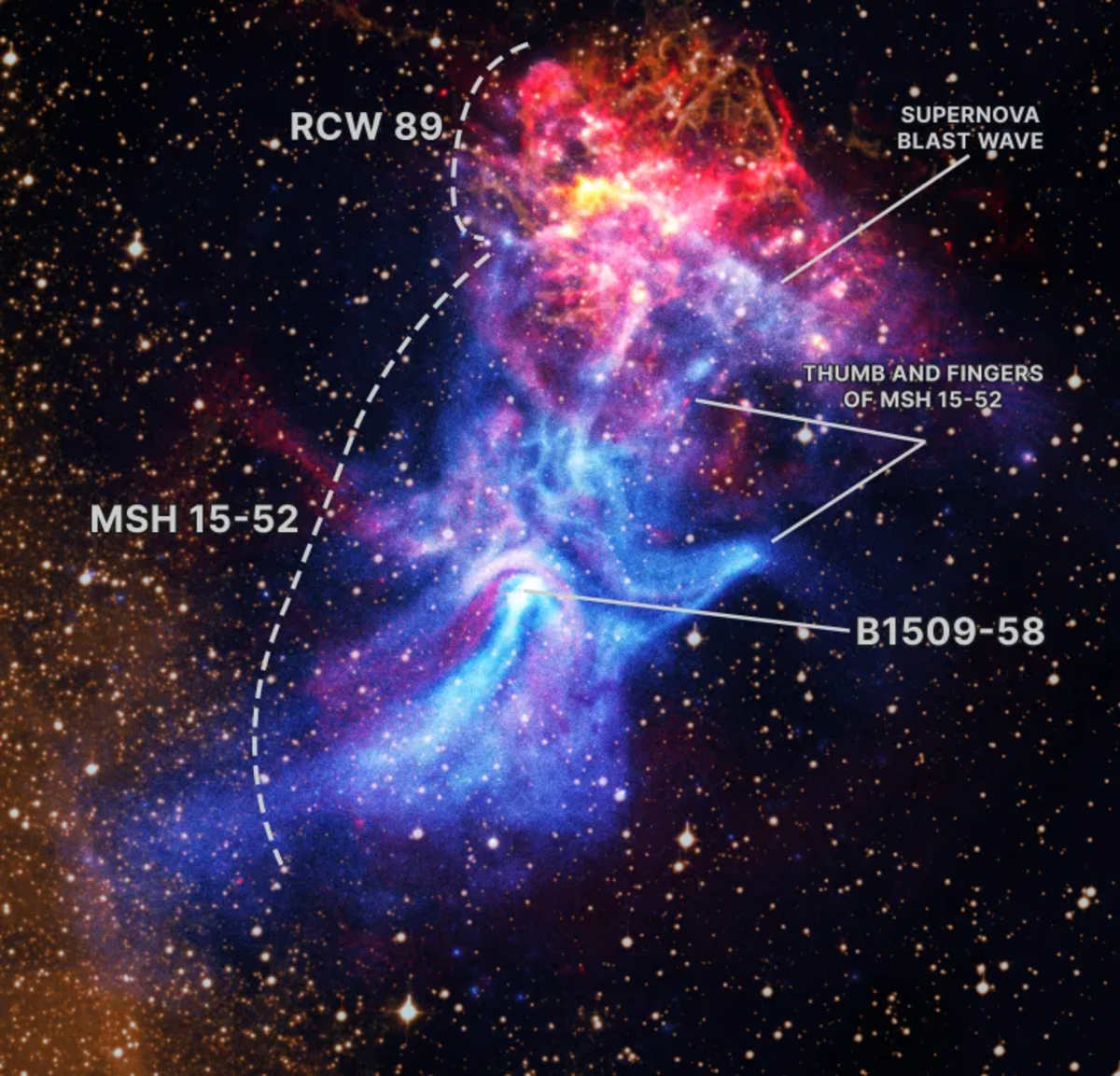
For the first time, new radio data from the Australia Telescope Compact Array (ATCA) have been integrated with existing X-ray data from the Chandra Observatory. The resulting composite image, with ATCA radio data in red and Chandra's X-rays in blue, orange, and yellow, reveals intricate details not visible in either dataset alone. The overlapping areas of X-ray and radio emission appear as purple, while an optical image of hydrogen gas adds a golden backdrop, highlighting stars and remnants of the original supernova. The radio data has been particularly illuminating, showing intricate filaments that align with the nebula's magnetic field. These filaments are believed to be the result of the pulsar's particle wind colliding with the debris from the initial stellar explosion.
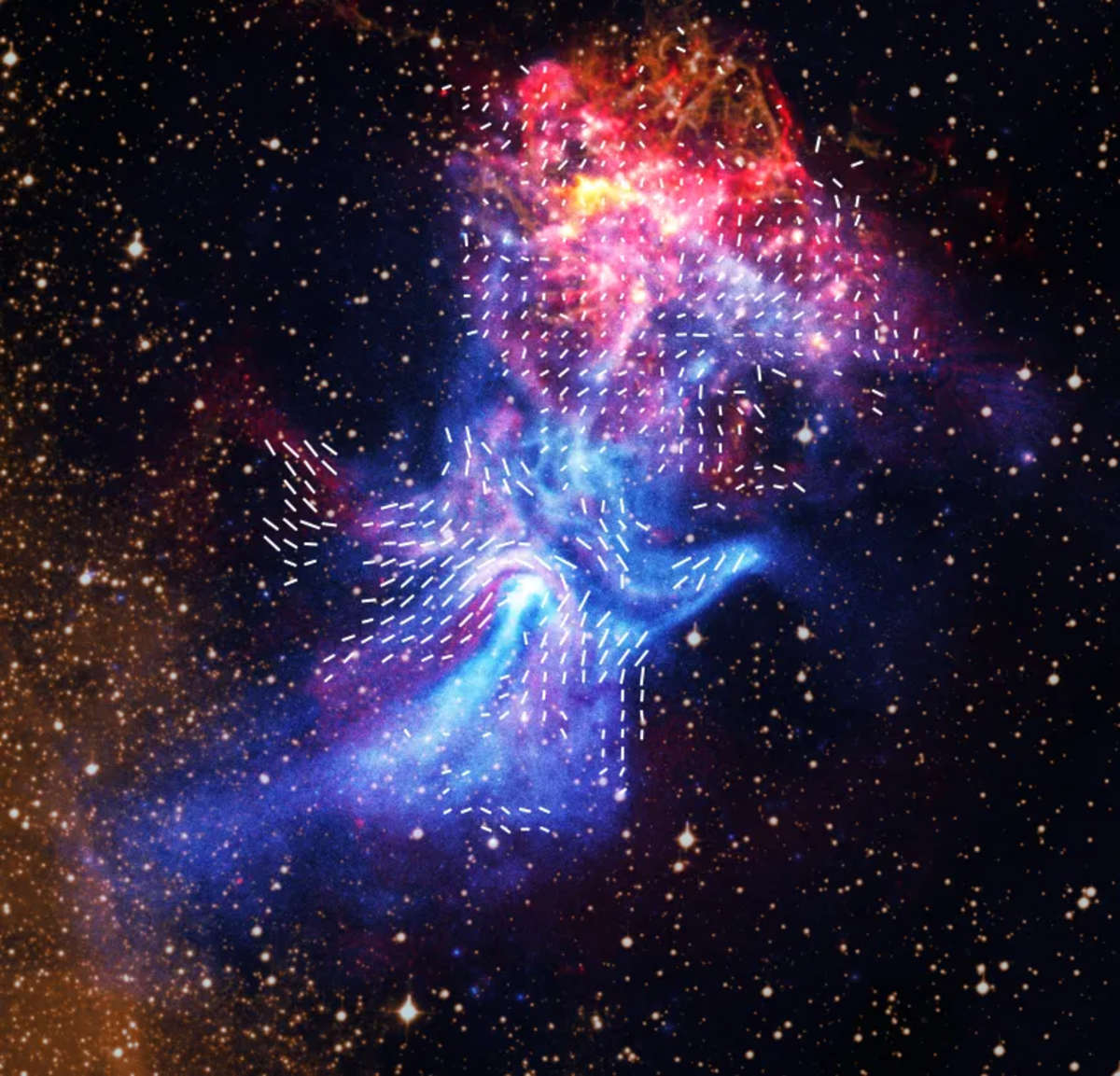
By comparing the two datasets, scientists have identified key differences in how the nebula emits light. For instance, some prominent X-ray features, including a jet and the inner parts of the "fingers," are absent in the radio waves. This suggests that energetic particles are escaping a shock wave near the pulsar and traveling along magnetic field lines to form the distinct finger-like structures. Additionally, the radio data show that the structure of RCW 89, the remnant of the supernova, is unlike other young remnants. Its patchy radio emission and its extension beyond the X-ray emission support the theory that it is colliding with a dense cloud of hydrogen gas.
Despite these breakthroughs, some mysteries remain. The sharp boundary of X-ray emission, which appears to be the supernova's blast wave, shows no corresponding radio signal, a perplexing finding, as young supernova blast waves are typically bright in radio waves. The complex interplay between the pulsar's wind and the supernova debris still presents many unanswered questions, highlighting the need for further research to fully understand these unique celestial structures.
This groundbreaking research was detailed in a paper published in The Astrophysical Journal. The work was led by Shumeng Zhang of the University of Hong Kong, with key contributions from co-authors Stephen C.Y. Ng, also from the University of Hong Kong, and Niccolo’ Bucciantini of the Italian National Institute for Astrophysics. Their findings represent a significant step forward in understanding the complex evolution of these unique cosmic structures.