Comet Tempel 2 to make its closest approach to Earth on August 3—viewing tips and its likely coordinates
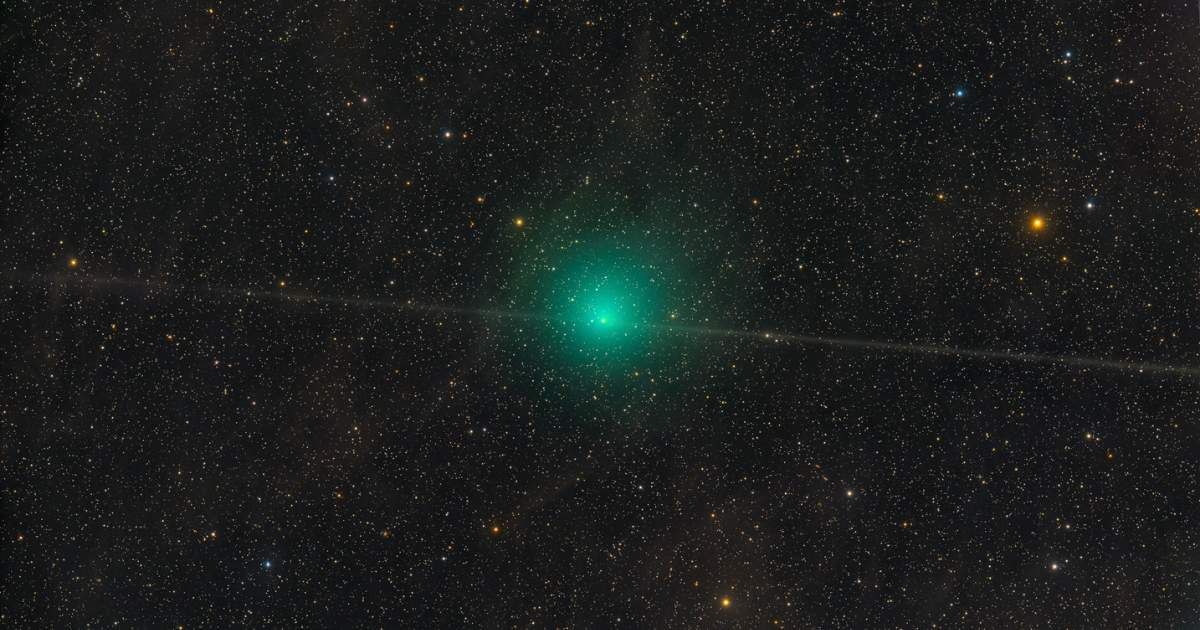
Skywatchers are in for an opportunity to catch a glimpse of the comet Tempel 2 as it makes its latest passage through the inner solar system. On August 3, 2026, the comet will make its closest approach to Earth, providing a window of opportunity across several weeks to photograph the comet. What's more, telescopic observation may also reveal a thin trail of dust that will be visible on either side of the comet's nucleus, showing debris left behind by the comet in its orbital plane over hundreds of years of orbiting the Sun.

Designated as 10P, the comet is about the same size as Halley's comet at 6.6 miles wide. It completes one trip around the Sun over a period of 5.4 years. For this trip, its perihelion (its closest approach to its host star) falls a day before it travels at its closest distance from Earth at 0.4 Astronomical Units or around 37 million miles. Its approach to us will be its most favorable appearance since 1967. The comet was named after German astronomer Wilhelm Tempel, who discovered it on July 4, 1873.
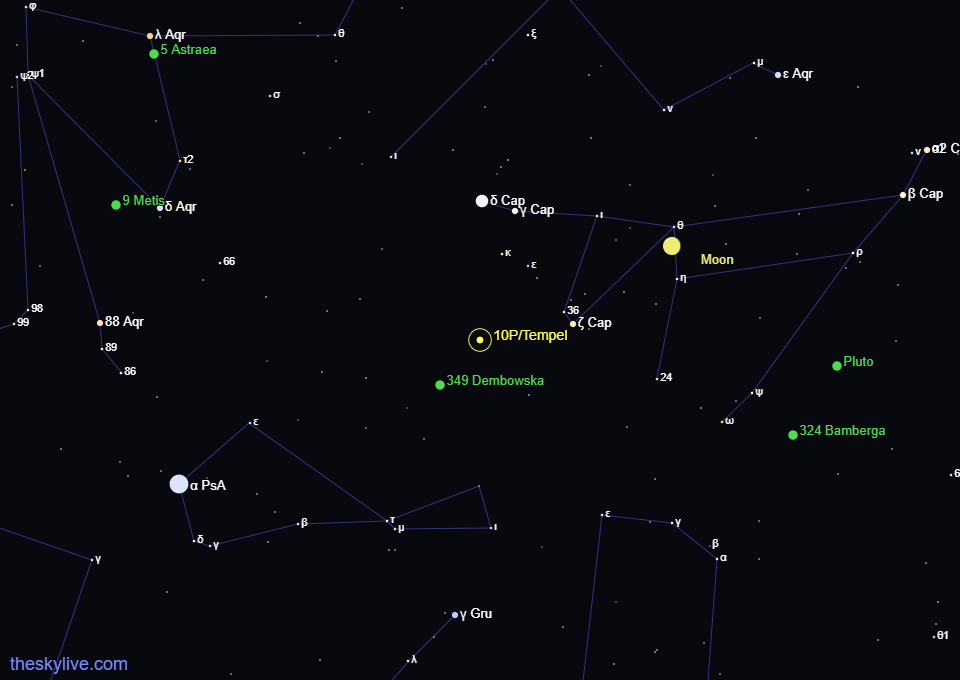
Tempel 2 is categorized as a Jupiter-family comet due to its short orbital period of less than 20 years. Its elliptical trajectory around the Sun brings it relatively close to the orbit of the gas giant at its furthest point (aphelion). The origin of Jupiter-family comets is thought to have been beyond Neptune's orbit in a region known as the Kuiper Belt, where they were later perturbed by the gravitational influence of Jupiter to settle them in short orbits around the Sun.
How to spot comet 10P/Tempel 2
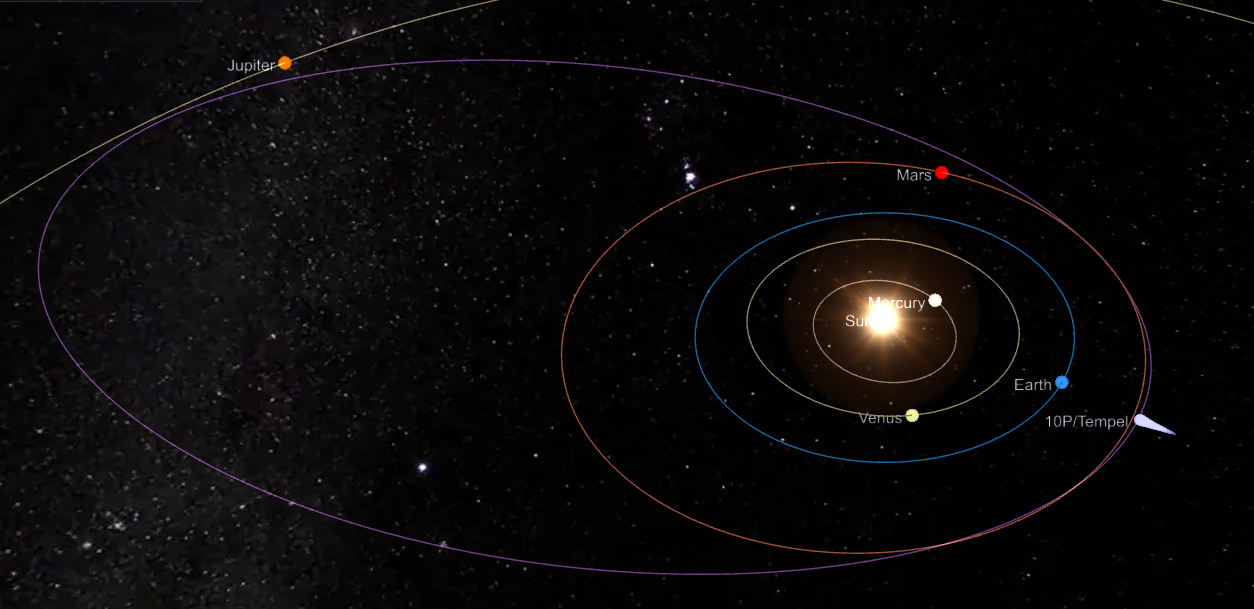
Tempel 2 will be found near the constellation Capricornus on July 30, 2026. It will be surrounded by a greenish coma, and its tail will not be visible to us owing to it pointing away from both us and the Sun. The comet itself can be seen using binoculars or small telescopes, although its visibility at a magnitude of 7 to 8 might be challenged by the brightness of a waning gibbous Moon—which passed its full Buck Moon phase just a day prior. By the time of 10P's perihelion on August 2, the comet will have moved closer to the horizon towards the Piscis Austrinus constellation.
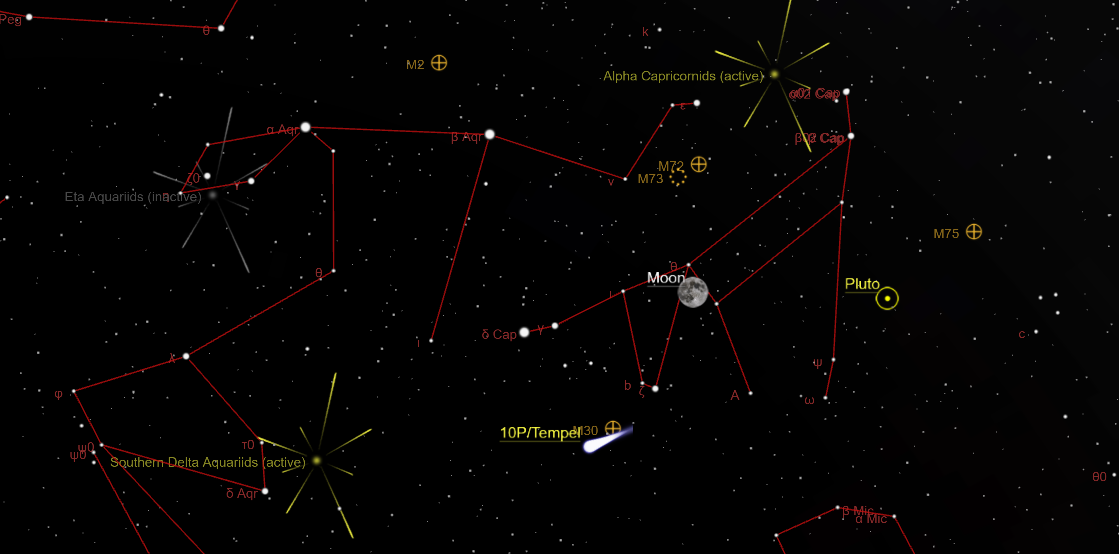
Since the Alpha Capricornids and Southern Delta Aquariids meteor showers are also going to coincide with the presence of the comet in the sky this week, their radiant points can be used as a general regional guide to locate the comet. Tempel 2 will be to the east of the Southern Delta Aquariids radiant and in the southwest direction from the Alpha Capricornids radiant for US-based skywatchers, according to TheSkyLive. With a right ascension of 21h 49m 08s and a declination of -23° 14’ 38”, Tempel 2 will remain close to the horizon for northern hemisphere observers, especially those in the US.
More on Starlust:
July 2026 skywatching guide: Catch Jupiter, Saturn, Neptune, and more
Buck Moon 2026: What else can you see in the sky during July's Full Moon?