A breakthrough Hubble discovery shows signs of a planet forming after its host star's death
Astronomers have discovered that stars can have planetary systems well beyond what was thought to be the end of their lives. While scouring through data obtained by the Hubble Space Telescope, doctoral candidate Jamie Williams at the University of Warwick found signatures of an element that couldn't be identified before when observing a white dwarf. Williams is the lead author of the study, which was published in Nature Astronomy on October 5, 2026, and focuses on a white dwarf named HS 0209+0832.
A star's death may not always be the final chapter. A new discovery from Hubble's archive shows evidence of a planet forming *after* the star it orbits died. Find out more: https://t.co/xcyMazlHnp https://t.co/PoabT0mi6S
— Hubble (@NASAHubble) October 5, 2026
The research hints at a scenario where the exoplanet received its materials late in the star's life. "Rather than the white dwarf stage being a kind of epilogue to the story of a star and its planets, this research points to the systems we are familiar with only being the first chapter of a potentially much longer tale, with some new characters showing up. That’s a really exciting prospect to pursue," said Williams.
Hubble first observed the white dwarf in 1999, in the process recording roughly 100 chemical features that had remained unidentified. "What Hubble is showing us in this white dwarf system is something we haven’t seen before: a high abundance of the element niobium, the signature of which I was unfamiliar with when I first found it in the archival data," Williams added. The now-retired FUSE (Far Ultraviolet Spectroscopic Explorer) mission also helped confirm that this element was niobium. The amount detected by Hubble showed that rather than forming at the star's birth, this observed niobium was synthesized later in the white dwarf's existence.
Niobium is an element that is also found on Earth and is used in jewelry and medical imaging devices. Nicholas Stone, a theoretical astrophysicist at the University of Wisconsin–Madison who was also part of the research team, said that the element is different from most elements that form inside stars due to nuclear fusion. "Instead, these heavy elements can only be synthesized in the exotic conditions that briefly emerge inside dying stars. The presence of niobium is a signpost of these ‘death’ throes, and the expulsion of the dying star's innards into space," explained Stone.
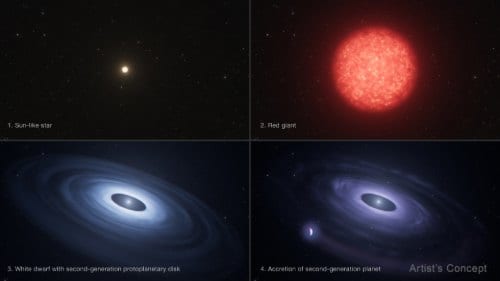
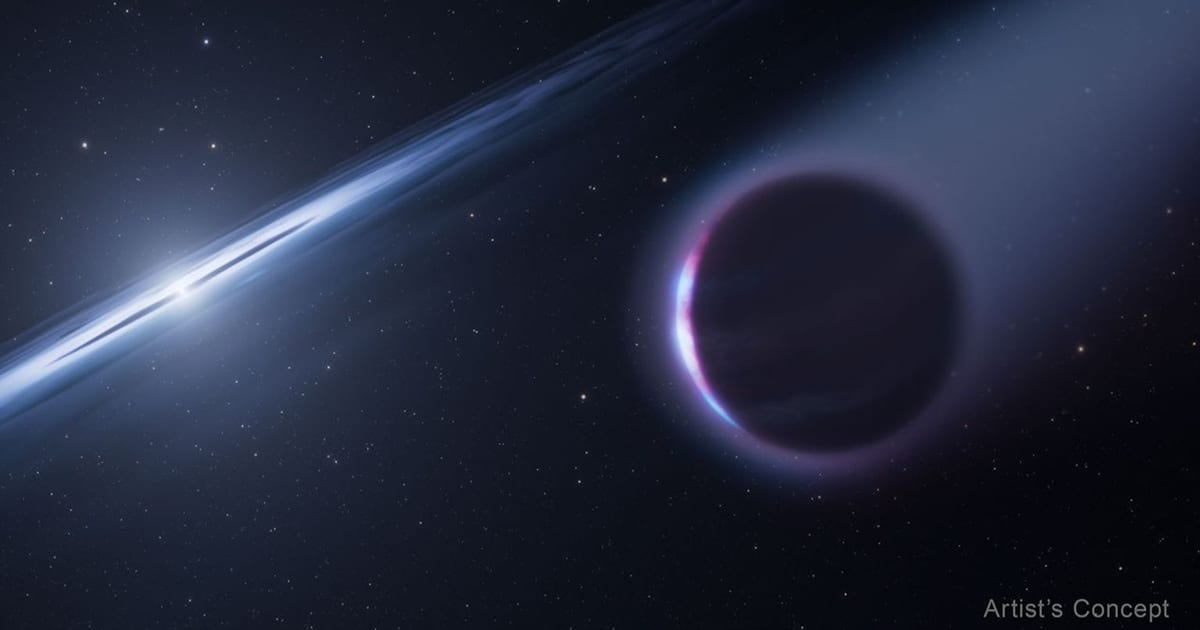
When a low-mass star dies to form a white dwarf, it ejects its outer layers into space. In this case, the scientists think that the niobium-enriched material was also chucked into its surroundings, thus creating an accretion disk. Much like how accretion disks around new stars come together to form planets, this research also indicated that this expelled material ended up forming a gas giant the size of Jupiter. However, this exoplanet orbits much closer to HS 0209+0832 at a distance of about 3.7 million miles—which is closer than Mercury is to the Sun. Scientists know this, thanks to the TESS (Transiting Exoplanet Survey Satellite) mission by NASA. TESS made observations of HS 0209+0832 over a four-month period, making note of a faint, regular brightness signal repeating every 4.4 days that indicates an orbiting planet.
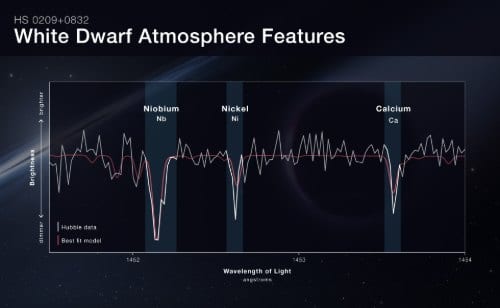
Because of the intense radiation from HS 0209+0832, the gas giant is also losing a large amount of its atmospheric mass. This mechanism manifests itself in the form of a comet-like tail of matter forming around the planet in the direction away from the star. This material, which is rich in niobium, falls back onto the host star after forming rings around it. This, the researchers think, is the reason why they detected signatures of niobium coming from the star itself. As for the planet, the researchers think it is here to stay. "If the second-generation planet is there, I think it is likely to survive. Eventually, the white dwarf will cool and then maintain a consistent temperature, with the planet in its stable habitable zone for millions of years,” Williams said. Going forward, the scientists hope to find similar systems and build statistical data on such systems to establish how planetary systems around dead stars evolve and how prevalent they are in our universe.
More on Starlust
NASA's IXPE successfully studies a distant white dwarf star for the first time in history
Scientists discover a rare Neptune-sized exoplanet that leaves a mark on its host star