Shenzhou-21 taikonauts return to Earth after longest Chinese single-crew space mission
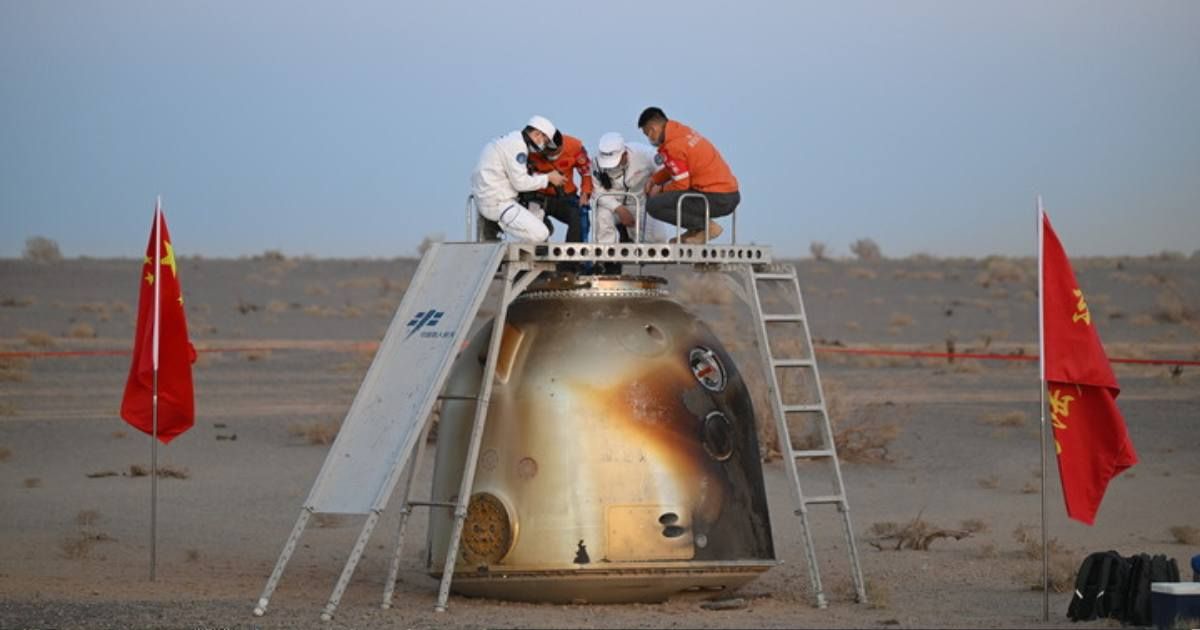
The three-person crew of Shenzhou-21 returned safely to Earth from the Tiangong space station at 8:11 pm China Standard Time (8:11 am EDT) on May 29, 2026. This marked the conclusion of the longest single-crew mission aboard the Chinese space station, with the taikonaut trio having launched to the orbital laboratory on October 31, 2025. The landing took place at the Dongfeng site in the Inner Mongolia Autonomous Region on Friday, per Xinhua.
The three astronauts of China's Shenzhou-21 crewed spaceflight mission are now on their way back to Earth, and they are all in sound condition, the ground support team said on May 29.#ChinaSpaceLaunch #ChinaSpaceStation #Spacehttps://t.co/wGDVXHiSQ0 pic.twitter.com/30nxasY7AI
— CCTV+ (@CCTV_Plus) May 29, 2026
The Shenzhou-21 crew consisted of commander Zhang Lu, spaceflight engineer Wu Fei, and payload specialist Zhang Hongzhang. For Lu, this was his second flight to space after Shenzhou-15, while the remaining crew members experienced spaceflight for the first time. Once the required safety checks were completed, ground recovery personnel from the Jiuquan Satellite Launch Center opened the hatch of the crew capsule and conducted a preliminary evaluation of the astronauts' health before helping them out. The crew then interacted with the media before being escorted to medical examination vehicles.
Welcome home, taikonauts! 🚀
— Ambassador Kong Xianhua (@China_Amb_Mdv) May 31, 2026
On Friday, the return capsule carrying the Shenzhou-21 crew — Zhang Lu, Wu Fei and Zhang Hongzhang — landed safely at the Dongfeng landing site in Inner Mongolia. All three astronauts are in good health, marking the complete success of the mission.… pic.twitter.com/45lXXumVy1
Lu directed everyone's attention to an apple that he brought back from the space station as a tribute to all technology and science workers across the country ahead of China's National Science and Technology Workers Day that was observed on May 30. "On the launch day of the Shenzhou-21 space mission, the ground support team gave us an apple to wish us a safe and smooth mission," he recalled. "So when we departed the Tiangong space station, we deliberately brought an apple back to give to all sci-tech workers, and say to them, 'Thank you for your tireless hard work.'"
After a historic 210-day orbital stay that set a new record for the longest in-orbit duration by a Chinese taikonaut crew, the Shenzhou-21 astronauts concluded their extraordinary space journey on Friday by returning to Earth aboard the Shenzhou-22 spacecraft.… pic.twitter.com/Gm0Sd8yN4Y
— Global Times (@globaltimesnews) May 29, 2026
During their stay onboard the orbital outpost, the Shenzhou-21 crew conducted experiments across a variety of scientific fields, including microgravity fundamental physics, space material science, and space life sciences. The Chinese Academy of Science (CAS) noted that around 41.14 kg of scientific samples were sent to Earth along with the crew. The payload, in fact, included samples of the world's first experiment on human artificial embryos as well as what has been described as "brain organoids." These samples were transported to the Technology and Engineering Center for Space Utilization (CSU) under the CAS in Beijing on Saturday.
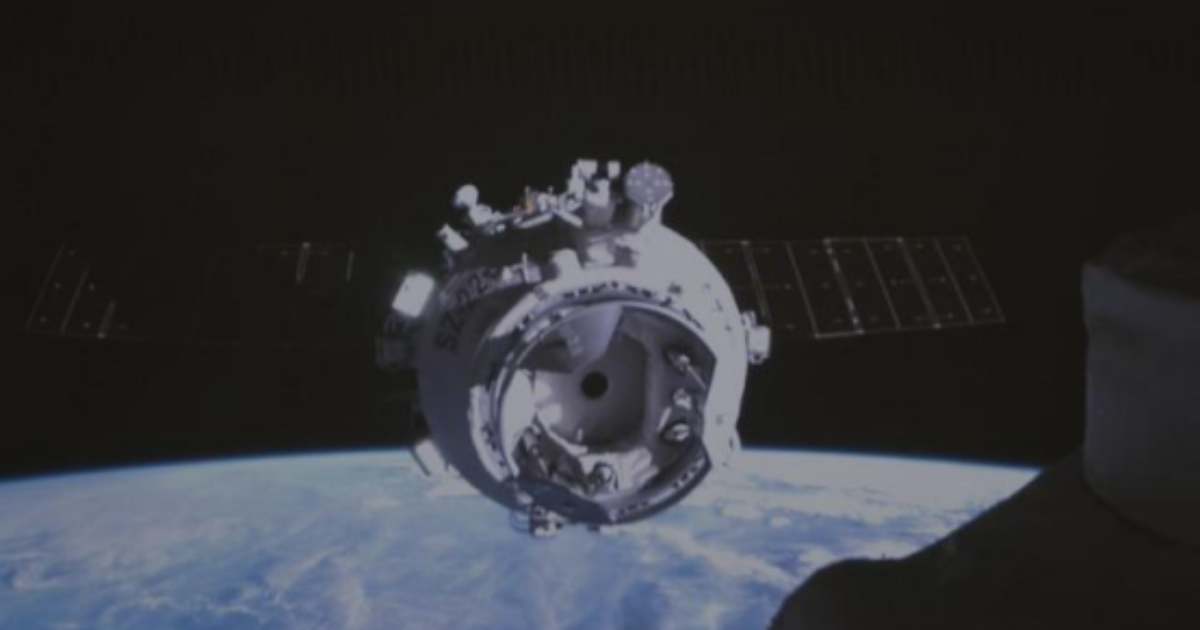
The Shenzhou-21 crew also conducted three spacewalks, during which they inspected the Shenzhou-20 return capsule's viewport window and installed debris-shielding devices on the space station. As its name suggests, the Shenzhou-20 capsule was meant for the return of the crew with the same designation. However, a suspected space debris impact on its viewport window rendered the capsule incapable of returning humans safely to Earth. Given Shenzhou-20's crew were nearing completion of their mission, they came back home in the Shenzhou-21 capsule, needing the Chinese space administration to launch an empty Shenzhou-22 spacecraft specifically for this return. The extension of Shenzhou-21 by a month at the station furnished even more proof of China's capacity to sustain its crews for long in-orbit stays. In fact, one member of the Shenzhou-23 crew will test this capability even further by remaining at the Tiangong space station for a year.
More on Starlust
China unifies its space programs to put astronauts on the Moon by 2030: 'We will spare no effort'
China is reaching for the Moon: Inside its growing manned spaceflight capabilities