Here's how you can follow the journey of interstellar comet 3I/ATLAS this week

Skywatchers looking toward the constellation Virgo this week have a notable target: Interstellar comet 3I/ATLAS. The icy visitor, which has been the subject of global discussion for the past few weeks, is currently positioned approximately 325 million kilometers (202 million miles) from Earth, according to Sky Live.

Currently observable with a magnitude of 9.8, the comet's apparent coordinates place it at a Right Ascension of 13h 04m 37s and a Declination of -04° 59’ 07” at the time of writing this article. Light reflecting off the comet takes roughly 18 minutes and 5 seconds to reach our planet. 3I/ATLAS's movement across the sky shows a steady progression through Virgo, with its brightness remaining relatively consistent at around magnitude 11 for this week, as it gradually shifts its celestial coordinates, per data released by the Comet Observation database (COBS).
Astronomers are anticipating the comet's closest approach to Earth for Friday, December 19, 2025. At that time, 3I/ATLAS will sweep within 268.9 million kilometers or 167.2 million miles (or 1.797 AU) of our planet.

On November 11, comet 3I/ATLAS will be in the Virgo constellation, holding a magnitude of 11, per COBS. Its precise apparent coordinates will be at a Right Ascension of 13h 02m 25s and a Declination of -04° 48’ 16", per forecast by SkyLive. The comet continued its transit through Virgo on November 12, maintaining its observed brightness at magnitude 11. Celestial positioning will shift to a Right Ascension of 12h 59m 55s and a Declination of -04° 35’ 52”. Tracking data for November 13 indicates that 3I/ATLAS will remain steady at a magnitude of 11.1 within the same constellation. Its apparent coordinates will be as 12h 57m 23s Right Ascension and -04° 23’ 12” Declination.

For November 14, the comet is predicted to have a magnitude of 11.1. Its position will stay in Virgo, recorded at 12h 54m 48s Right Ascension and -04° 10’ 16” Declination. Observations for November 15 place 3I/ATLAS at magnitude 11.1. The comet was registered at 12h 52m 11s Right Ascension and -03° 57’ 03” Declination, within the same constellation. Tracking data for November 16 confirms the comet will still reside in Virgo, showing a minor dip in observed brightness to magnitude 11.2, stated COBS. Its coordinates will log at 12h 49m 31s Right Ascension and -03° 43’ 33” Declination, closing the week closer to its anticipated December flyby, per Sky Live.

Comet 3I/ATLAS, recognized as only the third confirmed object to enter our solar system from interstellar space, is now on its outbound journey, per Earth Sky. The visitor recently completed its perihelion, or closest pass by the Sun, on October 29, 2025, at 11:47 UTC. At that critical juncture, the object, believed to be a comet originating from beyond our stellar neighborhood, approached within approximately 203 million kilometers or 126 million miles(1.36 AU) of the Sun.
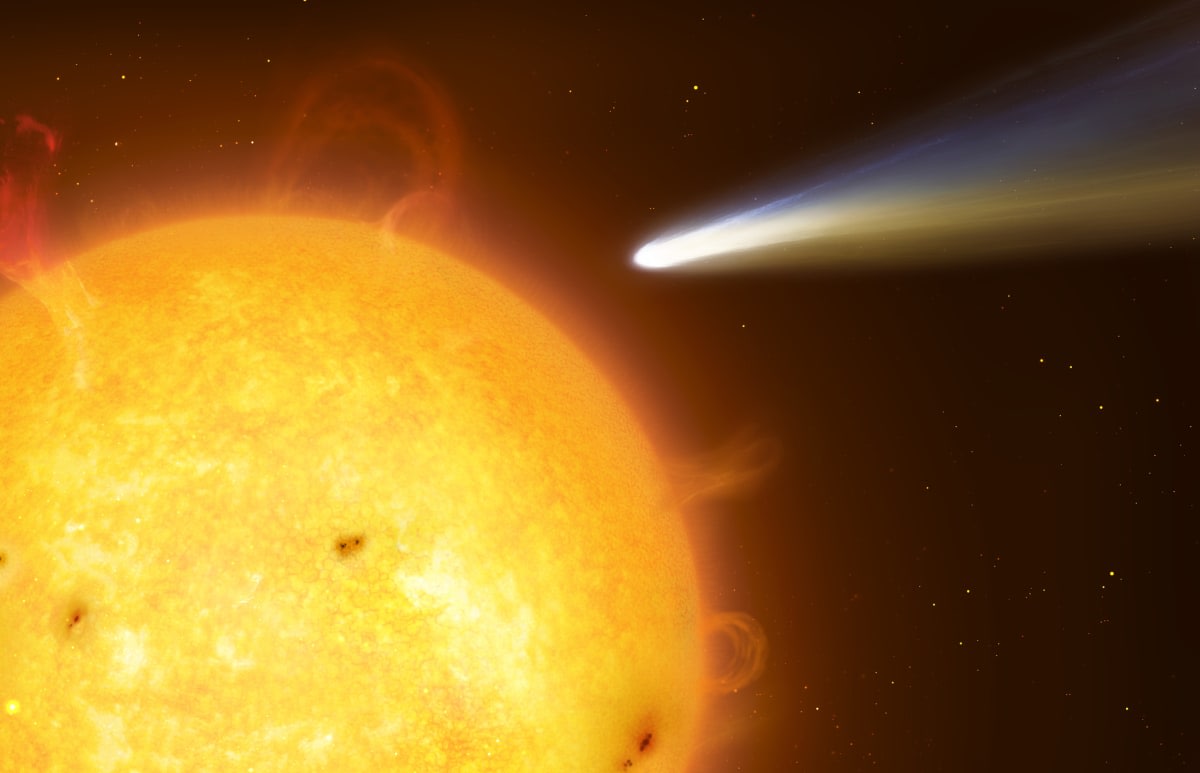
Amateur astronomers are still attempting to spot the comet in the pre-dawn sky as it escapes the Sun's direct glare. Given its current brightness, 3I/ATLAS will never be visible to the unaided eye from Earth. Observing the object requires a minimum of an 8-inch (20 cm) or larger telescope. The best viewing opportunities are projected for late November, when the comet should be better positioned in the morning sky for observation.
More on Starlust
Comet 3I/ATLAS is in the Virgo constellation—here's how you can locate it
China's Mars mission Tianwen-1 captures rare images of interstellar comet 3I/ATLAS