Love from Mars: NASA captures surreal heart-shaped landscapes on the Red Planet
The heart-shaped beauty of Mars
Over the years, NASA has spotted some of the strangest and most fascinating sights on Mars. But not every image leaves us with questions. Some are simply so beautiful and unexpected that they make us stop and stare for a moment.
Every year, Malin Space Science Systems has marked Valentine’s Day by sharing unique heart-shaped features spotted across the surface of the Red Planet. Here’s a look at some of the most unique yet stunning images taken by the Mars Reconnaissance Orbiter over the years.
Mars Valentine 2021
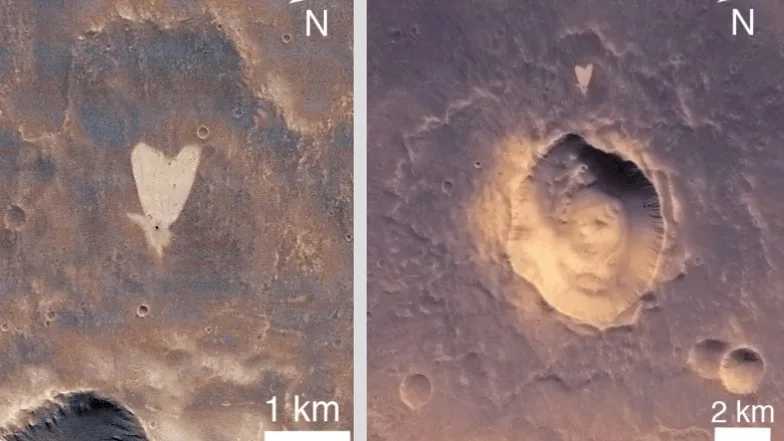
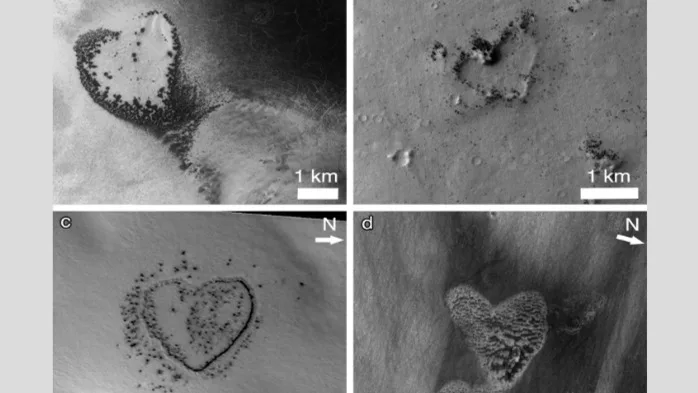
This image is titled “Mars Valentine 2021” by the Malin Space Science Systems (MSSS). In this image, you can see four different heart-shaped landforms and surface patterns on Mars. These images were captured by the Mars Reconnaissance Orbiter (MRO) using its Context Camera (CTX).
The first two images (a and b) were taken on August 11, 2020. Image c was taken on August 13, and the last image (d) was taken on October 25 of the same year. These images are based on CTX data from NASA/JPL-Caltech/Malin Space Science Systems and show the unusual heart-shaped features that can appear naturally on the Martian surface.
Mars Valentine 2022
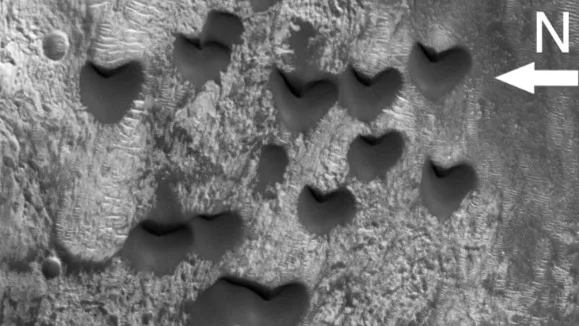
Next up, we have “Mars Valentine 2022,” which shows several heart-shaped dunes in Noachis Terra in the southern hemisphere of Mars. The dunes are approximately 500 meters in size and are located at about 47.4°S, 341.2°W. The image was taken by CTX on February 12, 2021.
In the image, north is to the left and illumination comes from the lower left. As per MSSS, “Over the past 22 years, Malin Space Science Systems has featured other heart-shaped Martian landforms on Valentine's Day in images acquired by MRO CTX and the Mars Global Surveyor (MGS) Mars Orbiter Camera (MOC)”.
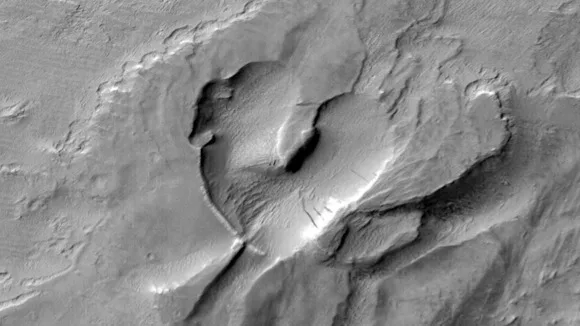
From Mars, With Love (1999)
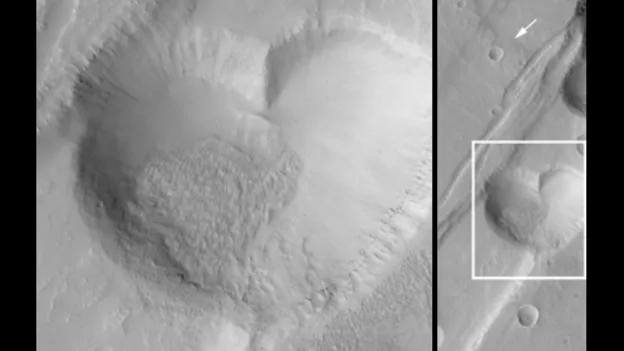
This one is the oldest image recorded on the MSSS website (from the year 1999) with the title “From Mars, With Love.” The heart-shaped pit you can see on the surface is actually created by collapse within a straight-walled trough known as a graben. Grabens form along fault lines as the bedrock terrain expands. The heart-shaped pit is approximately 2.3 kilometers (1.4 miles) across at its widest point.
The particular feature is located on the east flank of the Alba Patera volcano in northern Tharsis, where the graben, pit, and surrounding lava flow can be seen. The MOC team targeted this area to study the relationship between the lava flow and the graben and pits that cut across it.
Love from Mars (2012)
Mars Reconnaissance Orbiter (MRO) Context Camera (CTX) team shared this beautiful image of a heart, as seen on the surface of Mars, on the day of St. Valentine's Day on February 14, 2012. But this image of a heart-shaped feature was first taken in 2009 by the orbiter’s camera near the Gordii Dorsum.
Describing the features, the website notes, “The pit is located at 8.6°N, 144.2°W and contains many interesting features, including slope streaks on the northeast wall of the depression. This picture is a subframe of the full CTX image B11_014104_1888_XN_08N144W. North is to the bottom, and illumination is from the upper left.”
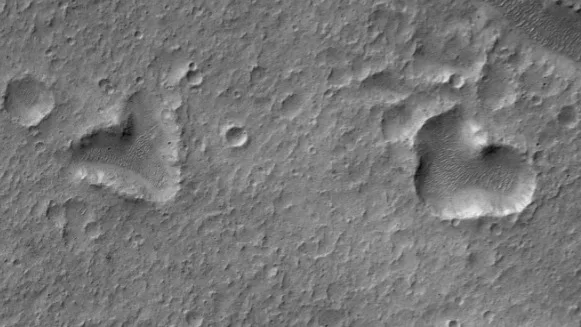
Mars Valentine 2019
When you first look at this image, it looks like someone has drawn little hearts on Mars, but these are actually created naturally on the surface. These two heart-shaped depressions are about 1 kilometer wide each. Inside them, rippled bedforms add another layer of detail to the Martian terrain.
The image was taken on December 1, 2018, near the equator at approximately 7.21°N, 52.37°W. With north pointing to the right and sunlight coming from the upper left, the shadows and textures help bring these unusual heart-shaped features into view.
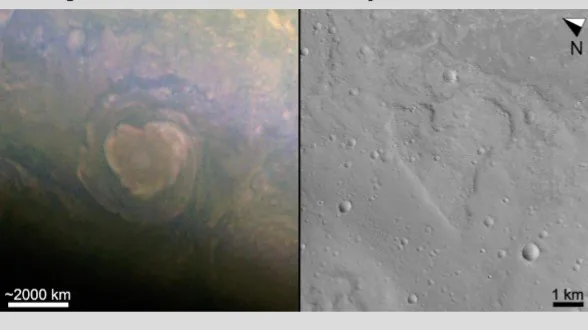
Jovian and Martian Valentine 2018
In 2018, NASA’s spacecraft captured two very different heart-inspired landscapes. The first one is from Jupiter, and the second one was spotted on Mars. JunoCam photographed a heart-shaped cloud high in Jupiter’s atmosphere on September 1, 2017.
It’s about 2,500 kilometers wide and located near the planet’s northern region. On the right, the Mars Reconnaissance Orbiter captured a roughly 4-kilometer-wide mesa in northern Isidis Planitia that resembles a heart from above.