Wait, what's that? The strangest things ever spotted on Mars
What’s there on the surface?
For years, NASA and the European Space Agency have been studying the surface of Mars in great detail in the hopes of finding signs of ancient life. Their missions have found evidence of ancient rivers and lakes that once shaped the Martian surface. But that's not all they've found.
Along the way, scientists have also come across some really odd views that made them stop and take a second look. Here’s a look at some of the strangest things spotted on Mars’ surface and what they turned out to actually be.
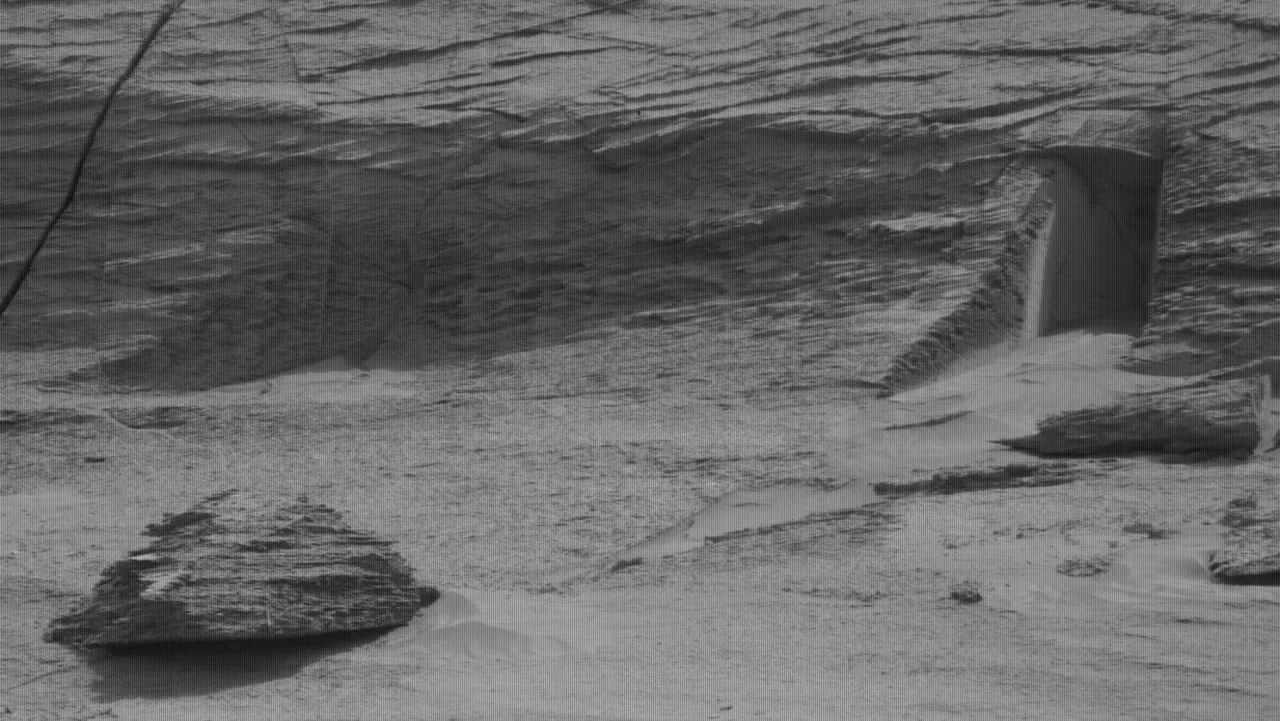
A perfectly cut "doorway" into a cliffside
Is that a doorway for Martians? Well, not really. This image was captured by NASA's Curiosity rover in 2022. It shows a small “doorway” opening in a Martian cliff that looked almost carved on purpose. "This is a very curious image, but in short – it looks like natural erosion to me," said geologist Neil Hodgson, who studies Mars.
He explained that the rock's layers, which are called strata, were likely "deposited perhaps 4 billion years ago under sedimentary conditions, possibly in a river ... or a wind-blown dune." Wind wore away the softer material over time, and the small opening formed where natural cracks met those layers. As for a quake shaking it loose, geologist Angelo Pio Rossi of Jacobs University in Bremen, Germany, said, "The fractures themselves are not created directly by Marsquakes, but simply by deformation through geologic time."
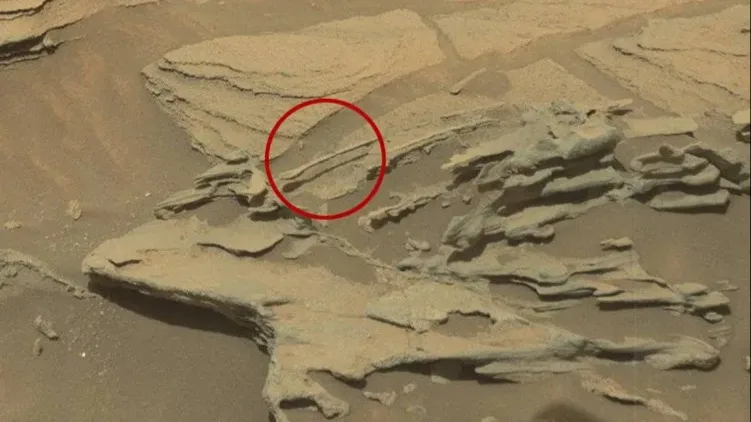
A rock that looks exactly like a “floating spoon”
In 2015, Curiosity captured a rock formation that appears to hover above the ground and looks like a spoon-shaped handle with a shadow underneath it. When NASA examined it, the space agency shared that it was most likely an illusion.
"There is no spoon. This weird Mars feature is likely a ventifact — a rock shaped by wind," explained NASA. This ventifact forms when windblown particles slowly sand down a rock's surface over a long time. Here, they have carved a thin base that makes the rounded tip look like it's floating in midair.
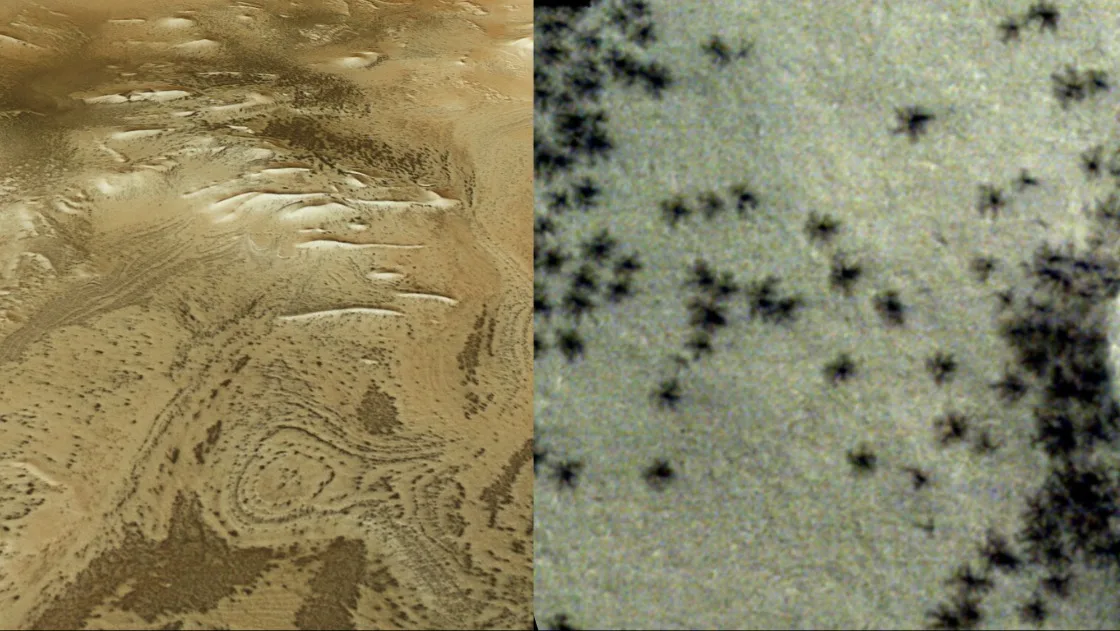
Thousands of dark "spiders"
This image, where you can see thousands of Martian “spiders”, was taken by the European Space Agency (ESA). They are not alive. This formation is usually seen in a region near the south pole, which is known as the Inca City, and can measure between 150 and 3,300 feet across. They are actually created when buried carbon dioxide ice warms up and sublimates.
As per ESA, “Rather than being actual spiders, these small, dark features form when spring sunshine falls on layers of carbon dioxide deposited over the dark winter months. The sunlight causes carbon dioxide ice at the bottom of the layer to turn into gas, which subsequently builds up and breaks through slabs of overlying ice.”
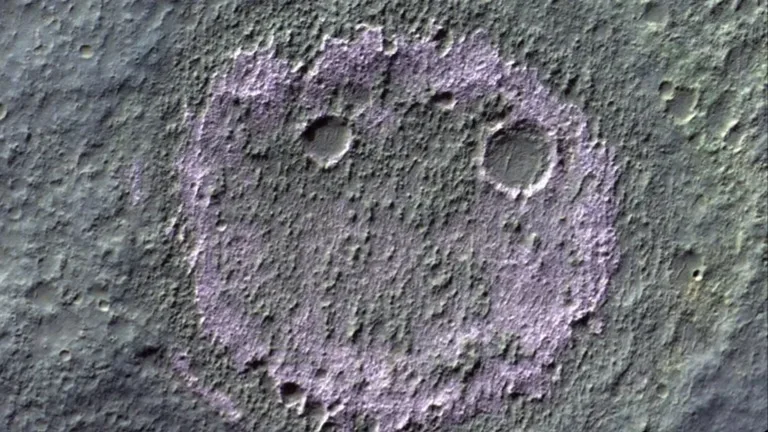
A giant “smiley face”
ESA's ExoMars Trace Gas Orbiter shared this image, where you can see a wide “grin” stamped into the Martian surface. But this is not an anomaly. This is created from a ring of chloride salt deposits with two crater "eyes." It's the remnant of a lake that dried up billions of years ago, and it only shows up under specific imaging conditions.
There are nearly a thousand similar chloride deposits scattered across the planet. As the study in the journal Scientific Data wrote, these deposits "can provide optimal conditions for biological activity and preservation," making them "a prime target for astrobiological exploration" as scientists hunt for possible signs of ancient life on Mars.
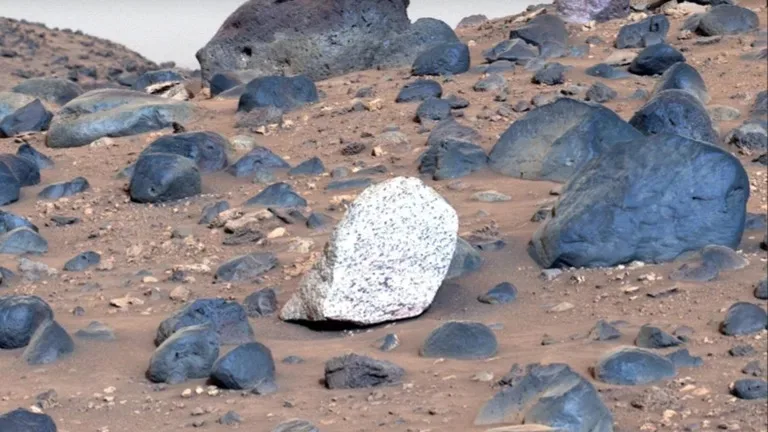
A very strange white rock
Perseverance has photographed this rock, which doesn’t look like anything we have spotted on Mars before. In this image, you can see there is a bright, speckled boulder standing out against the dark terrain of Jezero Crater. NASA's team nicknamed it "Atoko Point," after a similarly pale feature that appeared in the Grand Canyon. They described it as being "in a league of its own."
Mission co-lead Brad Garczynski said, "The diversity of textures and compositions at Mount Washburn was an exciting discovery for the team, as these rocks represent a grab bag of geologic gifts brought down from the crater rim and potentially beyond." Scientists think the rock either tumbled down from the crater rim or it was carried there by an ancient river.