Researchers accidentally discover a giant stellar 'blowtorch' at the Milky Way's border
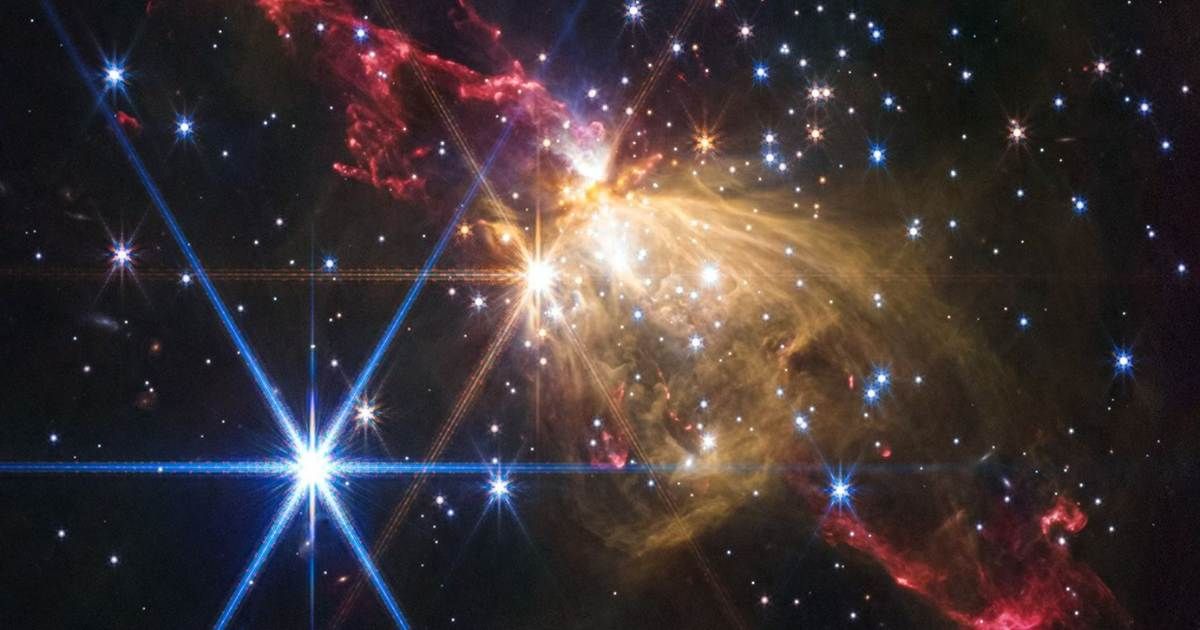
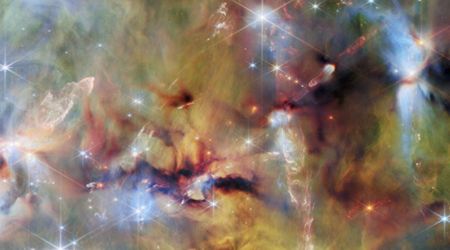
The James Webb Space Telescope has captured a spectacular celestial event: a colossal stellar jet, twice the length of the distance between our Sun and its nearest star system, erupting from a developing star. The rare phenomenon was observed in a distant nebula, Sharpless 2-284 (Sh2-284), on the far reaches of the Milky Way, as per NASA.
🆕 Webb has observed a vast stellar jet on the outskirts of the Milky Way!
— ESA Webb Telescope (@ESA_Webb) September 10, 2025
Read more: https://t.co/OkxRnFBjM2 or 🧵👇 pic.twitter.com/atu9651RL9
The powerful outflow, moving at hundreds of thousands of miles per hour, shoots from a central protostar that is roughly 10 times the mass of our Sun and located 15,000 light-years away. Researchers from the National Astronomical Observatory of Japan and other institutions say the discovery was a fortunate accident. “We didn’t really know there was a massive star with this kind of super-jet out there before the observation," said lead author Yu Cheng. "Such a spectacular outflow of molecular hydrogen from a massive star is rare in other regions of our galaxy.”

These highly focused jets of plasma are a star's dramatic "birth announcement," created when some of the gas building up around a new star is blasted away along the star's rotational axis, likely due to magnetic fields. While jets from smaller stars have been previously documented, this discovery provides valuable clues about the formation of massive stars and supports a theory of star formation. Co-author Jonathan Tan, of the University of Virginia, noted his surprise at the jet's "order, symmetry, and size." The jet’s detailed structure, captured by Webb’s infrared imaging, shows evidence of it plowing through interstellar dust and gas, creating distinct knots and linear chains. According to Tan, the jet's structure is a timeline of the star’s formation, with the tips representing older material propelled outward over 100,000 years.
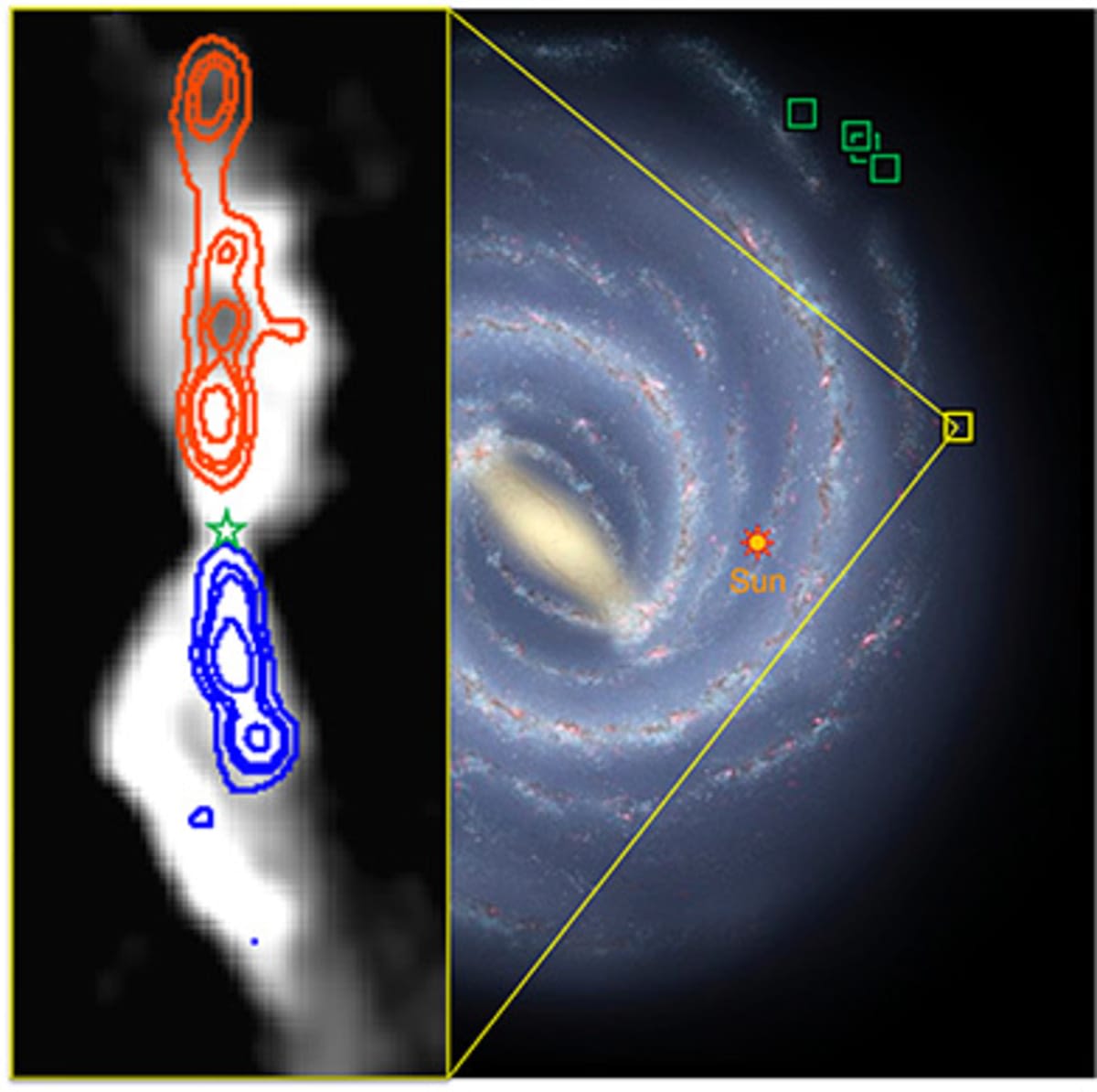
The detection of this massive jet suggests that the bigger a star, the larger its outflow. The jet’s symmetrical structure, with opposing sides almost perfectly aligned, supports a theory known as "core accretion," which posits that massive stars form from a stable disk. This challenges a competing theory, competitive accretion, which suggests a more chaotic formation process that would result in a less stable, twisted disk during launch. Located in a cluster of a few hundred stars, the stellar jet’s home is in a region of the Milky Way that's characterized by a low concentration of heavy elements. This "pristine" environment is similar to conditions in the early universe, making it a valuable "laboratory" for studying how massive stars form in these conditions, as mentioned by NASA.
This is an example of a Herbig-Haro (HH) object. Hundreds have been observed, although it is rare to see one of such size and strength. Webb’s observation suggests that HH jets scale with the mass of the star powering them. 3/3 pic.twitter.com/UUHo8myzbI
— ESA Webb Telescope (@ESA_Webb) September 10, 2025
“Massive stars, like the one found inside this cluster, have very important influences on the evolution of galaxies," said Cheng. "Our discovery is shedding light on the formation mechanism of massive stars in low metallicity environments, so we can use this massive star as a laboratory to study what was going on in earlier cosmic history.” The study, which also used data from the Atacama Large Millimeter Array (ALMA) in Chile, was accepted for publication in The Astrophysical Journal.
More on Starlust
Scientists uncover one of the most metal-poor stars ever seen, a rare find in Milky Way's halo
Scientists successfully mapped magnetic fields at Milky Way's heart to unlock how stars form