A Caltech team has simulated a chemical reaction that could offer a glimpse into the origin of life

A Caltech team has moved a step closer toward solving the ultimate puzzle: the origin of life. Researchers have computationally modeled a chemical reaction that might have cooked up the building blocks of DNA and RNA in the harsh environment of early Earth. The Caltech team's work, published in the journal Icarus, could help explain how life started on Earth (and potentially elsewhere in the universe) by showing how simple molecules can transform into the complex biological material for life.
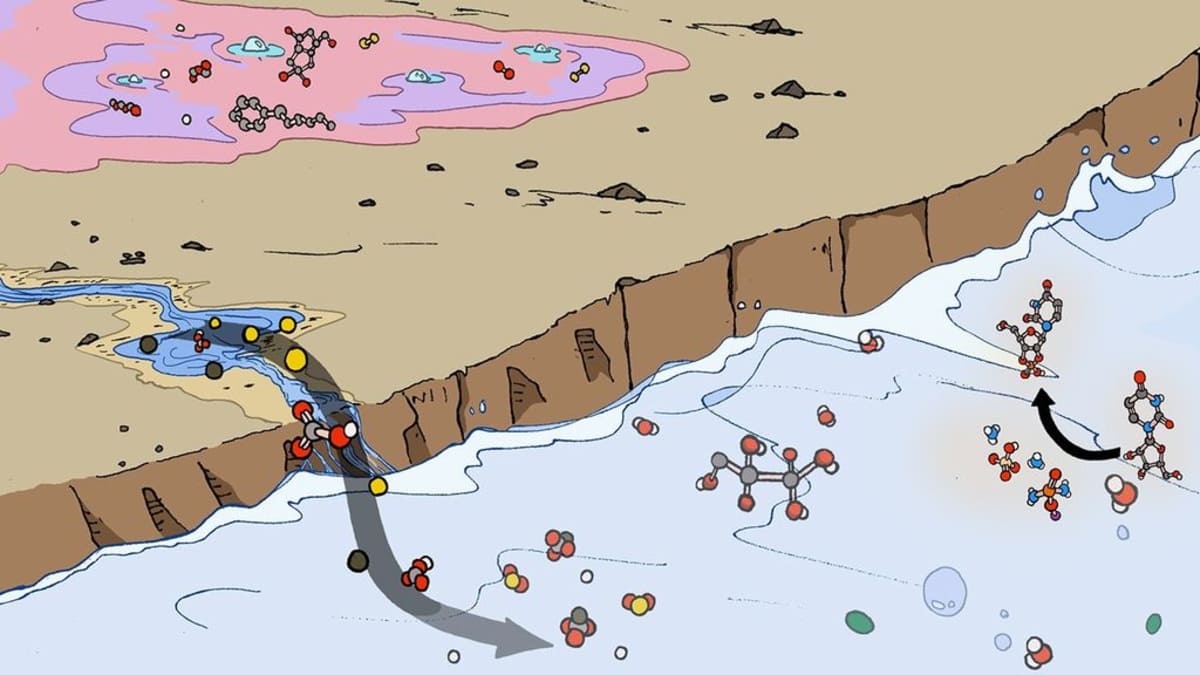
During the first billion years of its history, our home planet was not as hospitable as it is today. Indeed, early Earth was a turbulent place, where volcanoes continuously spewed lava and toxic gases, while oceans of liquid water splashed across the planet's surface. However, some time over three billion years ago, this chaos settled a bit, creating chemical conditions that sparked life as we know it. From tiny microbes to us humans, every known life form uses DNA and RNA to reproduce and survive. These complex polymers are made up of molecules called nucleotides, each of which features one of five canonical bases: adenine, thymine, guanine, cytosine, or uracil. These bases bond with one another to form the famous twisted double-helix of DNA, or the single-stranded structure of RNA. But the bases themselves are complex organic compounds. How did they actually form in early Earth’s hostile environment? The Caltech team, led by former postdoctoral scholar Jeehyun Yang (now at the University of Chicago), believes they have found an answer. They have mapped a new chemical mechanism that models exactly how these nucleobases could have formed.
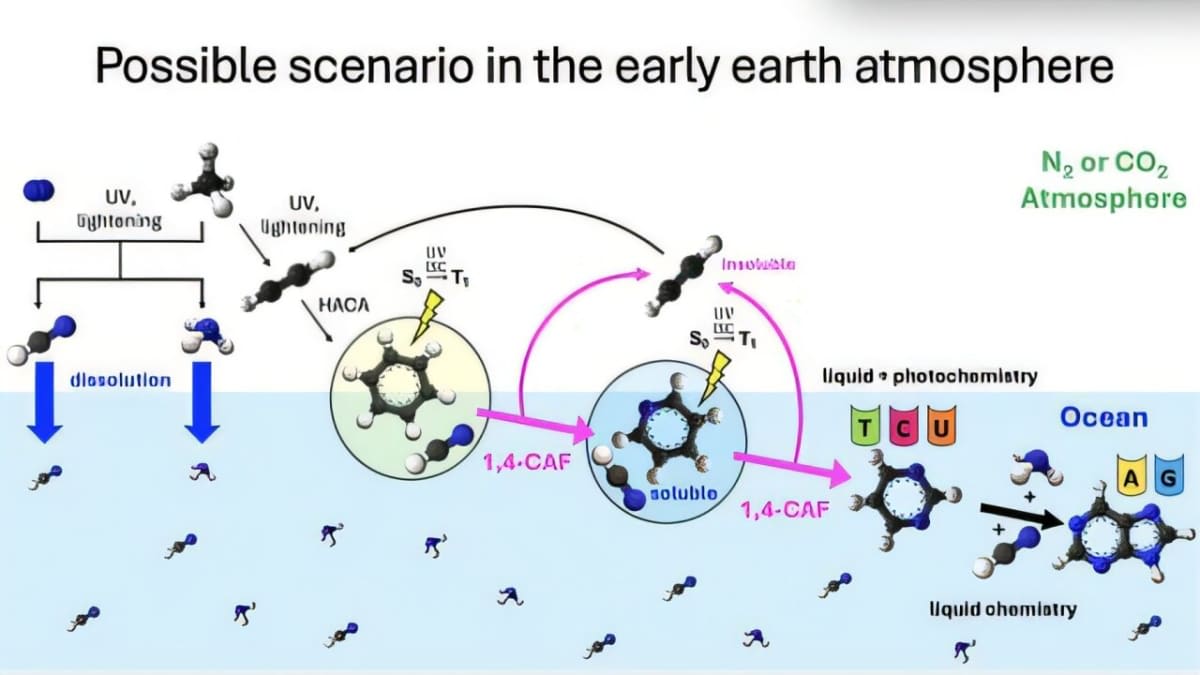
Using computational software, Yang and his team first sought to determine which molecular structures were common to all five nucleobases under the extreme temperatures and pressures that prevailed on early Earth. This hunt led them to identify the usual suspects—nitrogen, carbon dioxide, and methane—but also yielded a surprising ingredient: benzene. Benzene is an organic compound comprised of a hexagonal ring of carbon atoms, with a single hydrogen atom attached to each of these carbon atoms. But could a complex molecule like benzene remain stable in the harsh conditions of early Earth? Yang’s modeling showed that it could, provided the atmosphere was dominated by nitrogen or carbon dioxide. More importantly, Yang demonstrated that benzene could react with hydrogen cyanide (HCN) gas. Through this reaction, the benzene ring incorporates nitrogen atoms, directly transforming into the precursors for nucleobases. Previous theories explaining how HCN could build nucleobases required long, highly improbable chains of chemical reactions. This new pathway offers a much simpler, highly efficient explanation. "This is a possible scenario for what could have happened in the early Earth's atmosphere," Yang says in a statement. "Benzene could have met with HCN and, spurred on by photochemical energy from ultraviolet light or lightning, carried out the reaction to incorporate nitrogen into the carbon structure. The resulting structure would be soluble in water and could have dissolved into the ocean, where we suspect life first originated," Yang added.

While the study offers a plausible model, the timeline remains an open question. Assuming early Earth had an abundant supply of benzene and hydrogen cyanide gas, this chemistry would have needed to operate continuously to supply enough prebiotic molecules for single-celled organisms to eventually evolve. Exactly how long that process took is still unknown. To bridge the gap between computer models and physical reality, the team's next step is to demonstrate these reactions in a laboratory environment.
More on Starlust:
Asteroid that killed the dinosaurs helped microbial life flourish for millions of years
NASA's Habitable Worlds Observatory may find signs of alien life with this proposed upgrade