NASA's Webb helps pinpoint location of farthest fast radio burst—it's not what scientists expected
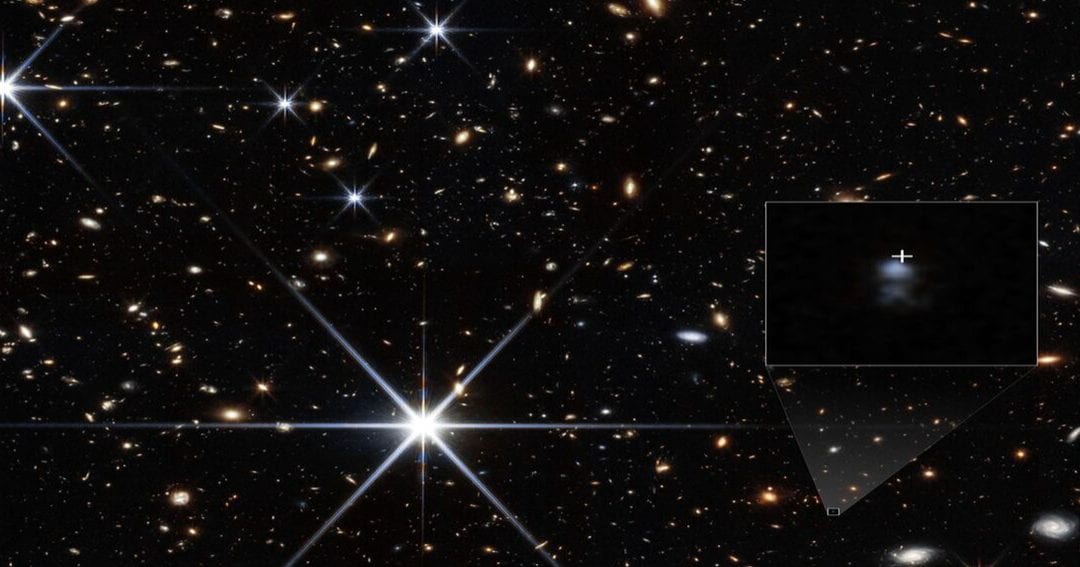
NASA's James Webb Space Telescope (JWST) has helped scientists pinpoint the location of a powerful burst of radio waves from far away in the universe, the farthest ever detected. These flashes are known as fast radio bursts (FRBs), and last only milliseconds, and scientists are still trying to understand what causes them. In this particular case, the elusive burst came from a time when the universe was about 3 billion years old, and it originated from a place scientists did not expect—a very small galaxy.
An enigmatic burst from the distant universe
Fast radio bursts (FRBs) are difficult to study because these flashes last only a few milliseconds, and many of them are never detected again. This makes it difficult for scientists to pinpoint their origins and understand what produces them. “What makes fast radio bursts interesting is that we don't know what generates them. We have theories for what objects produce them, but we don't have conclusive proof,” said Manisha Caleb, lead author of the study at the University of Sydney, in a statement.
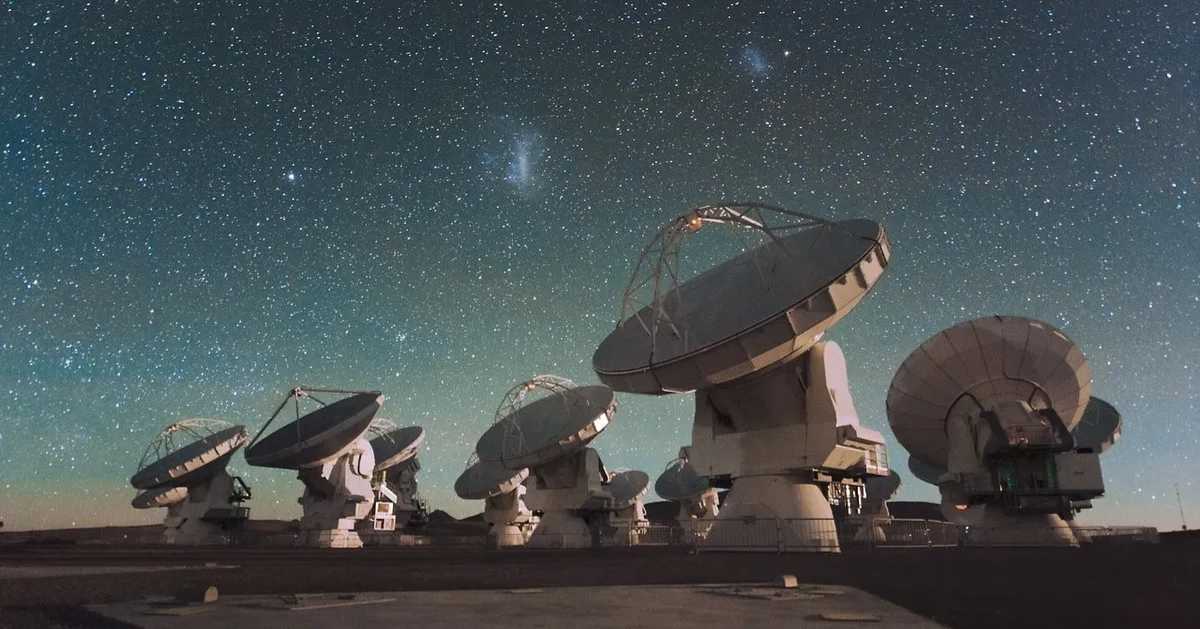
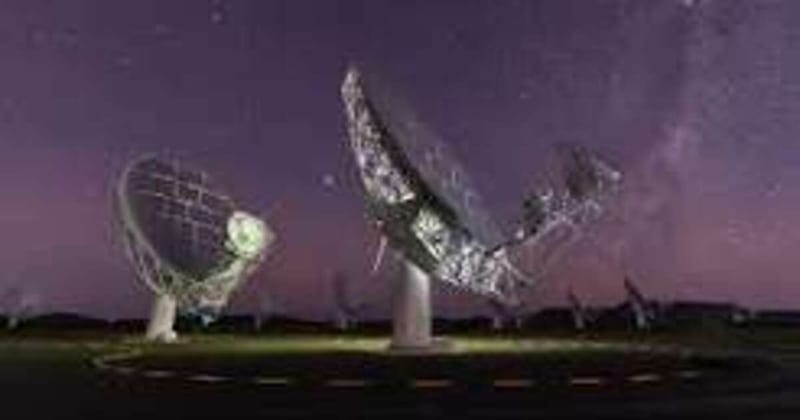
The radio burst, named FRB 20240304B, was detected on March 4, 2024, by the MeerKAT radio telescope in South Africa. After analyzing the radio signal, scientists suggested that the burst had traveled a long way through space. However, the signal alone was not enough to confirm how far away it came from—scientists first needed to identify the galaxy from which the burst originated.
Although scientists knew the burst's position, powerful ground-based telescopes could not clearly identify a galaxy at that location. To find its source, researchers turned to the JWST. Webb's observations helped them observe a faint, small galaxy at the same location from where the burst originated.
How did Webb measure the burst's distance?
After identifying the galaxy, Webb studied its light to help scientists confirm how far away it was. For this, they used the NIRSpec (Near-Infrared Spectrograph) instrument on Webb, which splits the light into different wavelengths. This helps scientists study distant galaxies and measure how much their light has stretched.
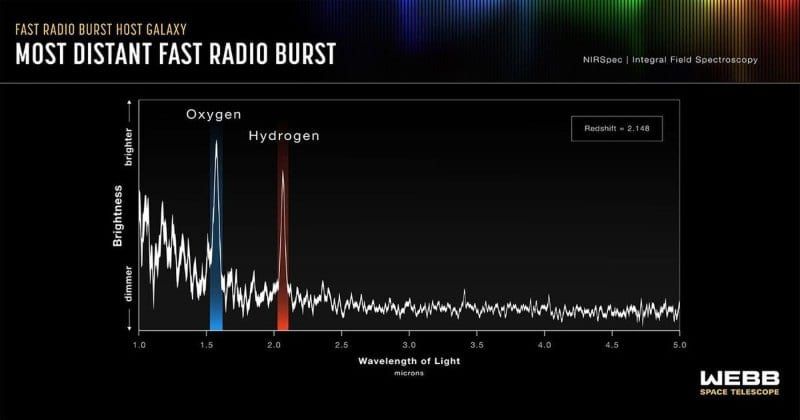
This stretching is known as redshift. As the universe expands, light traveling from distant galaxies stretches to longer wavelengths. Scientists measured the galaxy's redshift at 2.148, which placed the burst at a time when the universe was only about 3 billion years old. In other words, the burst came from a much earlier period in the universe's history, when the cosmos was still relatively young.
Why did the burst's host galaxy surprise scientists?
Normally, scientists have observed FRBs in different galaxies and found that many of their host galaxies are massive and actively forming stars. That's why researchers expected the host galaxy of this distant FRB to be large, containing a multitude of stars. However, the galaxy Webb identified was a dwarf galaxy where new stars were still forming. This was completely different from what researchers expected, as the galaxy was around 1,000 times less massive than they had anticipated. “We thought it would be a big, nicely formed galaxy with lots of stars, and instead it was a little dwarf galaxy, although it was actively forming stars,” said lead author Caleb.
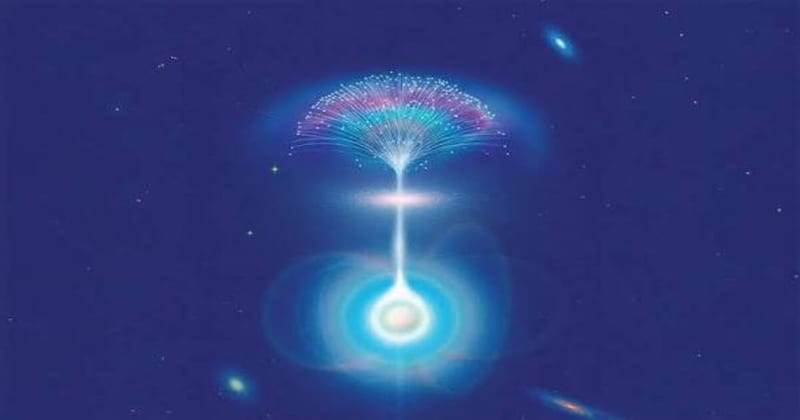
This discovery of the galaxy's size is not the only important part of this finding. It also helps scientists understand the possible origins of FRBs. According to the neutron star merger theory, FRBs could be produced when two neutron stars merge. However, these mergers can take billions of years to occur, which is why scientists would expect to find such events in older galaxies.
Caleb told NASA that, based on the evidence they found through the study, a neutron star merger was "very unlikely" to have produced this burst. While it's not clear what exactly produced this FRB, a theory suggests that these bursts could also originate from a single, highly magnetized neutron star, which is also known as a magnetar. Going forward, scientists expect to find more distant FRBs, which could offer fresh insights into their mysterious origins.
More on Starlust
Did scientists just find a new way to detect neutron star mergers? Study provides fresh clue
Neutron star mergers produce gold and platinum—and scientists may now know why