James Webb looks beyond Orion Nebula to image every stage of star formation
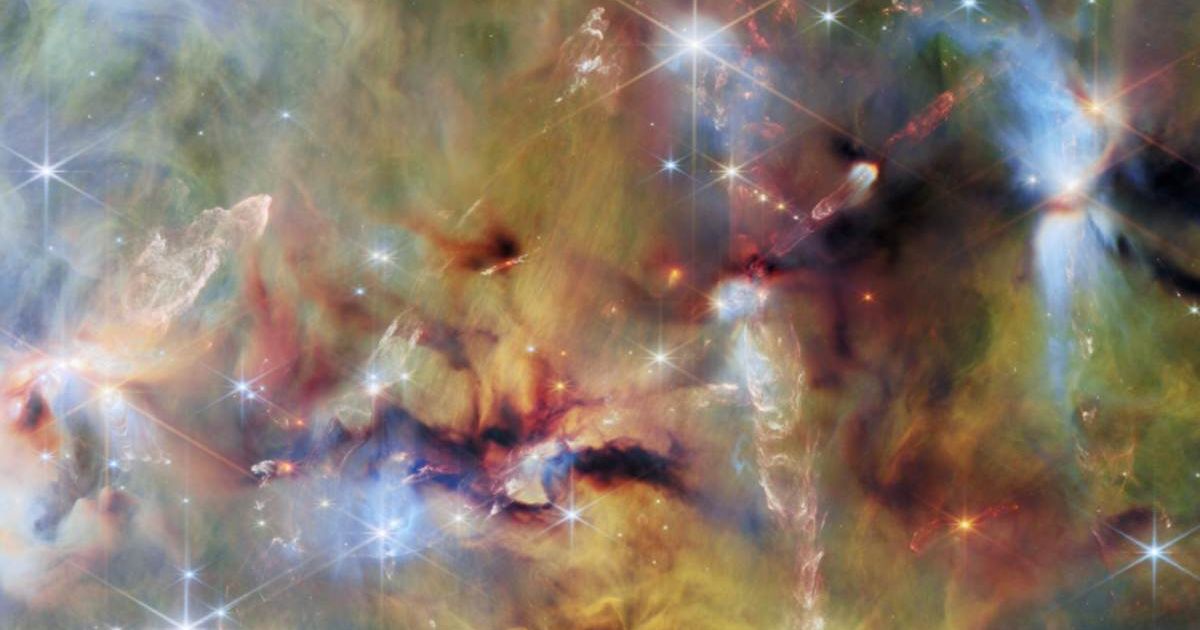
Since the days of the Mayans, the constellation Orion, which shines with brightly colored star-forming clouds, has mesmerized us. So much so that we have turned the James Webb Space Telescope, the world's premier observatory, multiple times towards it. In fact, the target of one of Webb's recent observations, according to the ESA, was the Orion Molecular Clouds (OMCs), a long filament of cold gas and dust behind the Orion Nebula (M42), housed within the constellation.
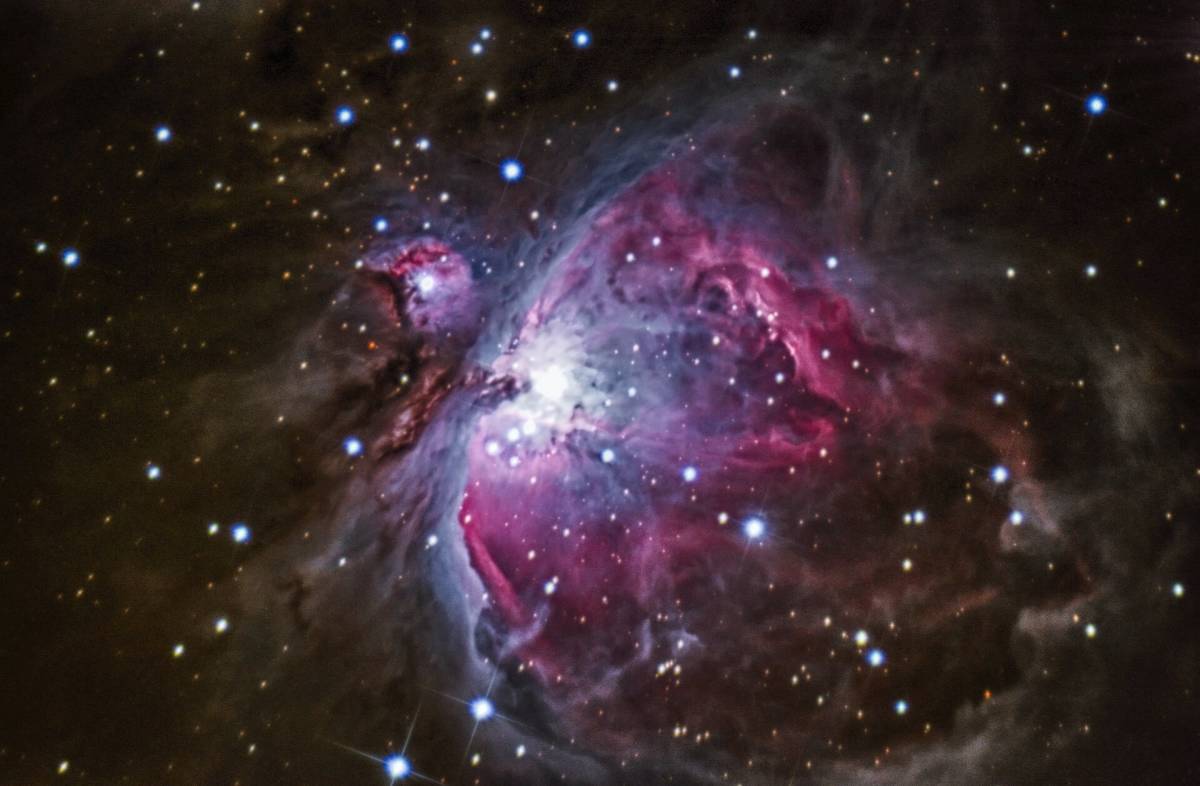
The filament has four parts—OMC1 through OMC4. Immediately behind M42 lies OMC-1. OMC-2 and OMC-3 lie to the north of M42, while OMC-4 drifts in the southern part. Webb turned its infrared eyes and focused on a small, northern part of OMC-2, located 1,280 light-years away from Earth. Only 150 light-years across, the region provides glimpses into every stage of star formation—from embryonic stars to protoplanetary discs and young stars beginning to illuminate their surroundings.

Vast clumps of gas shield OMC-2 from the radiation of nearby stars, creating an ideal environment that aids the formation of complex molecules. Gradually, increasing gravity makes the cloud collapse and spawn stars. The star formation begins with the birth of a protostar, which grows by feeding on a spinning disk of gas around it. Continuous flow of gas onto the protostar heats it up, causing it to glow. The energy acquired during this phase results in the formation of violent jets of gas that flow out from the poles of the protostar, thereby giving away its location. Since OMC-2 has a huge population of protostars, it is also the origin of many spectacular jet outflows that make their way through the dense material around them, creating shockwaves. The locations at which these shockwaves come in contact with the gas heat up and glow brightly, resulting in the formation of sharp ridges.
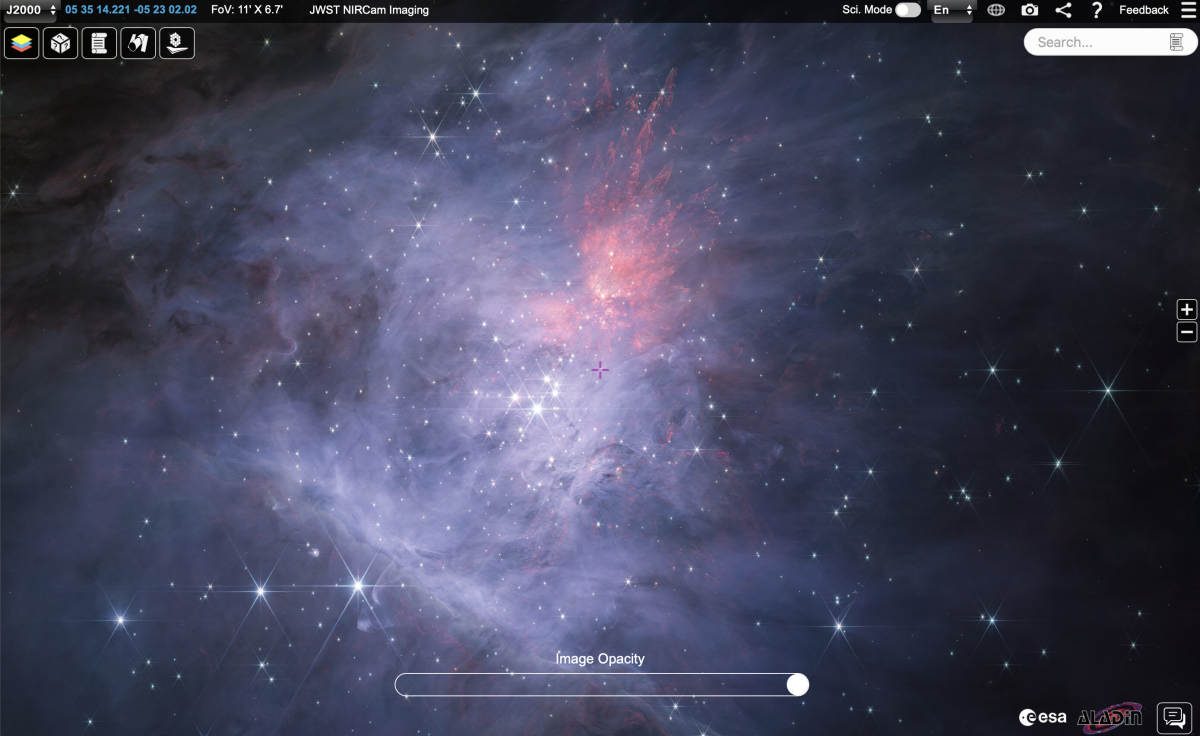
This dynamic environment of OMC-2 is invisible to optical telescopes because the thick gas and dust around the Orion Nebula absorb visible starlight, obscuring it. Webb’s powerful Near-Infrared Camera (NIRCam) lit up this world, revealing how warm dust glows in shades of orange, brown, and red. Complex carbon-rich molecules known as polycyclic aromatic hydrocarbons become vivid in yellow and green hues, while blue and cyan wisps reveal starlight scattered by dust grains. The observations were gathered as part of Webb observing program #5804, which focuses on OMC-2 and the neighboring OMC-3 region. For astronomers, these nearby molecular clouds represent ideal natural laboratories. They are close enough for Webb to resolve fine details, yet rich enough to showcase the earliest stages of stellar evolution.
More on Starlust
Baby stars don’t grow quietly—ALMA captures how a young star 'sneezes' rings of energy into space
Most massive galaxies stopped producing stars very early on in their lives—scientists find out why