What stopped star formation in some early, massive galaxies? New study using James Webb finds clues
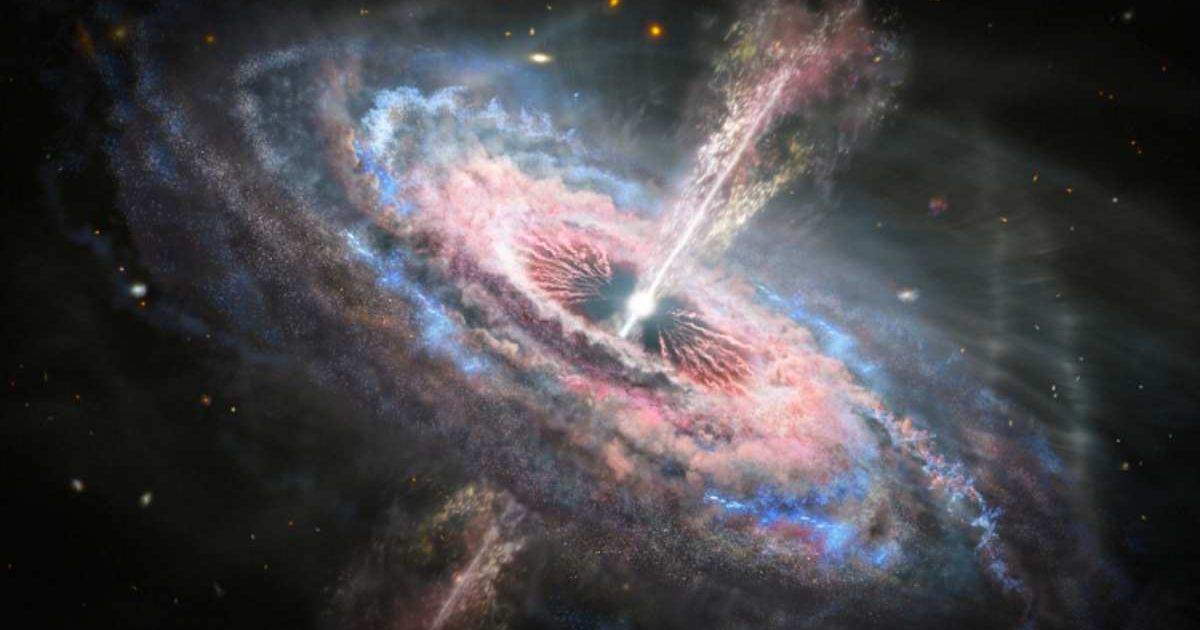
Using the James Webb Space Telescope (JWST), an international research team has detected clear signs of galactic winds in a sample of quasars in the first billion years of the universe. They found that these winds’ speeds are comparable to or faster than those observed in quasars that evolved later in the cosmos. Theoretical studies, led by Tiago Costa of Newcastle University's School of Mathematics, Statistics and Physics, have long predicted that powerful winds should be dominant in early quasars, and the new study, published in Nature, provides observational evidence of such energetic winds generated by quasars that date back to the early universe.
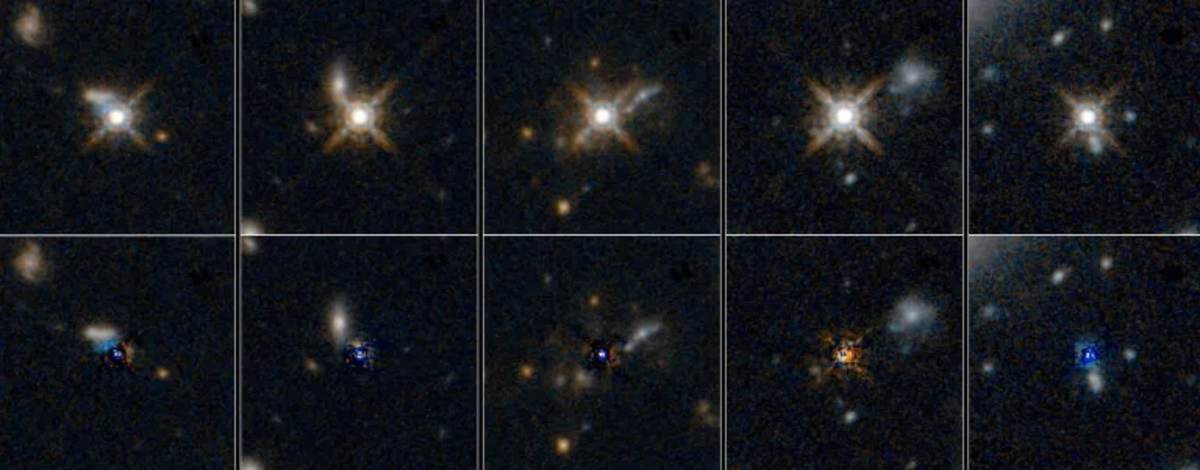
"It's exciting to now see clear evidence that these outflows were widespread, and even more extreme, in the early universe,” said Costa, co-author of the new study, in a statement. “The challenge now is to understand why, and what role they play in shaping these massive galaxies and their environments," he added. Theoretical models that describe early galaxy evolution have long relied upon the energetic output of quasars, with models suggesting that these quasars could have expelled large masses of interstellar gas from their host galaxies at tremendous speeds, exceeding several thousand kilometers per second. Such expulsion of gas is thought to have profoundly shaped galaxy evolution, but its detection remained elusive.
The present study was motivated by an earlier cosmological mystery. Astronomers had previously discovered many young galaxies that unexpectedly stopped star formation very early, around two billion years after the Big Bang, but were stumped. “Many of those galaxies look old in the sense that they had stopped forming stars long before it would be expected," said the paper's lead author, Weizhe Liu, a JASPER postdoctoral scholar at Steward Observatory. "How could they have formed so early and become so massive, when they quit star formation so early?" The likely reason may be the powerful winds generated by quasars that have now been observed by JWST. This process is probably spurred by supermassive black holes residing at the centers of the most massive galaxies, even in the early universe. Cosmological simulations, like those run by Costa, suggest that, with their blowtorch action, quasars strip their galaxy of its gas, preventing star formation in the host galaxy.
The team combed the early universe for quasars and observed 27 such objects from the time of one billion years after the Big Bang. Six of them exhibited exceptionally fast galaxy-scale winds, up to 5,000 miles per second (8,400 km per second), which is extremely fast even for a quasar. Quasars with such extremely fast outflows were at least four times more common at a cosmic epoch closer to the Big Bang than at later times, the survey found. The average kinetic energy outflow rate of quasars in the early universe was about 100 times higher compared to the ones that evolved later.
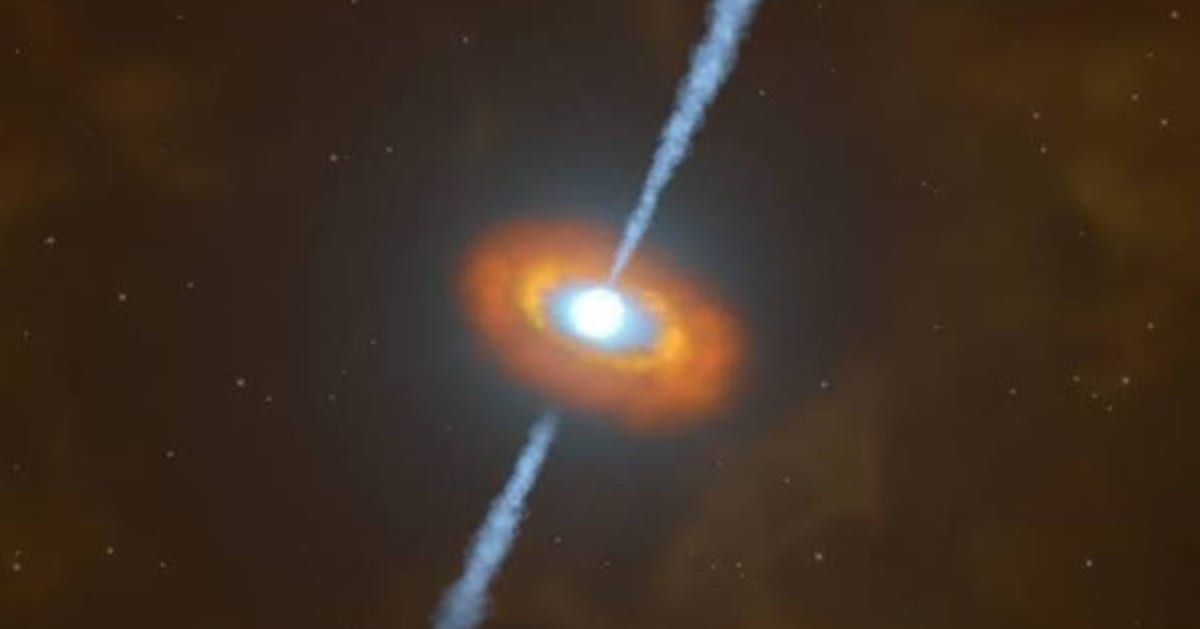
"In other words, quasars with extreme outflows were much more common in the early universe and became scarcer over time, which is surprising," said Xiaohui Fan, a Regents Professor and Associate Head of the Department of Astronomy who is the paper's second author. According to the researchers, such "super quasars" could help explain the abundance of galaxies that stopped forming stars very early in their lives in the early universe. “Although a few quasars feature a prominent particle jet, typically shooting out in opposite directions, scientists have long known that it is not the jet that blows the gas out from a galaxy,” Fan explained.

"Those jets move at speeds close to the speed of light," he said. "They essentially just punch a narrow hole into the galaxy. In contrast, the outflows we are talking about here are more like stellar winds, and we think they could be driven in many directions by radiation pressure from the quasar's extreme bright light." The team has found that these extreme outflow quasars have very short life spans, going dormant within about 100 million years, leaving behind a quiet galaxy. They estimate that every year, a galaxy with an extreme outflow quasar at its center would belch out gas equivalent to tens of thousands of solar masses. These findings by the JWST reveal that powerful quasar-driven winds may have shaped the universe’s earliest galaxies by ridding them of gas and thus halting the birth of stars.
More on Starlust
Tiny satellite galaxies orbiting the Milky Way could reveal the 'climate' of the early universe
Massive star clusters destroy their birth clouds faster, James Webb and Hubble find