Interstellar comet 3I/ATLAS to make its closest approach to Earth soon—where is it now?
The object is expected to make its closest approach on December 19, 2025, passing by at a distance of approximately 167 million miles.
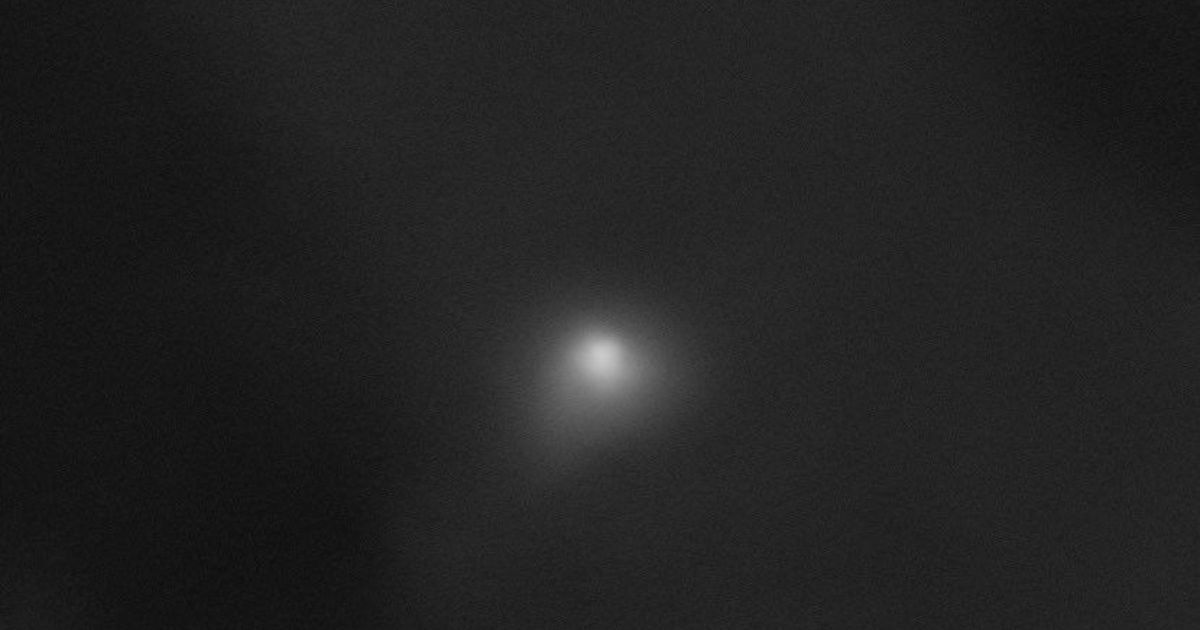
The High Resolution Imaging Science Experiment (HiRISE) camera aboard NASA’s Mars Reconnaissance Orbiter captured this image of interstellar comet 3I/ATLAS on Oct. 2, 2025 (Cover Image Source: NASA | JPL-Caltech)

Interstellar comet 3I/ATLAS, one of this year's most talked-about celestial visitors, is currently on its way out of the solar system and is expected to make a close pass by Earth. According to data on SkyLive, the closest approach of the object is expected on Friday, December 19, 2025. It is projected to pass by at about 167.1 million miles, which is equivalent to 1.798 AU. 

This image, taken by the MAVEN spacecraft on Oct. 9, shows the halo of gas and dust, or coma, surrounding comet 3I/ATLAS. (Image Credit: NASA/Goddard/LASP/CU Boulder)

Our third confirmed interstellar visitor is about 184 million miles from Earth, meaning its light takes more than 16 minutes to reach our planet. For astronomers following its path, comet 3I/ATLAS is currently positioned in the constellation Virgo. The most recent recorded apparent magnitude of this comet is 10.2 and is only visible via telescopes and maybe binoculars. Its apparent coordinates for today are a Right Ascension (RA) of 12h 25m 04s and a Declination (Dec) of -01° 37’ 17”.  

On November 25, 2025, the comet will be at RA 12h 20m 02s and Dec -01° 10’ 53”. The next day, on November 26, it will move to 12h 16m 47s RA and -00° 53’ 39” Dec. By November 27, the inbound visitor will be at coordinates 12h 13m 27s and -00° 36’ 05” Dec. On November 28, the object will be situated at 12h 10m 04s RA and -00° 18’ 06” Dec. Finally, on November 29, it will be at 12h 06m 37s RA and +00° 00’ 13” Dec.  
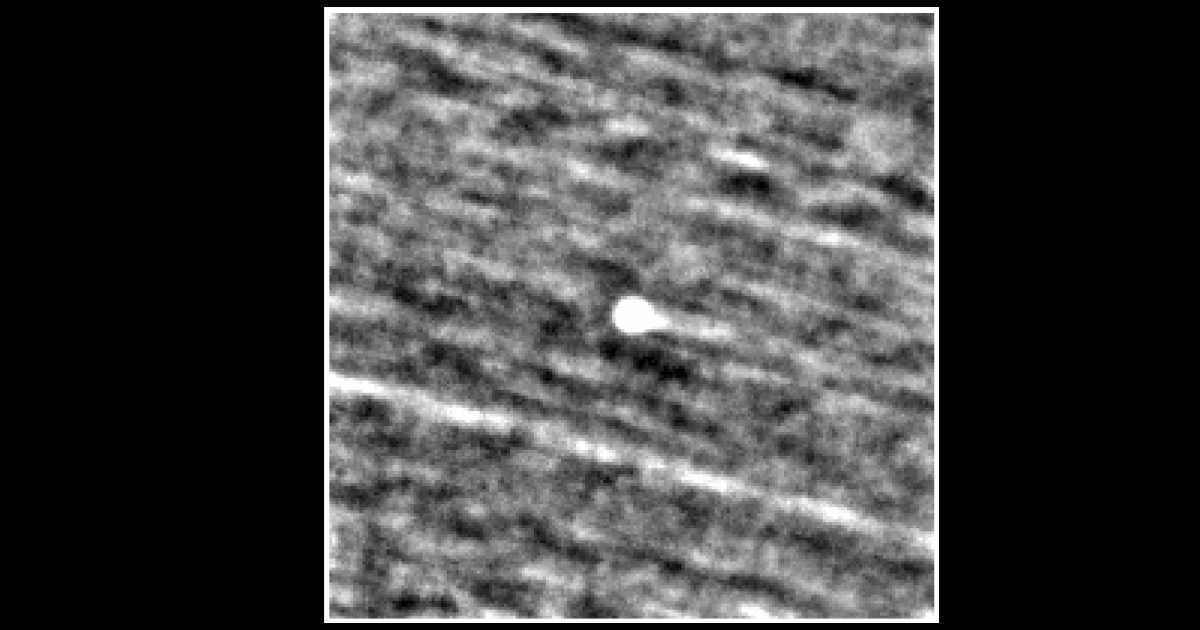
Comet 3I/ATLAS appears as a bright object near the center of this image, made from combining observations from NASA’s PUNCH mission taken from Sept. 20 to Oct. 3, 2025, when the comet was about 231 million to 235 million miles from Earth. Its tail appears as a short elongation to the right. Stars appear as streaks in the background.  (Image Credit:  NASA/Southwest Research Institute)
Comet 3I/ATLAS appears as a bright object near the center of this image, made from combining observations from NASA’s PUNCH mission taken from Sept. 20 to Oct. 3, 2025 (Image Source: NASA/Southwest Research Institute)

Recently, two dedicated amateur astronomers took the sharpest color image yet of the interstellar visitor, comet 3I/ATLAS, using only their backyard equipment. Michael Jäger and Gerald Rhemann used a standard 12-inch telescope and a specialized camera to capture an amazing photo that confirms the object's cometary nature while displaying several peculiarities. 

This image shows a classic comet structure: a bright, characteristic tail and a glowing head, or coma. The tail has a distinctive blue colour because it is formed of ionised carbon monoxide gas that is pointing directly away from the Sun due to solar wind. The green glow of the comet's head originates from diatomic carbon (C2) gas, which is created as the icy nucleus is warmed. But the most puzzling feature is a clear jet of material streaming sunward from the nucleus. Although sunward-pointing features are extremely rare for solar system objects, scientists have an explanation.

Comet 3I/ATLAS streaks across a dense star field in this image captured by the Gemini Multi-Object Spectrograph (GMOS) on Gemini South at Cerro Pachón in Chile (Cover Image Source: International Gemini Observatory/NOIRLab)

They theorize that this comet's centuries-long journey through deep space could have altered its outer crust. This tough, ancient surface is now shedding exceptionally large, heavy dust grains as it heats up near the Sun. These massive grains are too dense to be easily repelled by the pressure of sunlight or the solar wind, and this causes them to form an "anti-tail". This spectacular Earth-based image makes 3I/ATLAS an interstellar comet that is both fascinating and unusual. 

More on Starlust

NASA says 3I/ATLAS is 'not a danger to Earth' after revealing unseen images

Harvard astronomer Avi Loeb criticizes NASA’s big 3I/ATLAS reveal: 'Boring messages'
MORE STORIES

A 'Strawberry Moon' will grace the night sky in June, offering stunning views. Here's what to know.
23 hours ago
While 1997 NC1 isn't a threat, scientists are still keeping an eye. Here's what you need to know.
1 day ago
From dazzling meteor showers and full moons to a rare total solar eclipse, summer 2026 has it all.
2 days ago
Want to watch the Southern Delta Aquariids in 2026? All you need to know about the meteor shower.
5 days ago
The Bootids meteor shower is known for erratic outbursts. Here's all about this year's display.
Jun 18, 2026
The 11%-lit Crescent Moon will hide Venus for about an hour—and it will all happen in broad daylight.
Jun 17, 2026
Viewers from some parts of the world will be able to see a partially eclipsed sunset.
Jun 16, 2026
Based on estimates, the asteroid that resulted in the fireball was no larger than the palm of a hand.
Jun 16, 2026
A total solar eclipse will take place in August this year. Here's everything to know about it.
Jun 11, 2026
In less than 24 hours, the Sun erupted with three powerful solar flares.
Jun 4, 2026