Giant 'jet' of material detected on interstellar object 3I/ATLAS aiming at the Sun

New observations of the interstellar comet 3I/ATLAS appear to confirm that the alien object is emitting a massive jet of material directly toward the Sun, a phenomenon consistent with standard cometary behavior. The image was posted on the transient object monitoring site, The Astronomer's Telegram, on October 15, but has yet to undergo peer review and formal publication.

The composite image, captured on August 2 by the Two-meter Twin Telescope (TTT) at the Teide Observatory in Spain's Canary Islands, combines 159 50-second exposures. According to Live Science, the resulting picture prominently features the icy nucleus of 3I/ATLAS as a dark center surrounded by a bright glow, interrupted by a fan-shaped break that researchers identify as a large, high-velocity jet. This third-ever detected interstellar object, found in late June and confirmed by NASA in early July, originated from a star system outside our own. With an estimated width of 3 to 7 miles (5 to 11 kilometers), 3I/ATLAS is the largest and potentially the oldest interstellar body to cross our path.

While a small contingent of researchers has speculated the object could be an extraterrestrial craft, the overwhelming consensus among scientists is that 3I/ATLAS is a high-speed comet behaving precisely as expected. The new TTT images, which depict this material cannon pointed sunward, further solidify the object's natural origins.
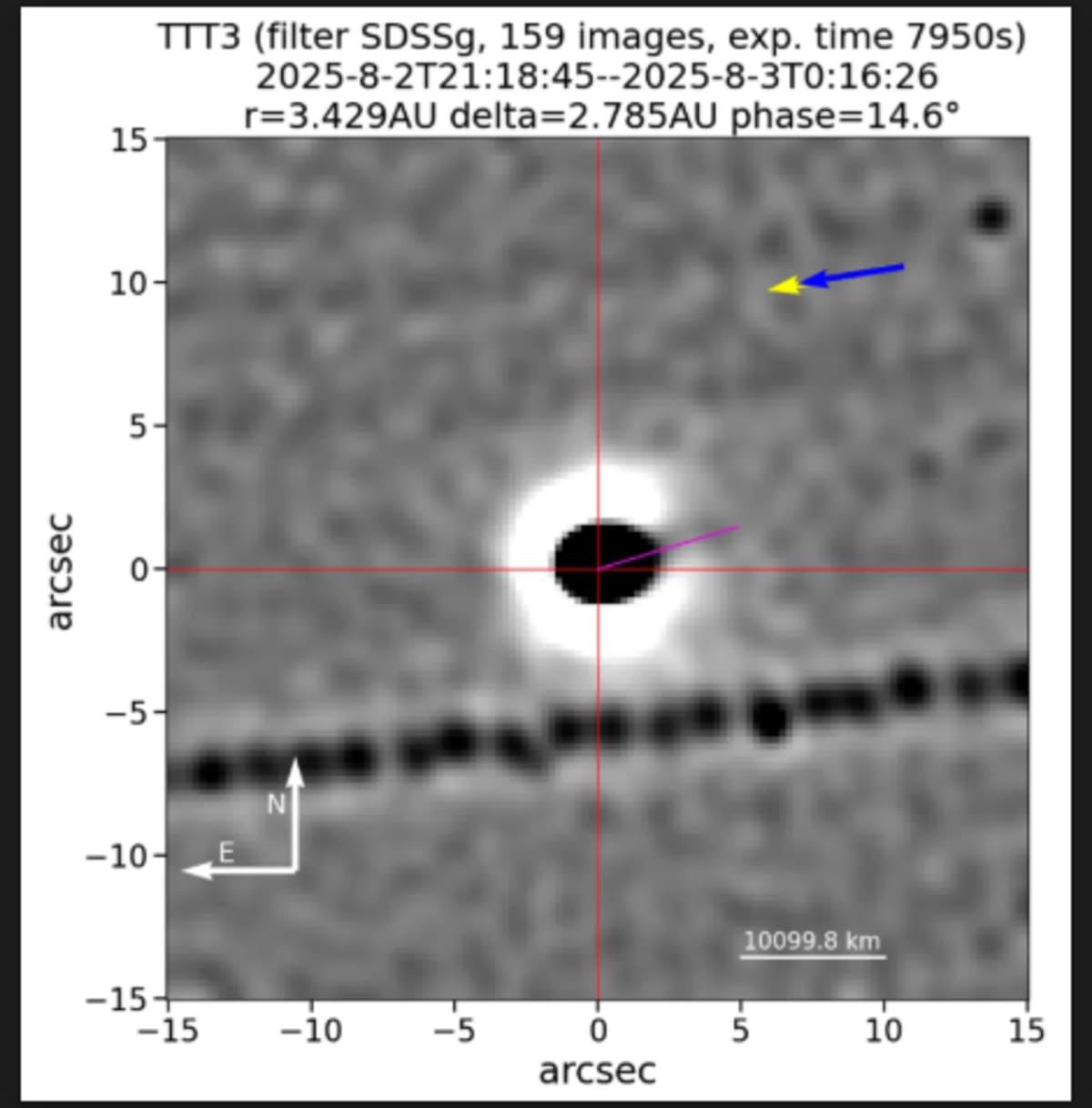
Unlike a comet's expansive, characteristic tail that streams away from the sun, these jets are localized and can point toward it. As astrophysicist Miquel Serra-Ricart, chief science officer at Teide Observatory's Light Bridges research institution, explained, this is "usual." Comets heat unevenly as they approach the sun. If a weak point on the surface heats sufficiently, sublimating gases can erupt like a geyser, propelling cometary matter thousands of miles toward the star. The jet's fan shape, as seen in the TTT image, results from the rotation of the comet's nucleus. Serra-Ricart, who posted the new findings, estimates the jet could stretch approximately 6,200 miles (10,000 km) from the surface of 3I/ATLAS.

The composition is likely dust particles and carbon dioxide, aligning with a large gassy plume detected around the comet by the James Webb Space Telescope in August. 3I/ATLAS passed Mars on October 3 and will reach its closest point to the Sun (perihelion) on October 29. The comet is currently on the far side of the sun. It will become visible again to Earth-based observers in mid-November, offering astronomers a rare opportunity to observe how the mysterious visitor has changed following its close approach.
☄️ #3I/ATLAS comet update!
— European Space Agency (@esa) October 7, 2025
On 3 October, our ExoMars Trace Gas Orbiter (TGO) turned its eyes towards interstellar comet 3I/ATLAS as it passed close to Mars.
Together with Mars Express, ExoMars TGO had the closest view of the comet of all of our spacecraft. It looked towards the… pic.twitter.com/HJE1CeaEwq
The study of interstellar objects, such as 3I/ATLAS, offers a unique window into the material composition and stellar processes of systems far beyond our solar neighborhood. As the comet continues its trajectory, researchers will leverage these rare observations to deepen our understanding of the universe's most distant travelers. Astronomers worldwide will continue to track its progress to glean every possible detail from this mysterious celestial visitor.
More on Starlust
Where is interstellar comet 3I/ATLAS now: Current visibility and position on October 23
Keck Observatory detects rare 'anti-solar tail' on interstellar comet 3I/ATLAS