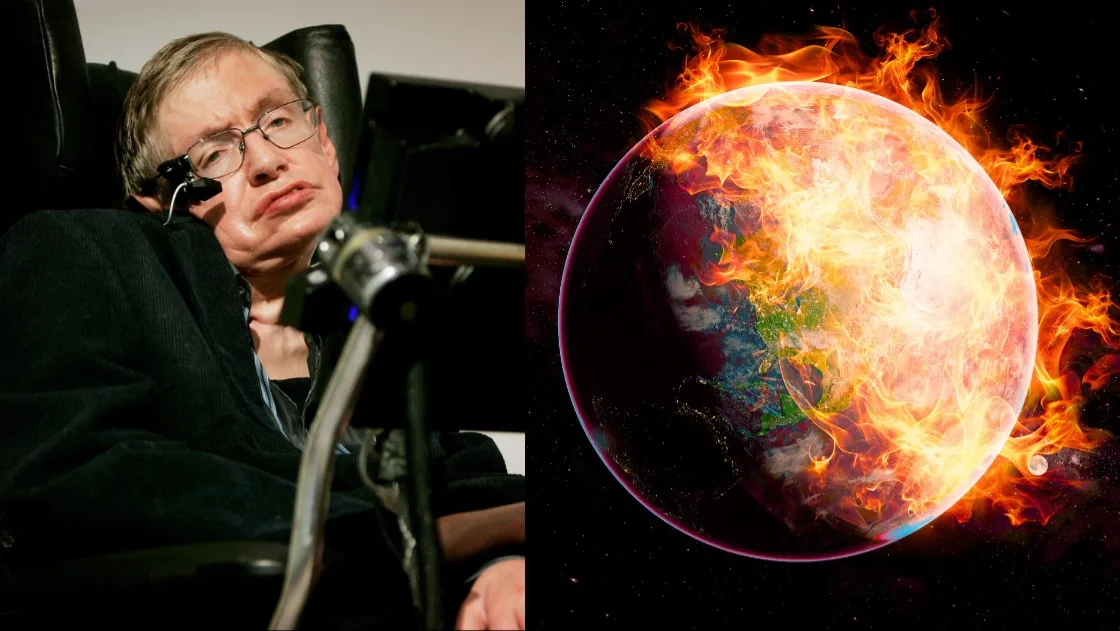
By 2600, Earth could become a "giant ball of fire," Stephen Hawking warned. Is NASA backing it up?
A prediction for the end of the world
Stephen Hawking once warned us that humanity is heading toward a doomsday scenario that may one day leave our only home, Earth, uninhabitable. He shared that our growing population and increasing energy use would be one of the reasons behind this threat. Hawking passed away the following year, and his warning faded with the years, until recently, when it resurfaced online.
So, what exactly did Stephen Hawking say about the future of life on Earth, and what does NASA have to say about it?
'The Earth would glow red-hot'
At the 2017 Tencent WE Summit, Hawking described a future scenario. He shared that Earth’s population has been doubling in the last 40 years, and this “exponential growth cannot continue into the next millennium”. If this continues, our planet will eventually struggle to support us.
He warned that “by the year 2600, the world's population would be standing shoulder to shoulder, and the electricity consumption would make the Earth glow red-hot. This is untenable."
It’s not just overpopulation that we have to worry about
But population growth and energy use were not the only things Hawking was worried about. He also pointed to other potential threats, such as artificial intelligence, genetically engineered viruses, nuclear war, and even the possibility of a major asteroid strike, which should not be completely ignored.
His reasoning, laid out in a 2016 BBC interview, was that the risk of a planetary disaster "adds up over time and becomes a near certainty in the next thousand or 10,000 years." He further told the BBC, “The development of full artificial intelligence could spell the end of the human race.”
What does NASA have to say about this?

Despite what Stephen Hawking has shared, NASA has not backed the “2066” doomsday timeline. When asked directly by Newsweek, the space agency said, "For more than 50 years, NASA has studied our home planet, providing information to directly benefit humanity and producing observations that can only be gathered in space that address some of the areas that Hawking mentioned."
But that doesn’t mean NASA is ignoring the risks humanity faces. NASA's own research has confirmed that greenhouse gases from burning fossil fuels are the main driver of rising global temperatures.
But the climate numbers are catching up anyway
According to the World Health Organization, "climate change is the single greatest health threat facing humanity." Its impacts are already affecting our health in many ways and causing damage that may not be reversible. Some scientists even argue that we may already be experiencing a "sixth mass extinction."
When it comes to climate change, NASA warns that "the effects of human-caused global warming are happening now, are irreversible for people alive today, and will worsen as long as humans add greenhouse gases to the atmosphere." The agency also states that how severe these effects become will depend on the choices humanity makes moving forward. As NASA puts it, "if we can reduce emissions, we may avoid some of the worst effects."