A 'nearly interstellar' object has just been discovered. Harvard astronomer clarifies possible link to comet 3I/ATLAS
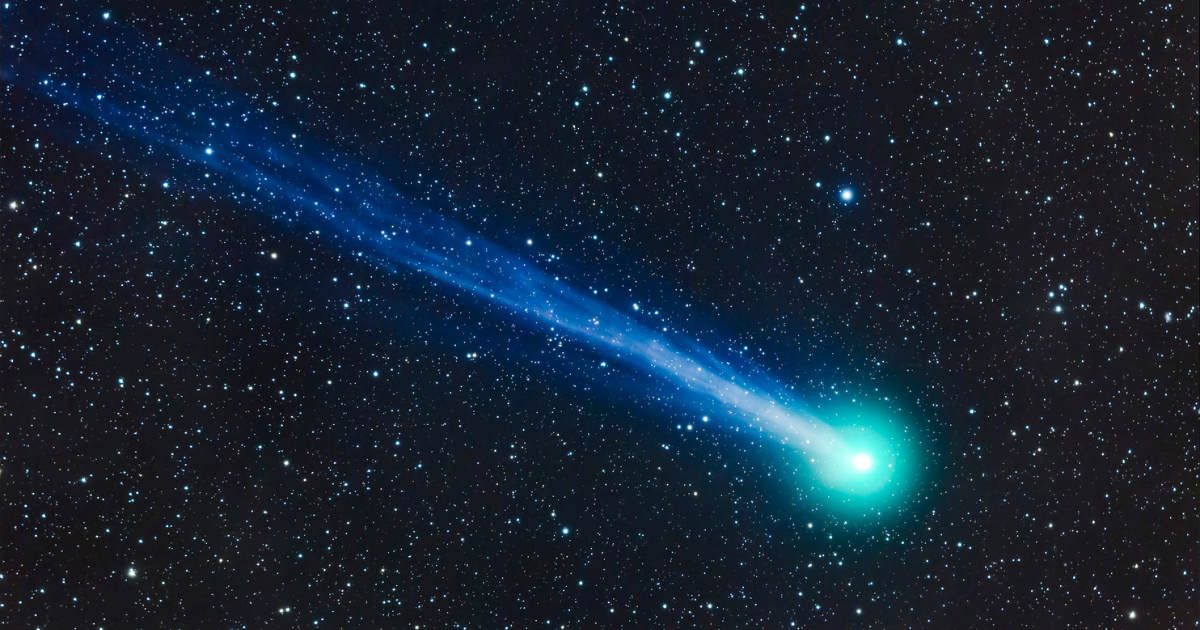
Recently discovered celestial object C/2025 V1 (Borisov), initially labeled as "nearly interstellar" due to its orbital characteristics, is more likely a visitor from our solar system's own Oort Cloud, according to Harvard astronomer Avi Loeb's Medium blog. The object, first identified by Gennady Borisov on November 2, 2025, sparked immediate attention because of its similarity to the enigmatic interstellar object 3I/ATLAS due to the absence of a clear cometary tail.
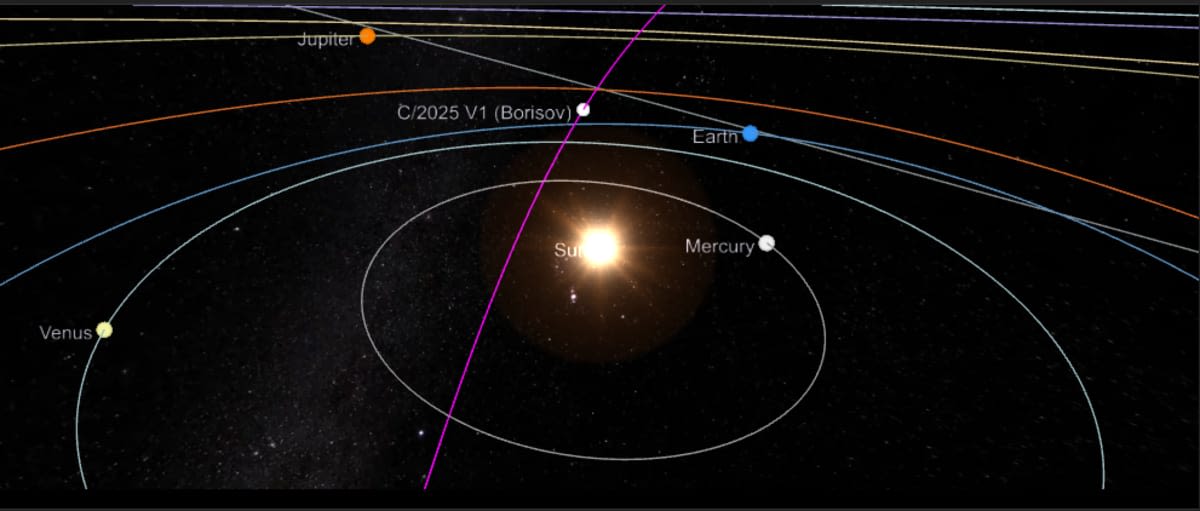
However, in an analysis of the new object's trajectory, Professor Loeb concluded that C/2025 V1 is unlikely to be truly interstellar. According to the data shared by Solar System Dynamics, the comet's orbital eccentricity is 1.0095, a value extremely close to the threshold of 1.0 that defines an unbound object. However, Loeb's research suggests that when traced back beyond the influence of the planets, C/2025 V1’s eccentricity would likely drop below 1.0, indicating an origin in the far-flung Oort Cloud. Unmodeled outgassing could also push the eccentricity to below 1.0.
BREAKING🚨: Astronomers have detected a mysterious new object C/2025 V1 Borisov, moving between 3IATLAS and Earth with no tail pic.twitter.com/3mKeuh5N6F
— All day Astronomy (@forallcurious) November 7, 2025
Loeb also addressed the fundamental question of whether C/2025 V1 could be linked to 3I/ATLAS, which some speculate could be a technological 'mothership' that released smaller probes. "C/2025 V1 is not related to 3I/ATLAS if it did not employ non-gravitational propulsion," Loeb Stated. The two objects' orbits are separated by a minimum of 75 million kilometers or 46.6 million miles (0.5 AU), and they never came closer than 225 million kilometers or 139.8 million miles (1.5 AU) without additional thrust. The measured non-gravitational acceleration of 3I/ATLAS is insufficient to bridge this distance.
![Hubble captured this image of the interstellar comet 3I/ATLAS on July 21, 2025, when the comet was 277 million miles from Earth. [Image Source: NASA, ESA, David Jewitt (UCLA); Image Processing: Joseph DePasquale (STScI)]](https://de40cj7fpezr7.cloudfront.net/c49eeb4e-e60a-46c0-b39f-68fbb2ee9297.jpeg)
Loeb emphasized that the composition, outflow velocity, and mass flux of 3I/ATLAS's jets can be easily measured as the object nears Earth on December 19, 2025. This close approach offers a critical opportunity to spectroscopically determine whether the interstellar visitor is a natural celestial body or a technologically propelled object.
Comet C/2025 V1's closest approach to Earth
While the comet's scientific significance is high, its current brightness puts it far out of reach for casual observation, per Sky Live. C/2025 V1 (Borisov) is currently located in the constellation Virgo, about 103.3 million kilometers from Earth (64.2 million miles). Its closest approach to our planet is projected to occur on Tuesday, November 11, 2025, at a distance of about 103.11 million kilometers or 64 million miles (0.68 AU).
Is it visible in the night sky?
The comet's current faintness means it is not visible to the unaided eye. Objects must be magnitude 6.5 or brighter to be potentially seen without optical aid under ideal, dark-sky conditions. A magnitude of 14.2 requires observers to use a telescope and a good, dark observing site to successfully track the object.

Impact safety confirmed
The latest orbit calculation, based on 99 observations collected over seven days, gives high confidence in the comet's path, according to Solar System Dynamics. The comet's Minimum Orbit Intersection Distance (MOID) with Earth is calculated at 0.396 AU. This is a considerable distance; for comparison, Mars at its closest approach is about 0.5 AU from Earth, and indicates no immediate risk of an impact.
More on Starlust
Here's how you can follow the journey of interstellar comet 3I/ATLAS this week
Comet 3I/ATLAS is in the Virgo constellation—here's how you can locate it