Rare twin quasars caught merging in early universe—they are connected by a cosmic gas bridge
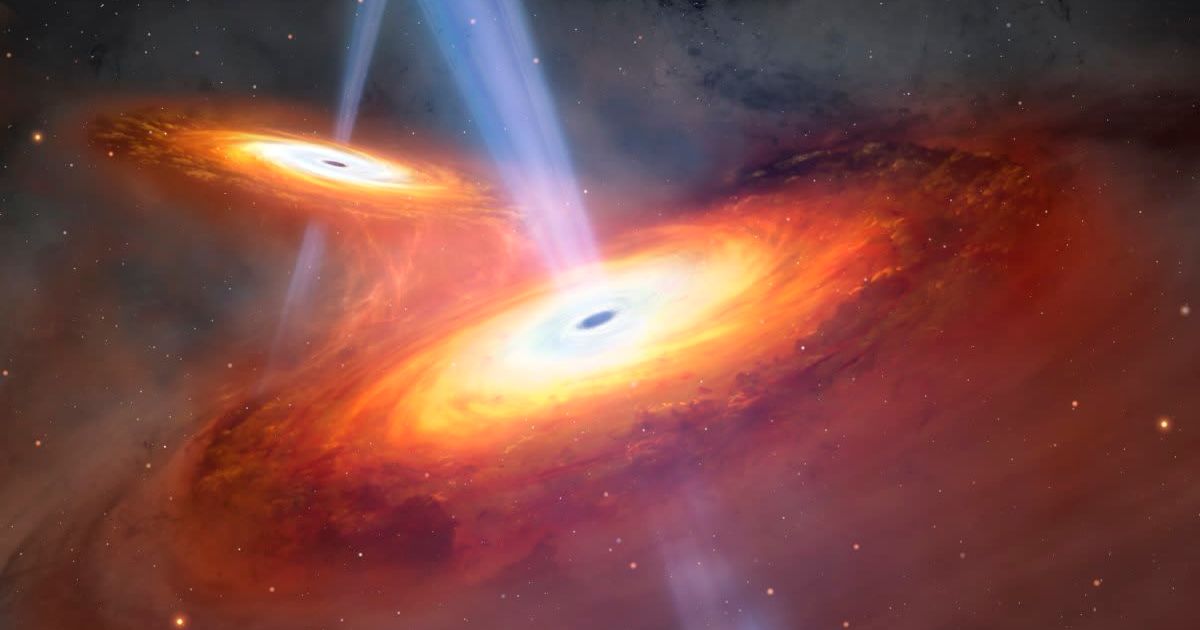
Rare twin quasars discovered merging in the early universe, revealing a galaxy collision and shared gas fueling supermassive black holes.
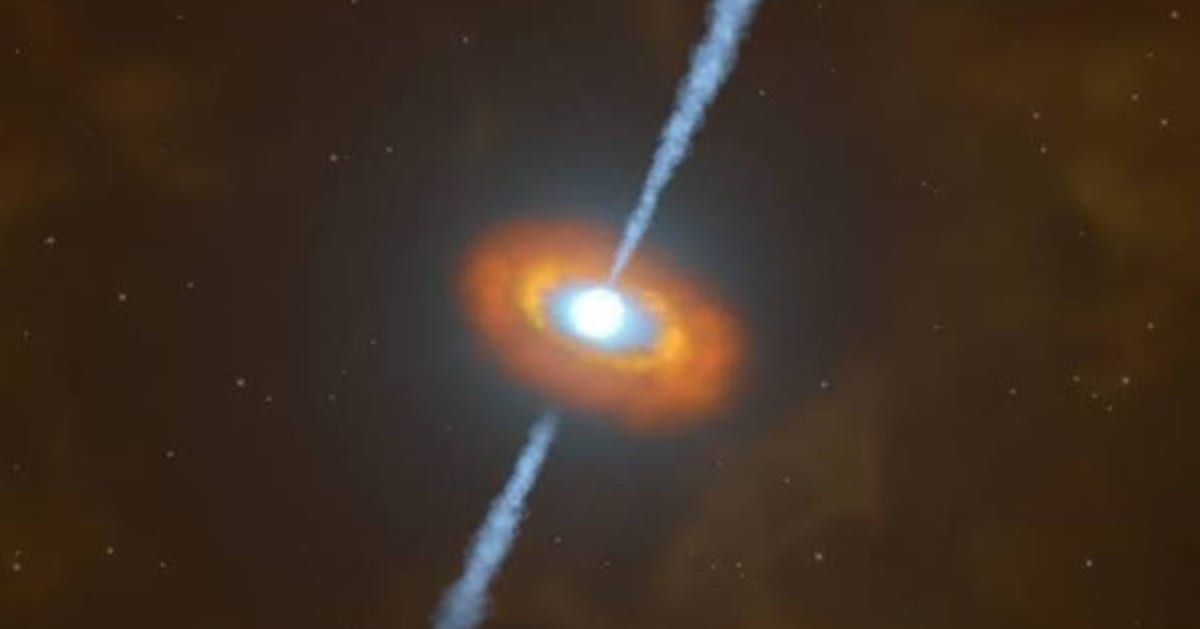
From a NOIRLab press release, for which this image was commissioned. The scene depicts quasars that are poised to merge, after their respective host galaxies have collided. (Cover Image Source: MARK GARLICK/SCIENCE PHOTO LIBRARY)

Astronomers have identified a rare cosmic event in a recent study. A team led by Minghao Yue submitted their observations on the arXiv of Cornell University. The team studied how two quasars shine side by side as their host galaxies merge in the early universe. Quasars are extremely bright cores of galaxies that belong to the family of active galactic nuclei (AGN). These quasars mainly receive energy from supermassive black holes

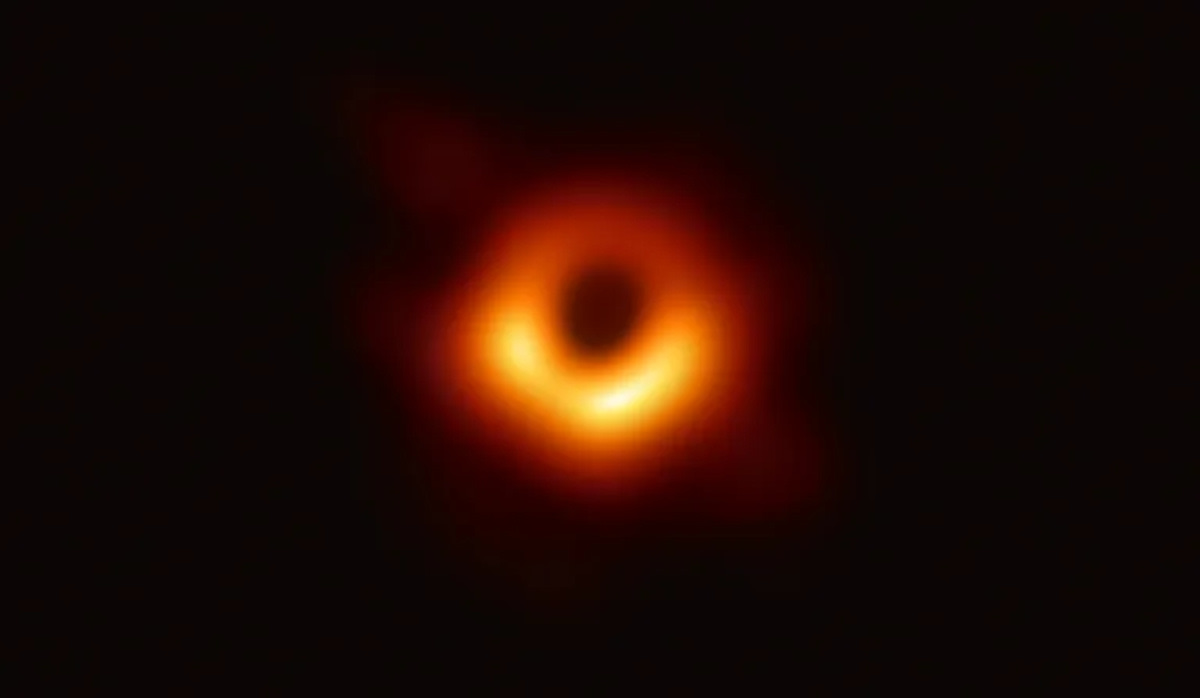
The first picture of a black hole was made using observations of the center of galaxy M87 taken by the Event Horizon Telescope (Image Source: NASA)
The first picture of a black hole was made using observations of the center of galaxy M87 taken by the Event Horizon Telescope (Representative Image Source: NASA)

The team used ALMA observations [Atacama Large Millimeter/submillimeter Array] to confirm that J2037–4537 is a genuine and closer quasar pair, which in all probability originated back when the universe was less than a billion years old. One of the primary catalysts behind the process of quasar formation is galaxy mergers, as those collisions funnel gas towards galactic centers. Quasars form from black holes, but they become active when large amounts of gas fall into them, releasing energy. However, it is extremely rare to spot two blazing quasars together in a single merging system. J2037–4537 are simultaneously active within a single merging system. 
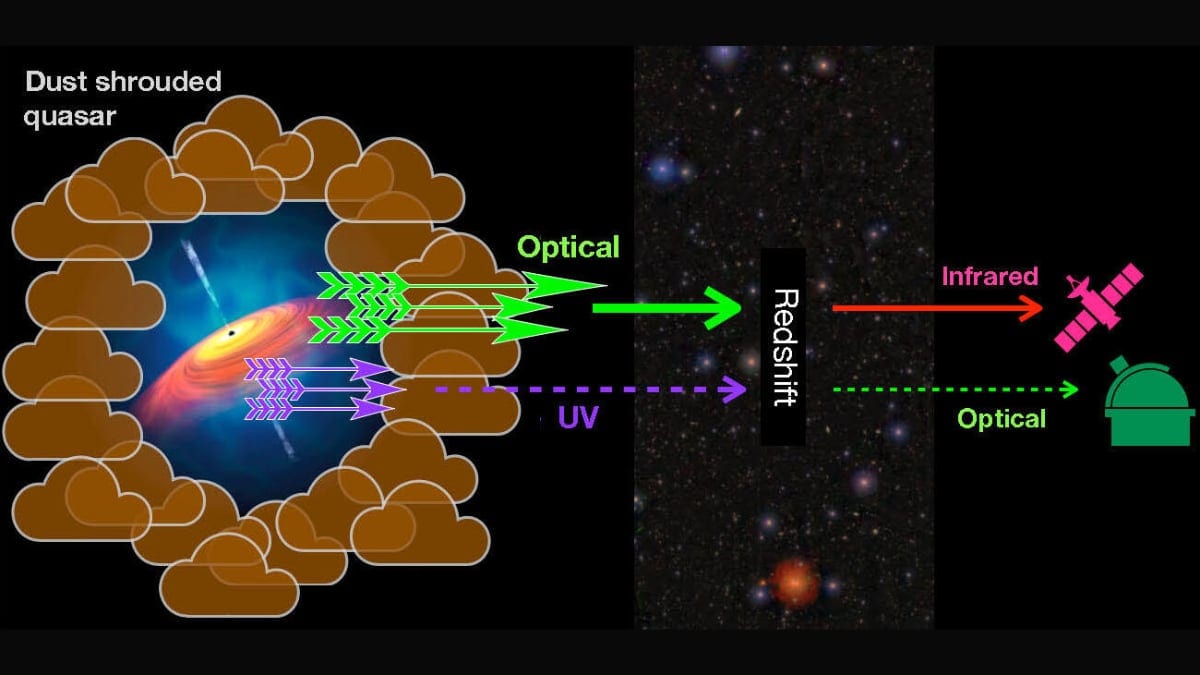
Schematic diagram showing how a quasar hidden by dust is observed. Light from a quasar in the early Universe is stretched by cosmic redshift, so ultraviolet light reaches Earth as visible light and visible light reaches Earth as infrared. When a quasar is covered by dust, ultraviolet light is absorbed and cannot escape, but infrared observations can capture the visible light that passes through the dust. Detecting such faint infrared light from early quasars required observations with JWST. (Credit: Yoshiki Matsuoka/NAOJ)
Schematic diagram showing how a quasar hidden by dust is observed. Light from a quasar in the early Universe is stretched by cosmic redshift, so ultraviolet light reaches Earth as visible light and visible light reaches Earth as infrared. When a quasar is covered by dust, ultraviolet light is absorbed and cannot escape, but infrared observations can capture the visible light that passes through the dust. Detecting such faint infrared light from early quasars required observations with JWST. (Representative Image Source: Yoshiki Matsuoka/NAOJ)

Back in 2021, J2037-4537 was flagged as a closer quasar pair. They were recognized as two objects with a redshift of z = 5.7. But the system’s true nature remained uncertain due to the possibility of gravitational lensing, where one quasar appears as two images. Now, new studies have confirmed that both sources are distinct.
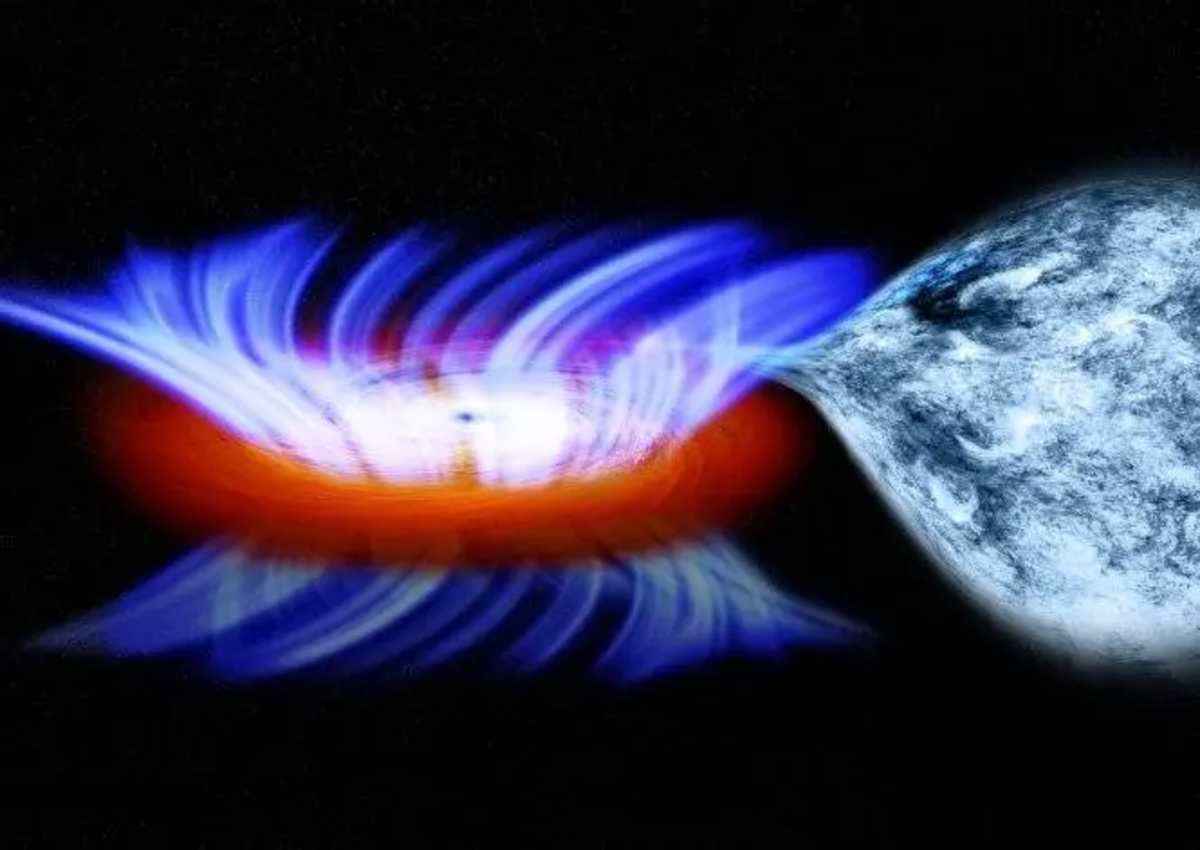
This artist's impression shows a binary system containing a stellar-mass black hole called IGR J17091-3624. (Representative Image Source: NASA/CXC/M.Weiss)

Minghao Yue of the University of Arizona and team resorted to ALMA, studied high-resolution observations, and confirmed the new update about them being distinct sources, although they are physically connected. When the researchers mapped the ionized carbon emission lines, they found traces of cold star-forming gas extending between two objects around J2037-4537. The gas formed a bridge of gravitational pull between the two. That pull, in turn, dragged materials out of each other, stabilizing the bridge. This bridge-like structure further confirmed that they are two different quasars.
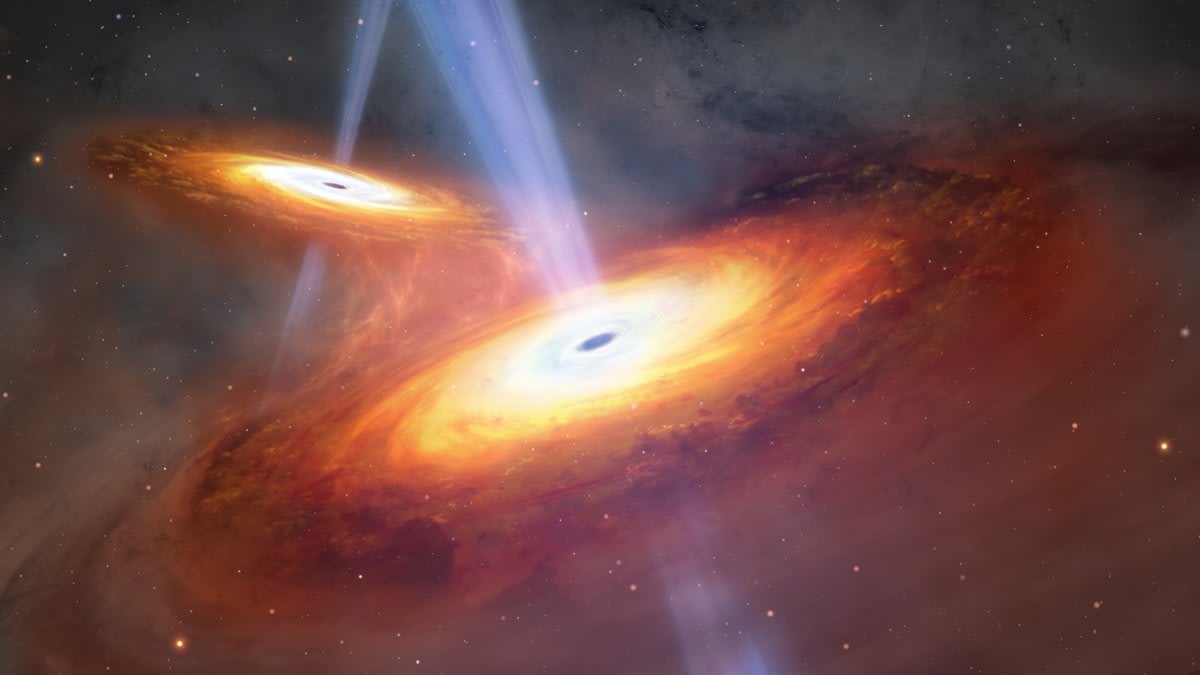
From a NOIRLab press release, for which this image was commissioned. The scene depicts quasars that are poised to merge, after their respective host galaxies have collided. (Cover Image Source: MARK GARLICK/SCIENCE PHOTO LIBRARY)
From a NOIRLab press release, for which this image was commissioned. The scene depicts quasars that are poised to merge, after their respective host galaxies have collided. (Representative Image Source: MARK GARLICK/SCIENCE PHOTO LIBRARY)

In the paper, the team reflected on their study and stated, "The dust continuum and [CII] line emissions clearly reveal the tidal bridge between the two quasars.” Following such a revelation, J2037–4537 is now one of only two confirmed quasar pairs at z > 5 ever found. Scientists have also found that the galaxies that host the quasars are huge star-forming galaxies with a dynamical mass of at least 10 billion solar masses. Researchers have also predicted that J2037–4537 would take about 2.1 billion years to transition into a supermassive black hole from quasars.

The best-fit lensing model for the continuum and [C ii] line emission. (Image Credits: arXiv:2604.06504v1 [astro-ph.GA] 07 Apr 2026)
The best-fit lensing model for the continuum and [C ii] line emission. (Image Source: arXiv)

The Quasars are powered by huge black holes, so when two such galaxies merge, their black holes slowly spiral toward each other, creating low-frequency gravitational waves in space. These waves are detected by scientists using Pulsar Timing Arrays (PTAs). In recent studies, a stronger background “hum” of gravitational waves has been found by PTAs. This hints that there might be more merging black hole pairs than previously thought. And studies about systems like J2037–4537 could help scientists explore this phenomenon in a better way.

More on Starlust

Accidental double zooming pinpoints unexpected millimeter waves near supermassive black hole's core

Solving the mystery of 'little red dots' in early universe, scientists discover a new class of black hole stars

JWST observes distant galaxy revealing evidence of first stars forged after the Big Bang
MORE STORIES

The properties of faint dwarf galaxies around the Milky Way can reveal a lot about the conditions of the early universe, the same way crop yields can tell a lot about spring weather.
1 hour ago
New laser-assisted technique may one day replace fuel-driven rocket propulsion
4 days ago
The new findings boost evidence that the Red Planet once had conditions suitable for life.
4 days ago
The older stars migrated out from the galactic center, leaving the younger ones inside.
5 days ago
TOI-201 is one of the few systems whose changes can be observed by humans in real time.
5 days ago
It can also make leather-like materials and building blocks for a Martian house.
6 days ago
The new image of the Trifid Nebula marks the 36th anniversary of NASA's Hubble Space Telescope.
6 days ago
“In the inner corona, a region very difficult to observe, we saw slow solar wind gusts moving three to four times faster than expected.”
Apr 17, 2026
“When we realised that Juice would be close to the comet around its closest approach to the Sun, we realised what a unique opportunity this was to collect a once-in-a-lifetime dataset.”
Apr 16, 2026