Over 1,000 radio galaxies with 'wings' identified amid mystery behind formation
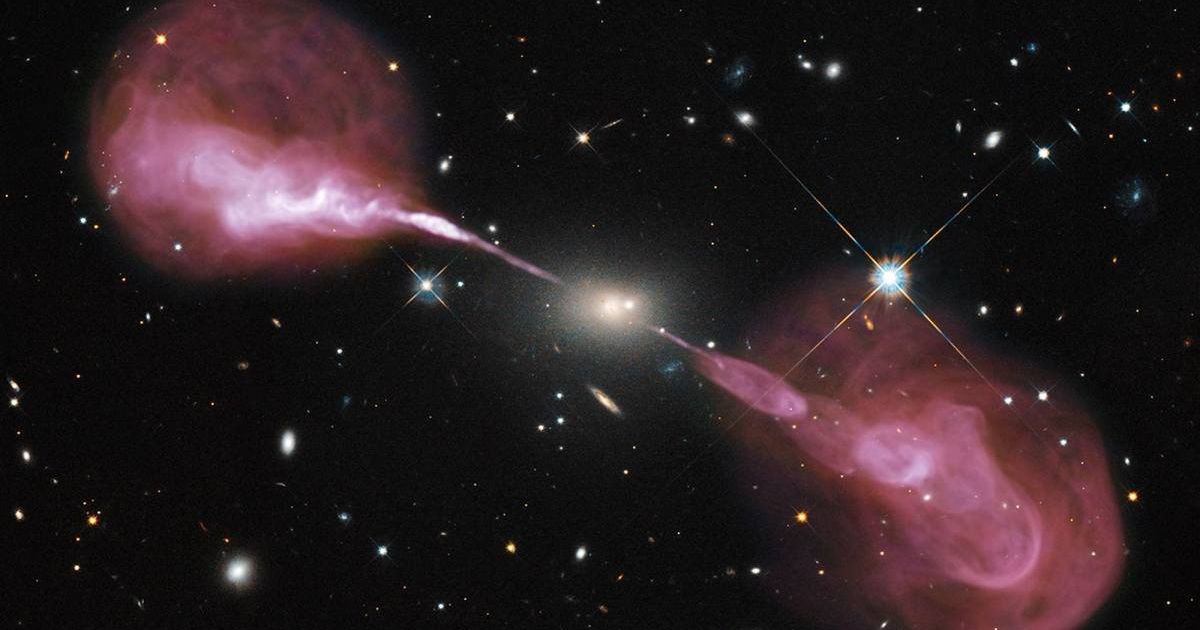
The discovery of over 1,000 winged radio galaxies vastly expands the current catalog.
An image showing radio galaxy Hercules A. (Image Source: NASA, ESA, S. Baum and C. O'Dea (RIT), R. Perley and W. Cotton (NRAO/AUI/NSF), and the Hubble Heritage Team (STScI/AURA))

Astronomers have uncovered over 1,000 "winged" confirmed radio galaxies and candidates in a recent survey, vastly expanding the catalogue of these elusive cosmic objects and providing scientists with a significant dataset to solve the mystery of how they are formed.
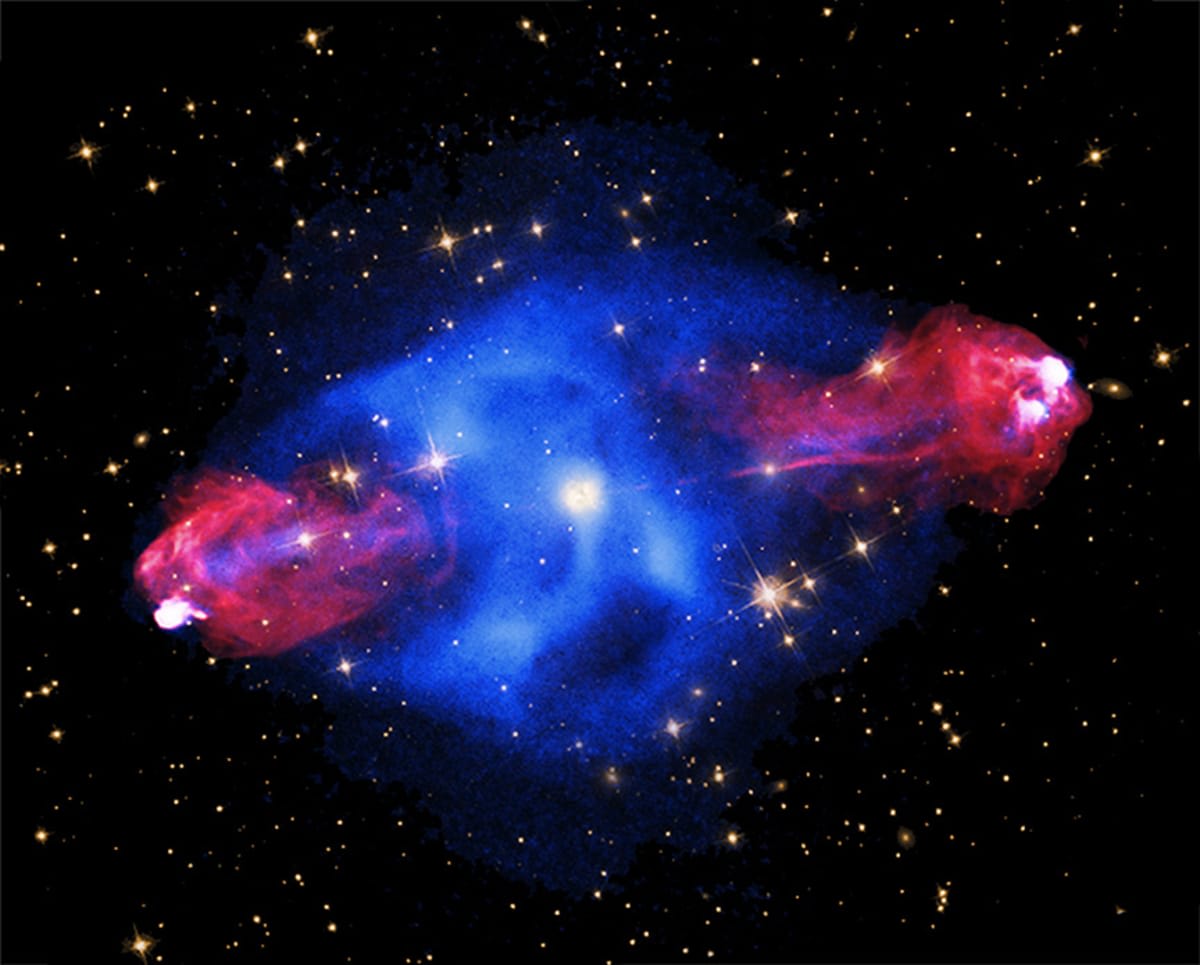
Cygnus A
(X-arithmetic) credit to - X-ray: NASA/CXC/Univ. of Chicago/H. McCall
Image showing Cygnus A, a powerful radio galaxy. (Image Source: NASA/CXC/Univ. of Chicago/H. McCall)

What are radio galaxies?

While most large galaxies have supermassive black holes at their center, radio galaxies are characterized by giant twin lobes of emission that extend far beyond the usual galactic structure. These lobes form when these supermassive blackholes violent eject twin jets of plasma as they consume surrounding matter.
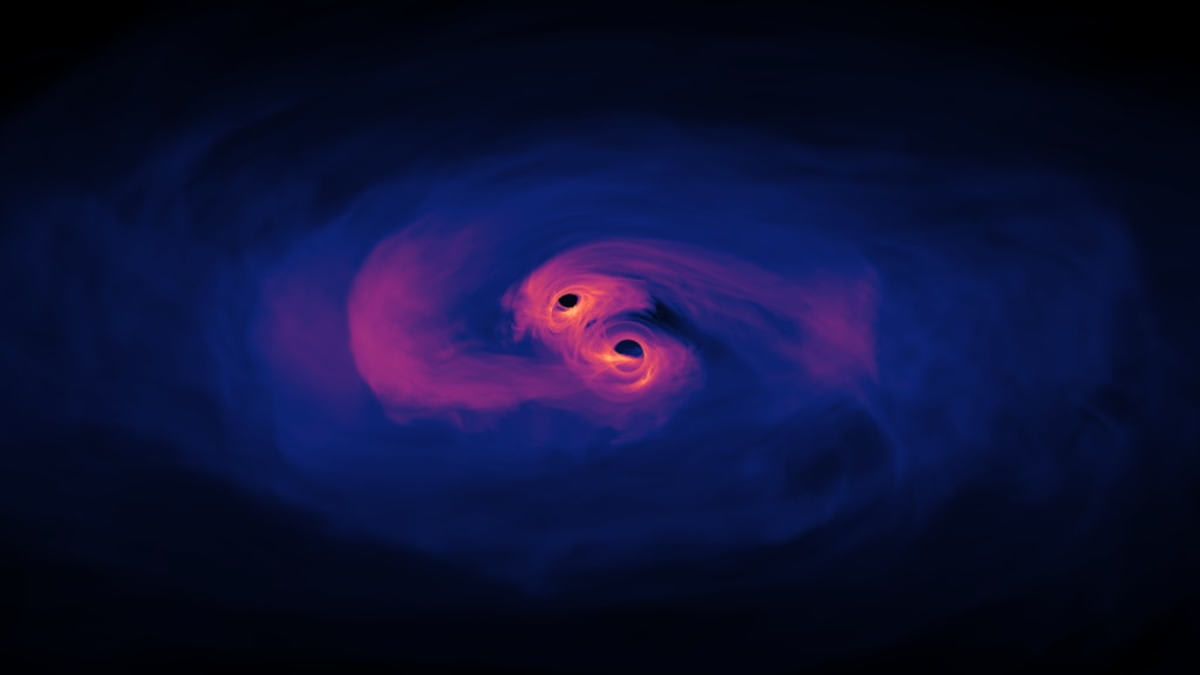
Simulation of the light emitted by a supermassive black hole binary system where the surrounding gas is optically thin (transparent) (Image Source: NASA's Goddard Space Flight Center | Scott Noble)
Simulation of the light emitted by a supermassive black hole binary system where the surrounding gas is optically thin (transparent) (Image Source: NASA's
 Goddard Space Flight Center | Scott Noble)

Winged radio galaxies, meanwhile, contain an extra pair of secondary emission lobes that give them the so-called 'wings.' Depending on how these secondary lobes shoot out from the black hole, they form distinct shapes in the cosmos, taking up X- or Z-like patterns. For the former, the secondary lobes seem to emerge outward directly from the center, while for the latter, the wings spill out from the outer edges of the primary jets.

The study's findings

Using data from the LOFAR Two-meter Sky Survey Data Release 2 (LOTSS DR2), researchers led by Soumen Kumar Bera from Xiamen University, China, announced the discovery of 621 newly confirmed winged radio galaxies, along with 403 strong candidates, noting that their identification rate was approximately three times higher than that of previous such studies. 
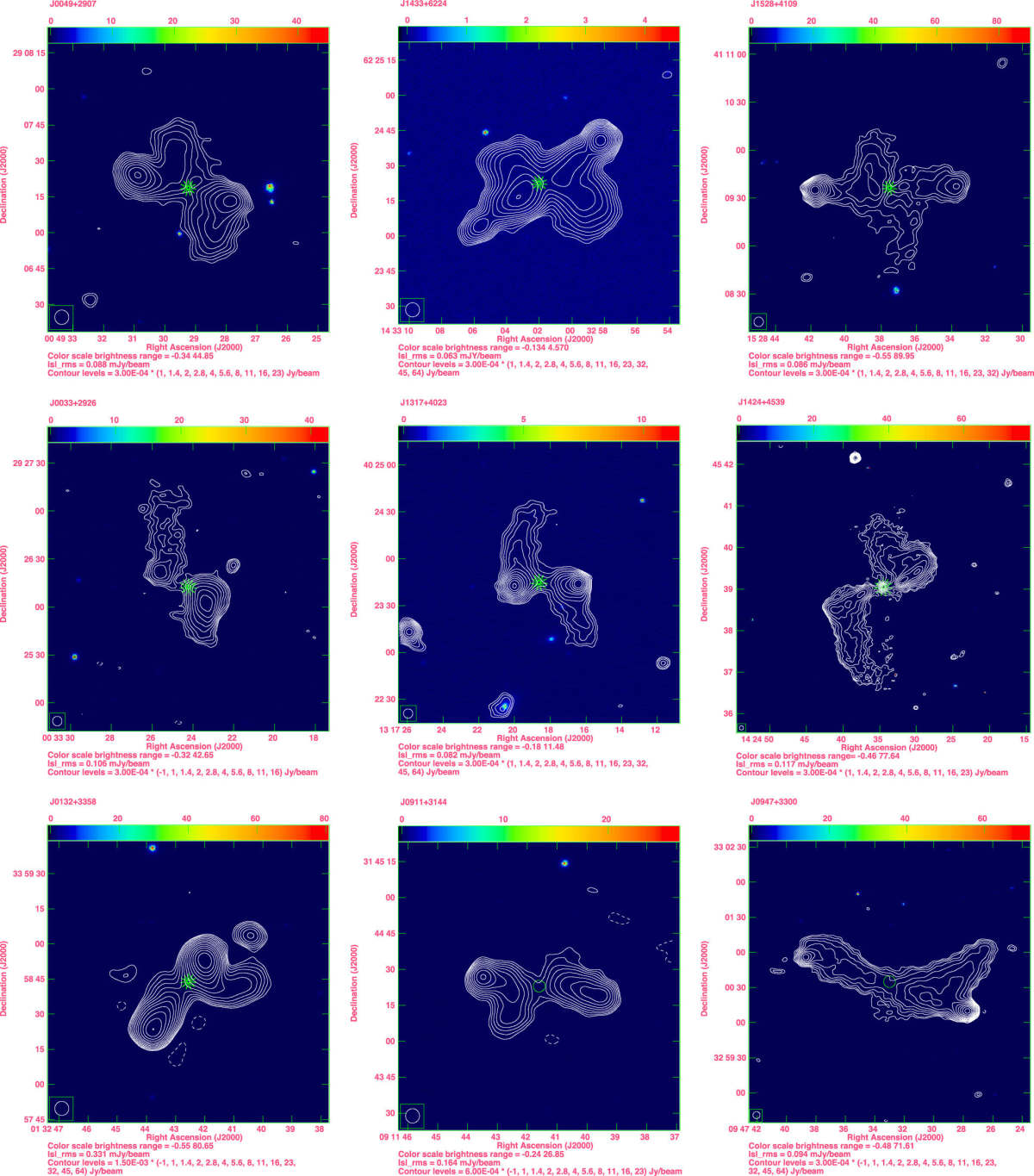
Three X-shaped radio galaxies (top panel), three Z-shaped radio galaxies (middle panel), and three candidates for winged sources (bottom panel). Image Credit: arXiv (2026). DOI: 10.48550/arxiv.2604.22347

Contributing to the extant catalogue, the study found that of the 621 confirmed radio galaxies, 382 were X-shaped radio galaxies (XRGs). The remaining 289 were classified as Z-shaped radio galaxies (ZRGs). Additionally, the researchers noted that 16% of their winged sources exceeded 0.7 megaparsecs, making them candidates for giant radio galaxies (GRGs).

The mystery behind the wings

The origins of the strange butterfly-like structures seen in winged radio galaxies are heavily debated, but astronomers have some leading theories. The most popular is the "backflow" model: as the black hole's plasma jets slam into surrounding cosmic material, the pressure forces the plasma to splash backward toward the galaxy's center, forming wings. 
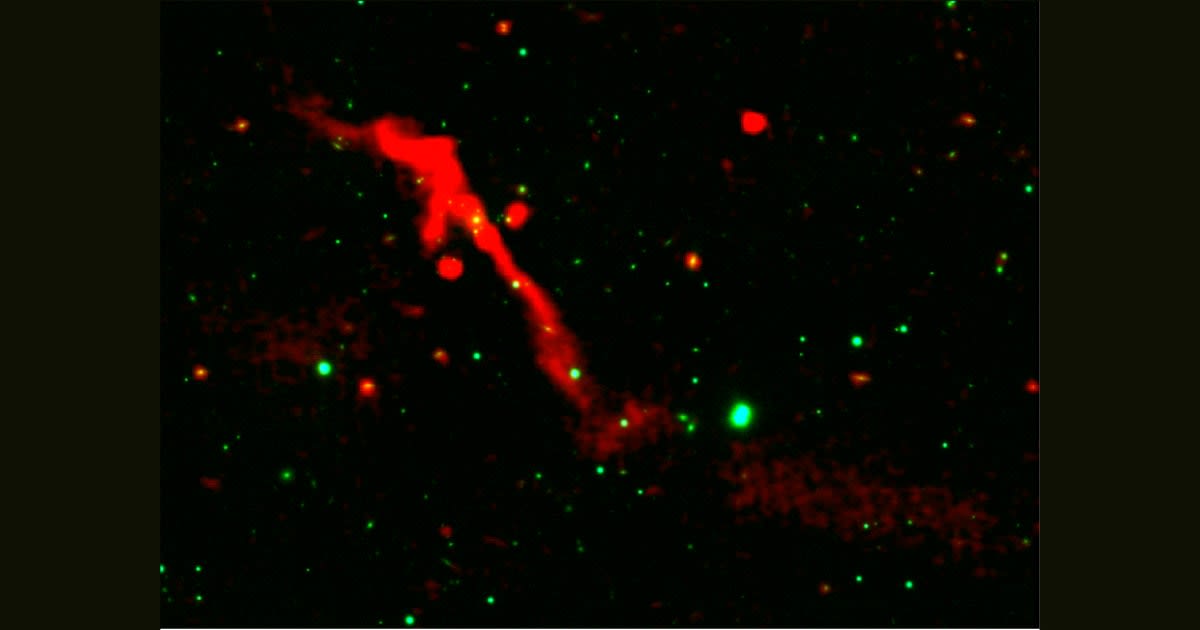
This LOFAR DR2 image of J1007+3540 superimposed over an optical image by Pan-STARRS shows a compact, bright inner jet, indicating the reawakening of what had been a ‘sleeping’ supermassive black hole at the heart of the gigantic radio galaxy.

Another leading theory suggests a more violent origin: a galaxy merger. If two supermassive black holes collide and merge, the resulting black hole might abruptly tilt, causing its jets to fire in an entirely new direction, leaving the old jets behind as 'fossil' wings.

More on Starlust:

Andromeda is headed toward the Milky Way, while other galaxies are moving away—and now we know why
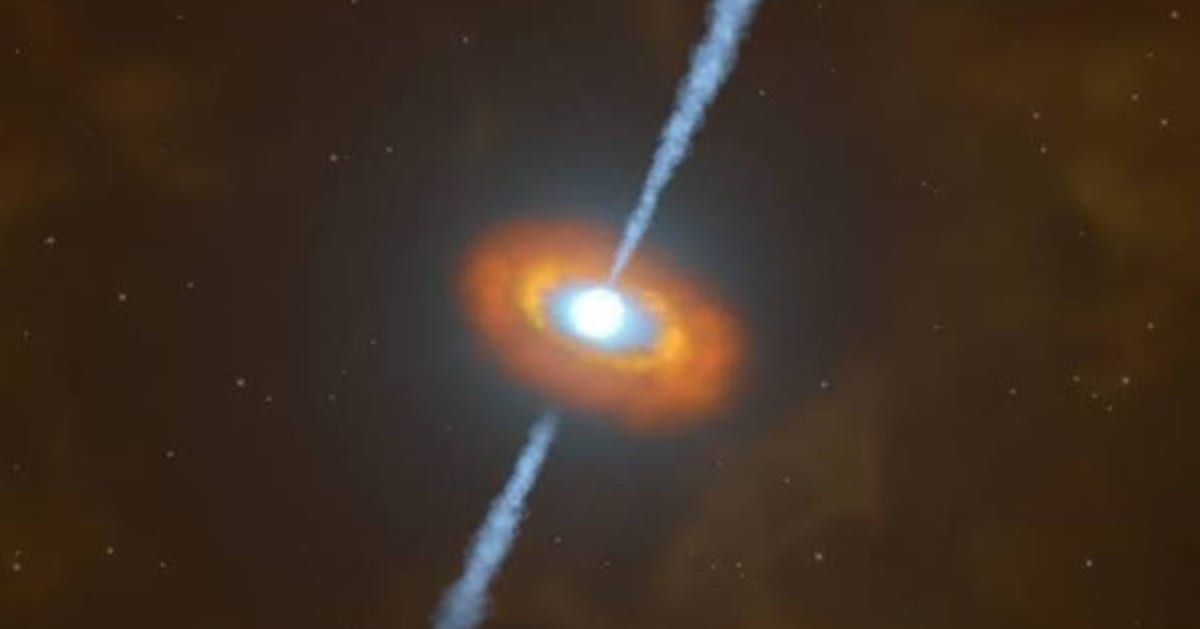
Astronomers stunned as JWST just spotted a 'Big Red Dot', a supermassive black hole devouring the early universe

MORE STORIES

The discovered galaxy reached a state of non-rotation when the universe was less than 2 billion years old.
3 hours ago
NASA's Chandra has discovered an X-ray dot, which is tiny, red, and located at a distance of 11.8 billion light-years but also glows in X-ray, unlike the mysterious little red dots.
5 days ago
The interaction between the internal rotation and magnetic fields retards or speeds up the spin rate.
5 days ago
Stellar winds blowing away from a nearby binary star probably form the gas clouds.
Apr 27, 2026
The properties of faint dwarf galaxies around the Milky Way can reveal a lot about the conditions of the early universe, the same way crop yields can tell a lot about spring weather.
Apr 27, 2026
Rare twin quasars discovered merging in the early universe, revealing a galaxy collision and shared gas fueling supermassive black holes.
Apr 27, 2026
New laser-assisted technique may one day replace fuel-driven rocket propulsion
Apr 23, 2026
The new findings boost evidence that the Red Planet once had conditions suitable for life.
Apr 22, 2026
The older stars migrated out from the galactic center, leaving the younger ones inside.
Apr 22, 2026
TOI-201 is one of the few systems whose changes can be observed by humans in real time.
Apr 22, 2026