Vera C. Rubin Observatory may have discovered one of the largest dwarf planets hidden beyond Pluto

The International Astronomical Union Minor Planet Center (MPC) announced on Tuesday that the Vera C. Rubin Observatory has discovered a potential dwarf planet beyond the orbit of Pluto. This object, temporarily named 2026 ED138 (ED138), measures between 372 and 932 miles wide (600-1500 km) and lies about 46 astronomical units away from Earth [1 AU is the distance between Earth and the Sun]. ED138 has been classified as a trans-Neptunian object, or TNO, which are objects that orbit the Sun at a greater distance than Neptune. Moreover, preliminary analysis indicates it could be among the largest dwarf planets discovered in this particular region of the solar system. If confirmed, ED138 will join Pluto, Ceres, Eris, Haumea, and Makemake on the list of dwarf planets recognized by the International Astronomical Union.
Meet our Solar System's newest dwarf planet candidate: 2026 ED138! Orbiting past Pluto, scientists found it in NSF–DOE Rubin Observatory data from earlier in 2026. Early analysis suggests it's 600–1500 km across, one of the largest found past Neptune! 🔗 https://t.co/wTOg898zBu https://t.co/hEgnk597rl
— NSF-DOE Rubin Observatory (@VRubinObs) October 27, 2026
An object is called a dwarf planet when it fulfills three conditions—it orbits a host star, it is mostly round, and it is big enough for its gravity to clear away any other objects near it. Initial observations, based on brightness and estimated surface reflectivity, suggest that ED138 must be round because icy bodies similar to its size normally are. Scientists also found that its orbit is almost 25 degrees off the solar system’s plane—it may have happened due to disturbance caused by gravitational interactions with Neptune. TNOs are of great interest because their size, composition, and orbital trajectories could provide insights into the formation of the solar system, the migration of giant planets, and scattering of smaller objects over time.
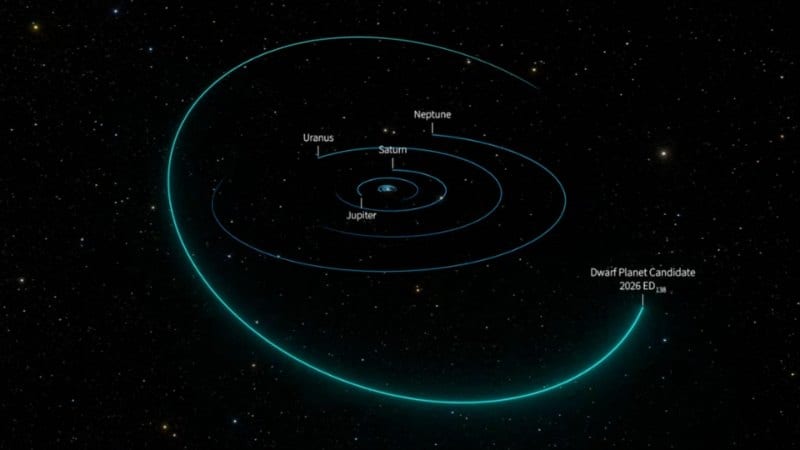
While there’s an estimate of ED138’s size, follow-up observations in infrared is needed to determine how big it actually is and confirm whether it’s indeed a dwarf planet. According to the Rubin Observatory, this object was found in a crowded region with millions of stars close to the plane of the Milky Way. This possible dwarf planet was hidden for so long because, to most telescopes, it got lost in a sea of stars. But with Rubin Observatory’s powerful algorithms, scientists were able to track this moving object through millions of points of light. These observations were carried out between March 4 and July 11—during this period, the observatory tracked ED138 30 times on 20 nights.

Matthew Holman from the Center for Astrophysics | Harvard & Smithsonian [CfA], who is working to improve Rubin's algorithms that search for distant moving objects and the one who found ED138 said in a statement—“My first reaction was one of excited disbelief. Objects like this are very rare, so I immediately started checking whether I or the code had done something wrong.”
Interestingly, Rubin provides scientists the luxury to find the object it has discovered in pictures taken decades ago. “Once we identify a new object, we can search back months, and sometimes even decades, finding it in images where nobody knew to look,” said Mario Jurić, faculty at the University of Washington and Rubin Solar System Lead Scientist. “This ability to both discover and ‘precover’ objects is transforming how quickly and accurately we can determine their orbits and understand the distant Solar System.” The Rubin Observatory, using the world’s largest 3200-megapixel camera, is conducting a Legacy Survey of Space and Time (LSST) to map the entire southern sky for 10 years. Its objective is to create a high-resolution time-lapse of the universe to reveal hidden secrets of the solar system, the Milky Way, and even the dark universe.
More on Starlust
Scientists just found a bizarre new form of ice that could explain what’s inside Uranus and Neptune