Rubin Observatory begins 10-year survey to create the 'greatest cosmic movie ever'
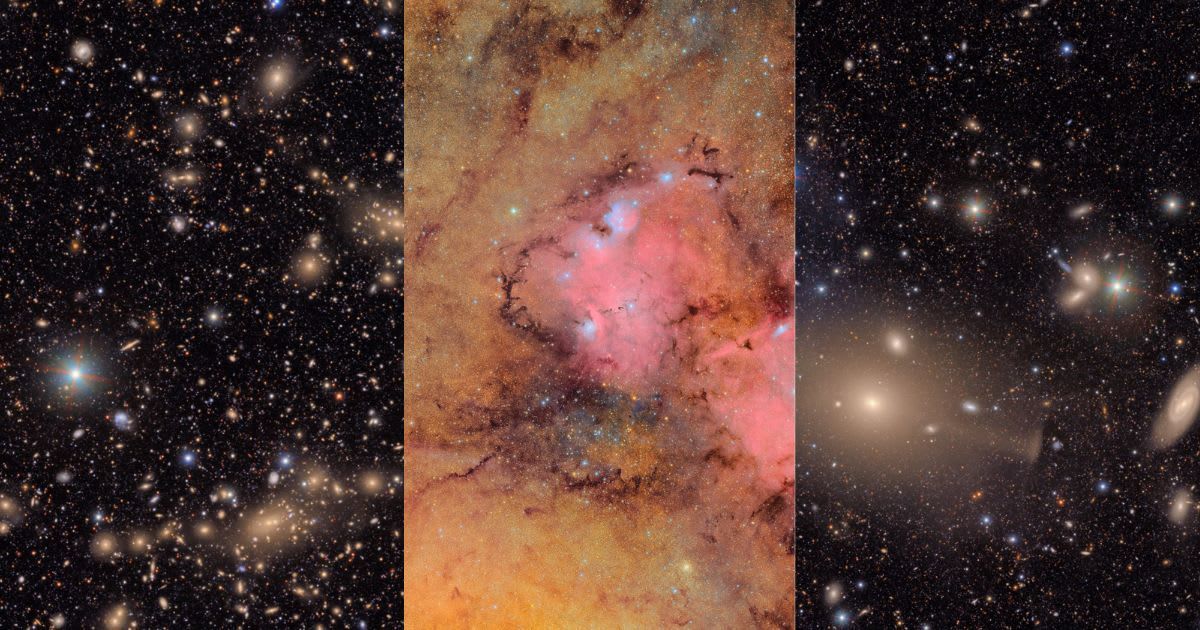
Located on a mountaintop in Chile, the Vera C. Rubin Observatory began a 10-year-long project called the Legacy Survey of Space and Time (or LSST) on June 29 to record what's being called the “greatest cosmic movie ever.” Instead of pointing at one target at a time, Rubin will photograph the entire southern sky, over and over again. This will be done with a 3,200-megapixel camera, the largest digital camera ever built.

What makes Rubin special?
Rubin's design combines a wide field of view, strong light-collecting power, and the ability to move quickly across the sky. In fact, it is capturing a new detailed image approximately every 40 seconds, covering faint objects as well as fleeting events in the sky. Each night, it is collecting around ten terabytes of data and producing around 7 million alerts of changes in the sky. By the time the project wraps up, each region of the sky will have been captured roughly 800 times. When those images are combined, they'll form a continuous, high-resolution record of how the universe changes over time. "Today, we begin filming the greatest cosmic movie ever made," said Brian Stone, the Director of the NSF, which is jointly operating the observatory alongside DOE's SLC National Laboratory, in a statement. "Every night, NSF–Department of Energy (DOE) Rubin Observatory will expand the frontiers of knowledge and strengthen America's global leadership in science and innovation.”

Adding to that, Darío Gil, the DOE's Under Secretary for Science, said "With the launch of the ten-year Legacy Survey of Space and Time, NSF–DOE Rubin Observatory is opening a new window on the universe. It is embarking on a mission that will redefine modern cosmology and astrophysics." He added, “With its world-class design and tools, Rubin Observatory will capture the dynamic nature of our cosmos and reveal unimagined insights into our universe's biggest mysteries, from our own solar system to the very structure of the universe.”
What will Rubin look for?
Chief among Rubin's targets are pulsating stars, supernova explosions, and the fossil records left behind by ancient galaxies. It will also look to uncover clues about dark energy (the mysterious force driving the acceleration of the universe) and dark matter (the invisible glue that is holding the universe together). "By seeking to understand the enigmatic phenomena of dark energy and dark matter, we are not just observing the stars; we are striving to grasp the fundamental laws that govern our existence," explained Gil.
The moment we've all been waiting for is finally here…
— NSF-DOE Rubin Observatory (@VRubinObs) June 30, 2026
On June 29, 2026, NSF–DOE Rubin Observatory officially began the Legacy Survey of Space and Time (LSST)!
🔗: https://t.co/uovjz1hbPW pic.twitter.com/tvNZt0Hzrc
The observatory is not just meant to observe the distant universe; it is also the most powerful tool ever built for finding objects within our own solar system, and this includes asteroids and comets that have never been recorded before. During its early optimization surveys that last a month and a half, Rubin identified about 11,000 previously unknown asteroids, including 33 near-Earth objects and 380 trans-Neptunian objects. Phil Marshall, Deputy Director of Rubin Operations for SLAC, said, "It's taken 20 years of hard science, engineering, and more to get to the point where we can call 'action' as we start rolling on this blockbuster movie of the universe. Millions of alerts in just the last couple of months show that Rubin is up and running as a discovery machine. Now we're putting it all together."
More on Starlust
Scientists witness a black hole's point of no return for the first time ever