Rare double disc around a dead star offers "remarkable" glimpse of our solar system's fate
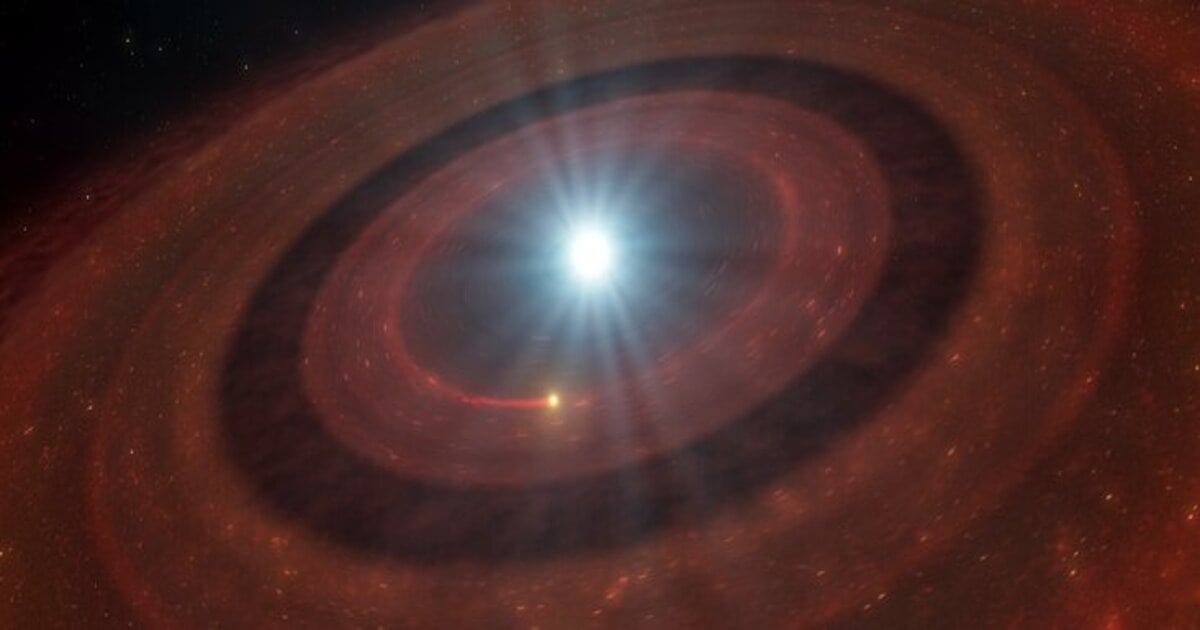
Observations with the X-shooter instrument on the European Southern Observatory’s Very Large Telescope have revealed the first known double debris disc around a white dwarf named J1328−1450. And this system, scientists believe, could be a window into the fate of our own solar system.
How do stars become white dwarfs?
When smaller stars like our Sun run out of nuclear fuel towards the end of their lives, they turn into red giants, which expand and begin shedding their outer layers at an increasingly fast rate. A white dwarf is the roughly Earth-sized yet extremely dense core that is left behind once a red giant is done shedding its layers. And while it's common for white dwarfs to tear apart asteroids and moons that dare venture into their vicinity, creating debris discs around themselves, it was the complexity of the system around J1328−1450 that had scientists intrigued.

How astronomers discovered the double debris disc
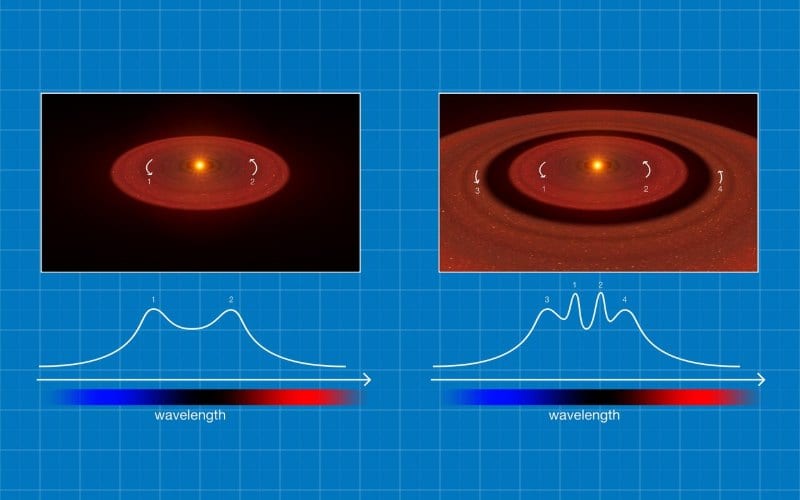
When a disc of gas orbits a star, one side of it approaches us while the other recedes. This produces two peaks in a spectrograph—bluer colors for the side moving towards us, and redder colors for the one moving away. The faster a disc spins, the further the two peaks will be from each other. But if there are two concentric rings, the spectrograph will show two pairs of peaks. And that is exactly what the astronomers saw with J1328−1450, with the peaks produced by the outer ring being closer to each other than those produced by the inner one, indicating that the former rotates more slowly. “The structure we see in this system is particularly intriguing because the two gaseous rings are remarkably stable and remain separated by a gap,” Felipe Lagos-Vilches, co-author of the study and an astronomer at the University of Warwick, UK, and at the Universidad Técnica Federico Santa María in Chile, said in a statement.
The discs may be traced back to two different planetary bodies
The team behind the study also observed differences in the chemical composition of the two rings. They found a good amount of magnesium in the inner ring, whereas its quantity was way lower in the outer one. Based on this, they think the material in the two rings may have originated from two planetary bodies in separate orbits—the inner ring may be traced back to an asteroid about a few kilometers in diameter, while the outer ring may have been a body the size of Pluto or even our Moon. Another possibility is that the material came from different layers of a single planetary body, such as its crust or core.
“We have known for some time that planets may survive beyond the transformation of their central star, but this is the first example of a complex system with a double debris disc and potentially two surviving planetesimals,” said Nicola Gentille Fusillo, who’s the lead author and an astronomer at the Università degli Studi di Trieste, Italy.
What this means for our solar system
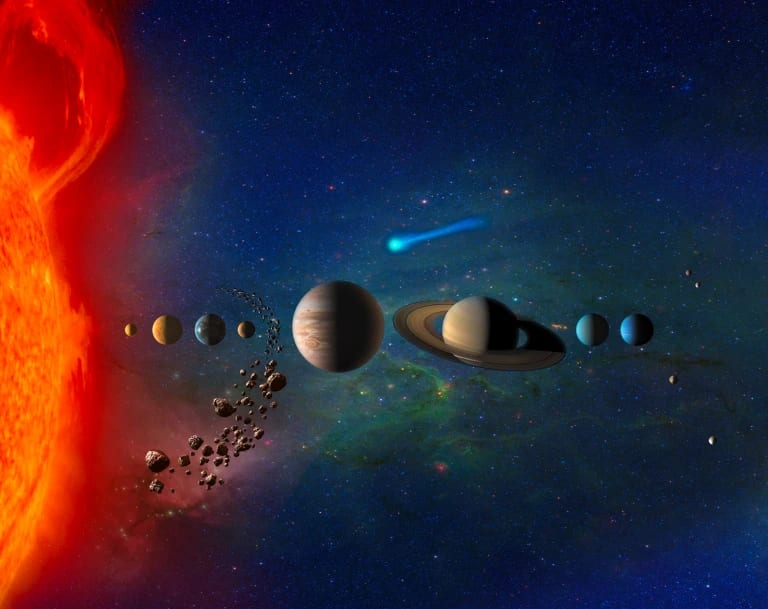
Besides magnesium, observations of the system also identified elements such as calcium, oxygen, and iron, which point towards a composition similar to that of the rocky planetary material found in our own solar system. And while our Sun is still in its main sequence phase, it will become a white dwarf, just like J1328−1450, in a few billion years. "The system therefore offers a remarkable glimpse of what the future of planetary systems, including systems like our own, might look like," said Lagos-Vilches.
More on Starlust
NASA's IXPE successfully studies a distant white dwarf star for the first time in history
Four dead stars discovered not too far from Earth stun scientists