Artemis III update: SLS rocket core stage in position for integration with boosters at NASA's Kennedy Space Center
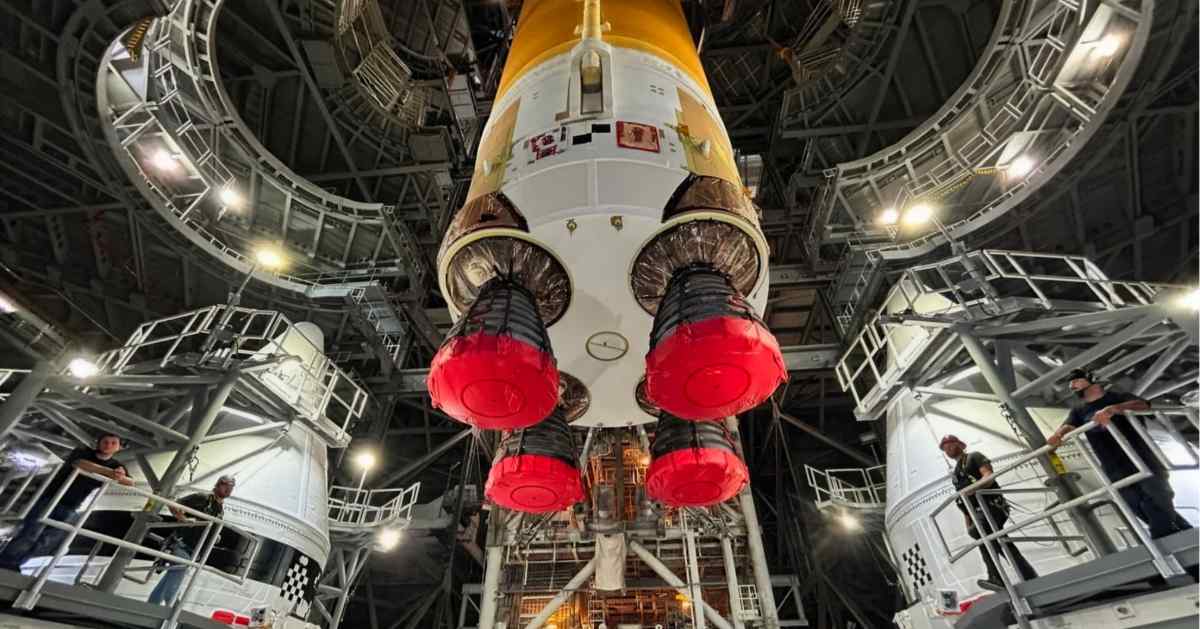
NASA announced on Monday that teams at the Kennedy Space Center had moved the Artemis III Space Launch System (SLS) core stage into what is known as the transfer aisle. Later, Artemis III mission commander Randy Bresnik revealed via an X post that the 212-foot central structure of NASA's Moon rocket had been erected and lifted up inside the Vehicle Assembly Building. This has been done so as to align it between the solid rocket boosters, which were put together the week before last.
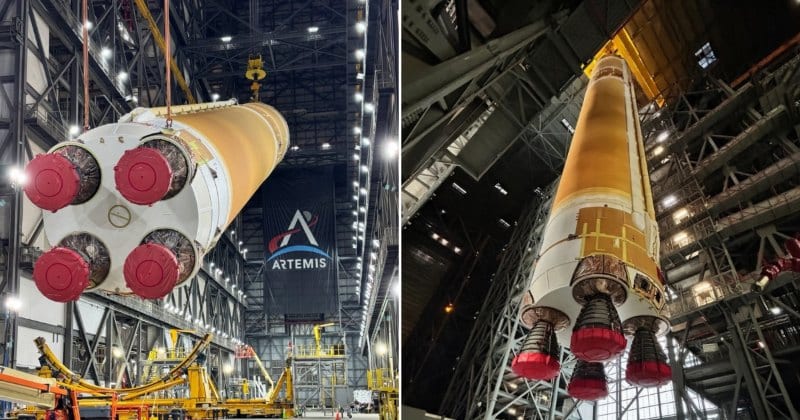
This maneuver has put the three largest parts of the Artemis III SLS rocket next to each other for the first time. To hoist the orange-colored stage into place, engineers and technicians who are part of the Exploration Ground Systems team used a unique lifting beam inside the transfer aisle. The transfer aisle is a vast corridor of open space inside the VAB that leads to the low and high bays on either side, which can be used for accessing different parts of the rocket as it is readied for missions. Bresnik, who recently also visited the VAB to check out the RS-25 engines along with his fellow Artemis III crew members, stated, "Our beautiful Artemis III Space Launch System (SLS) Core Stage left the surface of the earth (briefly) today as it ‘flew over the hump’ via a giant crane in the Vehicle Assembly Building to be mated between our 2 already assembled Solid Rocket Boosters on the Mobile Launcher."
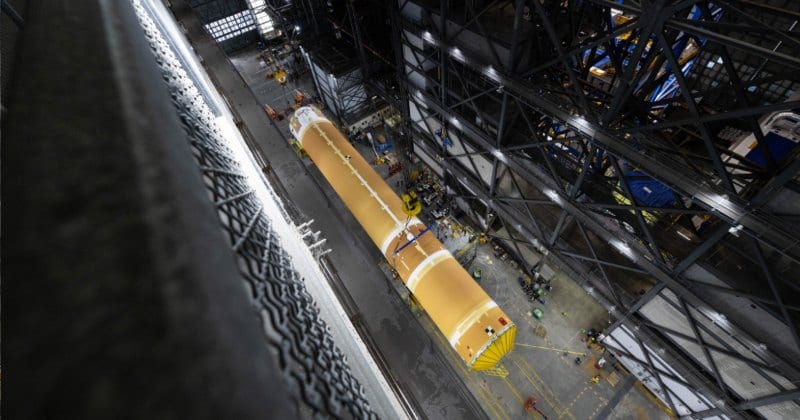
The core stage was built by Boeing at the Michoud Assembly Facility in Louisiana before being transported to KSC in April 2026 through waterways aboard the Pegasus barge. Its distinctive orange color comes from the insulation applied to it that keeps the cryogenic fuel inside it thermally isolated from the surroundings. It is composed of a forward skirt at the top, a liquid hydrogen tank, a liquid oxygen tank, an intertank, and the engine section at the bottom. In early September, teams also finished attaching the four RS-25 engines to its engine section. These four engines are derived from Space Shuttle hardware and deliver 2 million pounds of thrust at liftoff, powering the rocket into space by firing for the first eight minutes of the mission.
The SRBs provide the remaining thrust of over 6.8 million pounds, though they fire for just about two minutes after liftoff. Their arrival at KSC had been in segments via railroad. All of the aforementioned parts are being assembled on top of the mobile launcher. When put together entirely, the 322-foot SLS stack will be rolled out with the mobile launcher to Launch Complex 39B. The mobile launcher serves as the support structure for SLS and provides fuel and electrical connections via umbilicals to the rocket's tanks prior to launch.
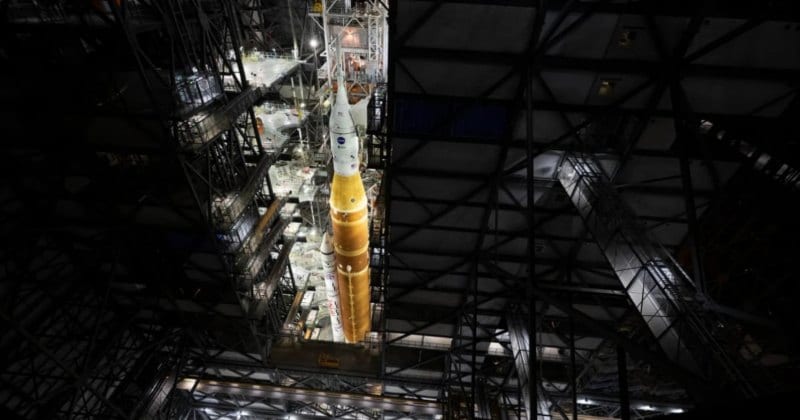
For Artemis III, the core stage will be topped off by a spacer instead of the Interim Cryogenic Propulsion Stage (ICPS). This is because the mission is not headed to the Moon but to a destination which is much closer (low Earth orbit). This configuration has been referred to as a 'short stack' even though the spacer is meant to replicate the dimensions of the ICPS. Latest updates from NASA have revealed the welding of the forward and aft rings to the spacer. The latter will be connected to the rest of the rocket via the launch vehicle stage adapter, and will be connected to the Orion crew module on top of it via the Orion stage adapter. Both of these parts are being readied for the mission sometime next year, while the spacer will have its dimensions verified again. Elsewhere at Kennedy, Orion—the only part slated to return with a crew after the flight—is also being made flight-ready.
More on Starlust
NASA reveals major details on SpaceX and Blue Origin lander plans ahead of Artemis III and IV
NASA shares moon lander timelines for SpaceX and Blue Origin ahead of Artemis III and IV