NASA shares moon lander timelines for SpaceX and Blue Origin ahead of Artemis III and IV

NASA has recently shared the development timelines for two landers that will help take astronauts to the Moon. This includes Starship, which is currently being developed by SpaceX, and Blue Moon by Blue Origin. As per the timeline, SpaceX is aiming to land an uncrewed Starship on the Moon before the end of 2027. On the other hand, Blue Origin is targeting an uncrewed landing in Q1 2028. This leaves little breathing room before Artemis IV, which would be the first crewed landing on the Moon since the Apollo program.
If things go smoothly, there will be more exciting launches in the coming year. More updates are coming soon as well. NASA will host a press conference on Friday, October 23, 2026. During the event, NASA Administrator Jared Isaacman, Associate Administrator Amit Kshatriya, and Artemis program director Jeremy Parsons are expected to discuss the status of upcoming moon missions and what NASA calls an “Artemis acceleration.” The detailed timeline was shared by Steve Creech, acting manager of the agency’s Human Landing System (HLS) Program, at the Astronautical Congress (IAC) in Antalya, Türkiye.
Since NASA has published an updated timeline for the HLS landers, I decided to present it as a tree-like timeline, showing what must come before each subsequent step. It’s a good visualization of the remaining steps needed to get these landers ready to land humans on the Moon, along with their progress on LEO tests for Artemis III.
— Chandler G (@Echo5550) October 20, 2026
Two landers, one Moon mission
NASA’s lander timeline includes two key demonstrations, which is moving fuel from one spacecraft to another in orbit, and landing on the Moon with no crew aboard. The company that is responsible for landers will have to qualify its vehicle to carry astronauts.
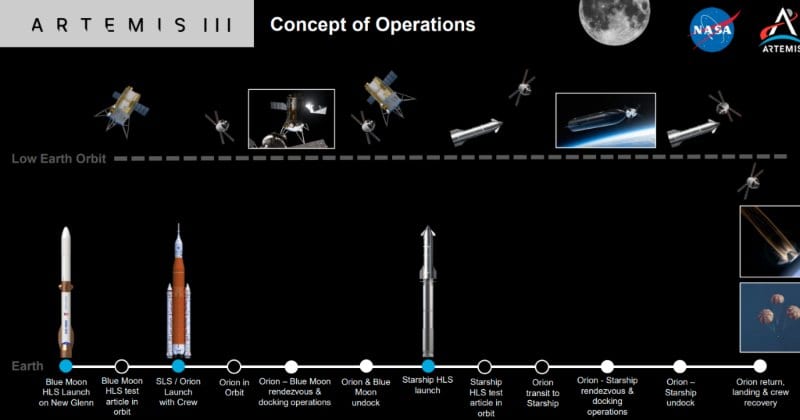
Artemis III is now targeted for the third quarter of 2027 and will stay in low Earth orbit. Four astronauts will fly in NASA’s Orion spacecraft and dock with test versions of both landers to check that they work together. Based on this, NASA will then decide which lander will take the astronauts to the surface on Artemis IV. As of now, Artemis IV is targeted for early 2028.
How will SpaceX prepare Starship for Artemis III?
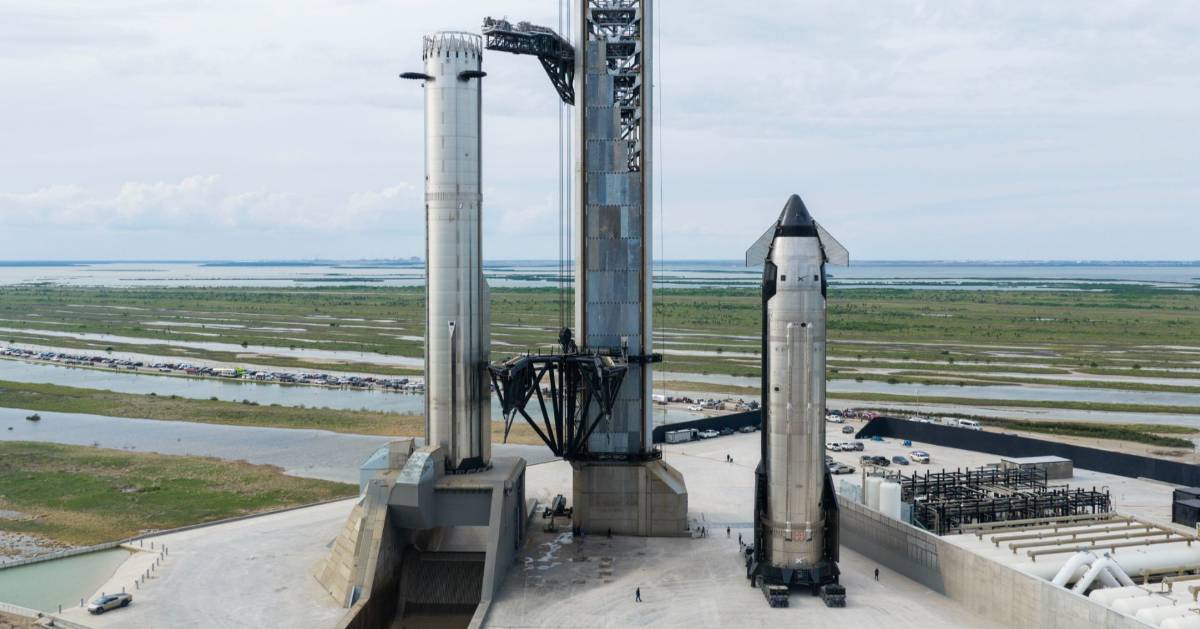
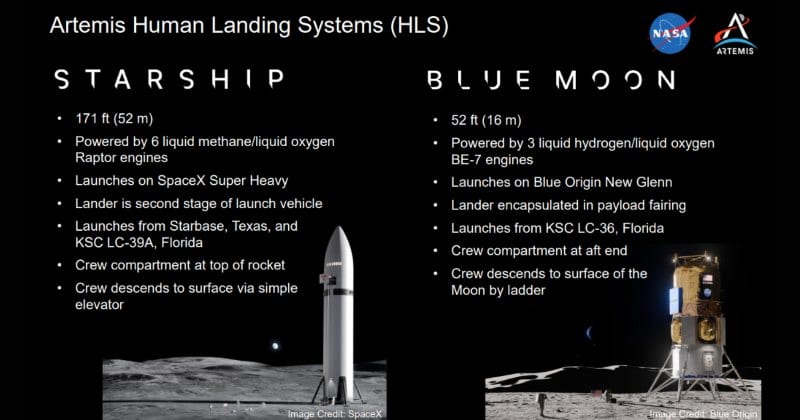
As per the timeline shared, the 2026 goal for SpaceX is to catch the upgraded Version 3 booster at the launch pad, as well as catching an upper stage for the first time, launching from a Florida pad still under construction, and possibly reflying a V3 booster. For Artemis III, SpaceX will use an existing V3 upper stage with minor changes and no crew cabin, so astronauts can dock with it but not enter.
🚨NEWS: NASA has released an updated timeline for SpaceX’s Starship HLS, outlining several key milestones: Q1 2027: In-orbit propellant transfer demonstration Q3 2027: Artemis III mission Q4 2027: Uncrewed lunar landing demonstration https://t.co/x0IDdRZuVM
— jacobruh 🚀 (@jrxcket) October 18, 2026
SpaceX also has to show it can transfer fuel between spacecraft in orbit. Artemis III itself won’t need any refueling flights. Because Starship is designed to be fully reusable, its tanks must be topped off in orbit before it can fly beyond low Earth orbit. A moon mission could need up to a dozen tanker launches. SpaceX is targeting an uncrewed lander launch around late Q3 or early Q4 2027, with an uncrewed landing before year’s end.
Blue Origin’s Moon landing plan stretches to 2028
Blue Origin’s Blue Moon Mark 2 (MK2) lander is 52 feet (16 meters) tall and runs on three BE-7 engines. Unlike SpaceX’s Artemis III vehicle, its test lander will have a crew cabin, partial life support, flight software, among other systems. This is so astronauts can climb in from Orion. Inside the lander, they can get a feel for the lander in zero gravity and try some of its systems.
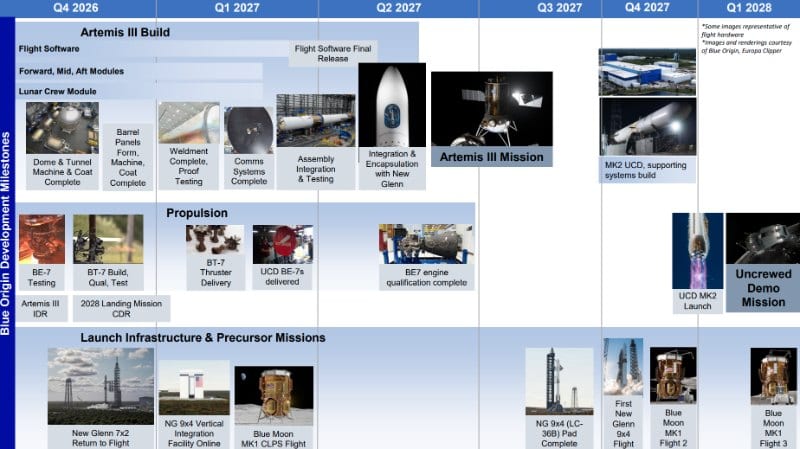
The schedule also hinges on New Glenn (Blue Origin’s rocket), which exploded in May and heavily damaged its Cape Canaveral launch pad. NASA’s presentation places the pad restoration and New Glenn’s return to flight in the fourth quarter of 2026. As for 2027, Blue Origin’s Blue Moon MK1, a smaller, uncrewed version of the MK2, is scheduled to launch to the moon’s surface as part of NASA’s Commercial Lunar Payload Services (CLPS) program. An uncrewed MK2 lander is expected to attempt its own moon landing in the first quarter of 2028.