NASA astronaut shares stunning auroras views from ISS amid geomagnetic storm warning in U.S.
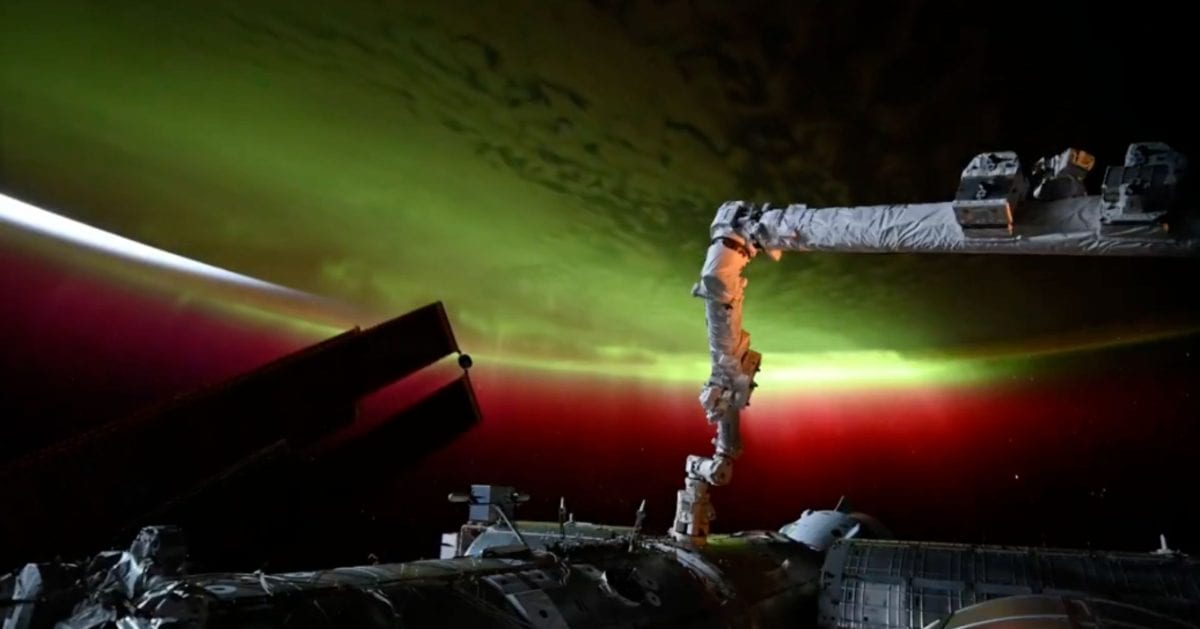
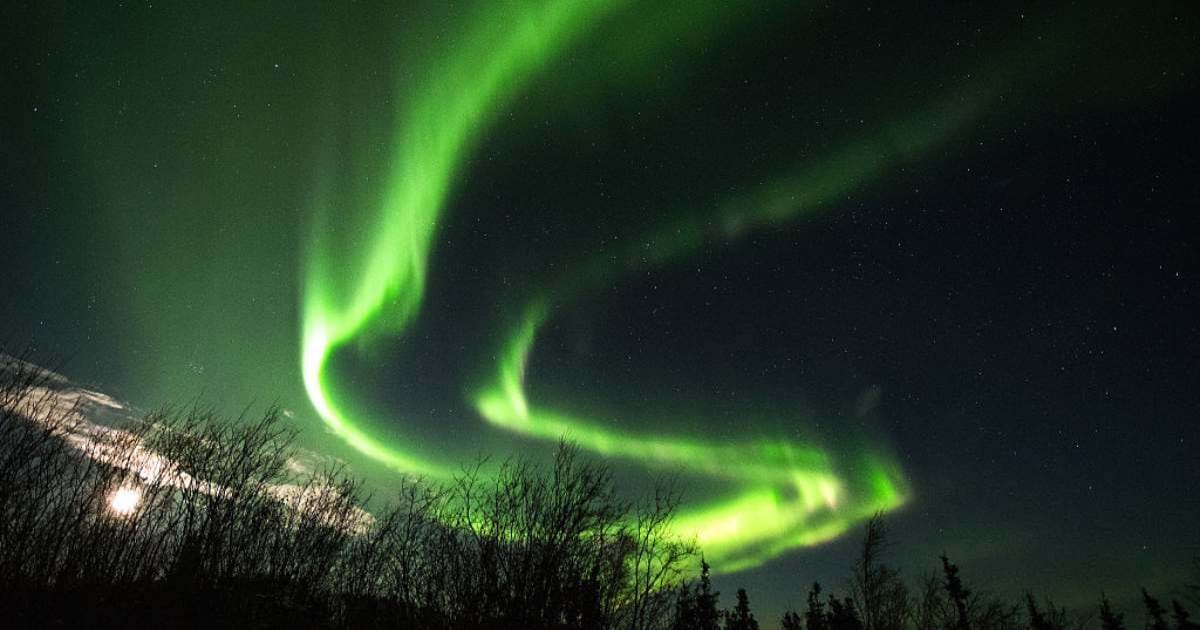
NASA astronaut Anil Menon has shared stunning views of auroras from the International Space Station (ISS) as Earth is bracing for a geomagnetic storm soon. Taking to X on Saturday, he posted a video of the bright green and red spectacle as the station flew over the affected regions in the low-Earth orbit. “Tonight’s amazing aurora after significant solar activity! As seen from station,” Menon captioned his post.
Tonight’s amazing aurora after significant solar activity! As seen from station. https://t.co/gsn9pSZqOg
— Anil Menon (@astro_anil) October 10, 2026
The National Oceanic and Atmospheric Administration (NOAA) has issued a warning for moderate geomagnetic storms on October 11 that could have some effects on technological structure and bring auroras to some northern and upper midwest states in the U.S. “Multiple CMEs are anticipated to affect Earth with elevated geomagnetic response, and dependent upon the orientation of the embedded magnetic field, potential exists for moderate storm levels,” the NOAA said in its warning.
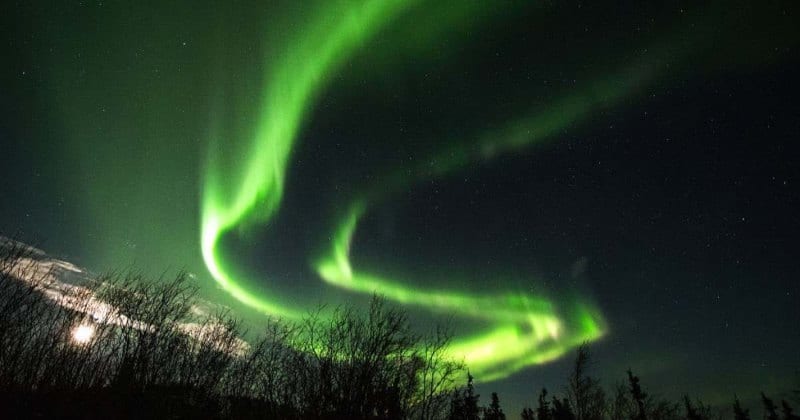
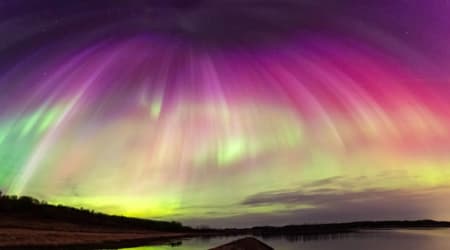
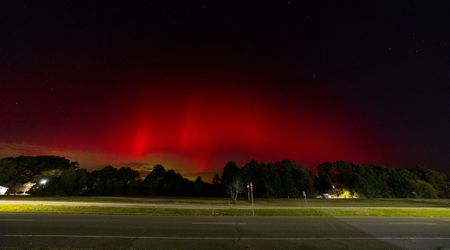
A major driver of strong auroras is the plasma discharged by the Sun during Coronal Mass Ejections (CMEs)—a phenomenon wherein billions of tons of charged particles are expelled into space. These particles are carried by the solar wind and when they reach Earth, they interact with its magnetosphere (the magnetic bubble around our planet) and get funneled toward the magnetic poles. Some of these high-energy particles (mostly electrons) slam into the atmosphere and mingle with oxygen and nitrogen, causing their atoms and molecules to accumulate energy and become ‘excited’. When these particles calm down, they release that energy, giving off light in different colors. In the northern hemisphere, auroras are called Aurora Borealis, and in the southern hemisphere, Aurora Australis.
Earth is getting hammered! Thanks to a fashionably late solar storm impact and continued flaring from Region 4549, impacts at Earth are building up. Aurora photographers should be seeing aurora where skies are clear while radio operators & GPS users should stay alert for increased signal degradation and noise on both the day and night sides of Earth. Conditions will worsen over the next 24 hours.
— Dr. Tamitha Skov (@TamithaSkov) October 10, 2026
According to space weather Physicist Dr. Tamitha Skov, the recent solar activity is resulting from a region on the Sun named AR 4549. “Aurora photographers should be seeing aurora where skies are clear while radio operators & GPS users should stay alert for increased signal degradation and noise on both the day and night sides of Earth. Conditions will worsen over the next 24 hours,” Skov posted on X. The NOAA says that the warning is about two CMEs that left the Sun on October 7 and October 8. The latter is the faster one and forecasters expect it to merge with the slower CME by the time they reach Earth.
Which U.S. states might the auroras be visible in?
There are several regions where the auroras might be visible from New York to Idaho in the U.S. These include the states of Pennsylvania, Michigan, Minnesota, Wisconsin, Iowa, North Dakota, South Dakota, Montana, Wyoming, New Hampshire, Vermont, Maine and possibly Washington.
More on Starlust
Space weekly recap, October 3 - October 10: Key stories you may have missed
NASA's Webb helps pinpoint location of farthest fast radio burst—it's not what scientists expected