NASA's James Webb Telescope spots 'exceptionally rare' cosmic event: 5 galaxies colliding in deep space
Astronomers have found a newly identified system, unofficially named 'JWST's Quintet,' where at least five galaxies and 17 star-forming clumps are merging.
UPDATED SEP 8, 2025
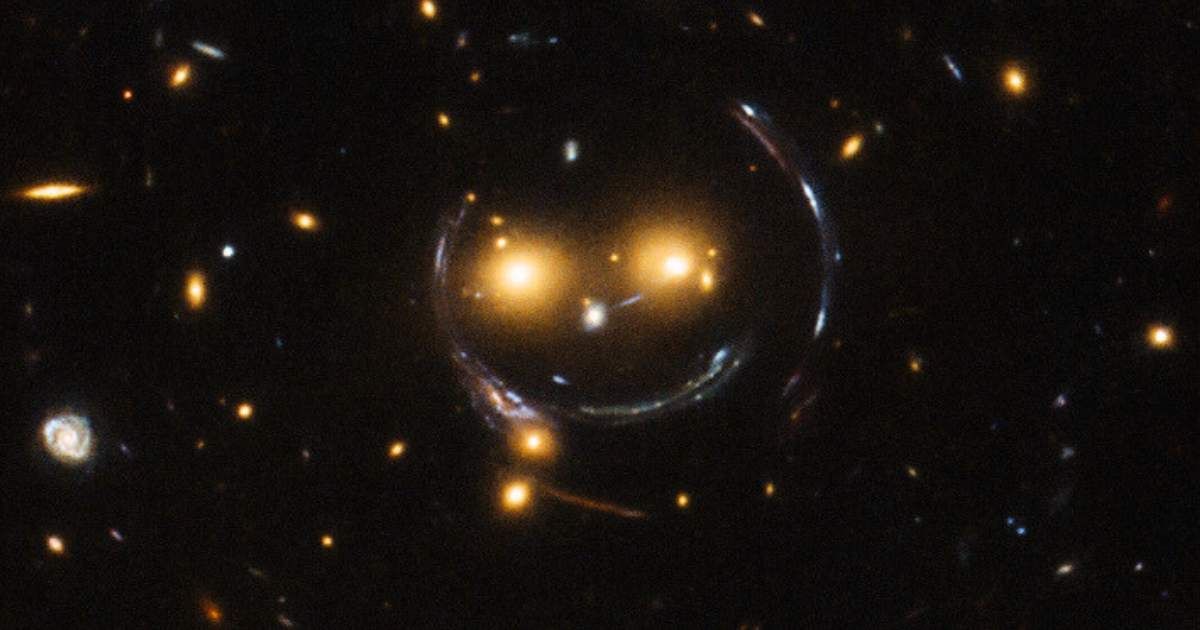
Galaxies SDSSCGB 8842.3 and SDSSCGB 8842.4 forming a 'smiling lens' in a photo taken in 2015 (Representative Cover Image Source: ESA/NASA, edited by Starlust staff)

Using data from the James Webb and Hubble space telescopes, astronomers have documented a highly unusual celestial event: a collision of five galaxies from the universe's infancy. The discovery, which occurred just 800 million years after the Big Bang, offers new insights into how galaxies form and evolve, as per Live Science

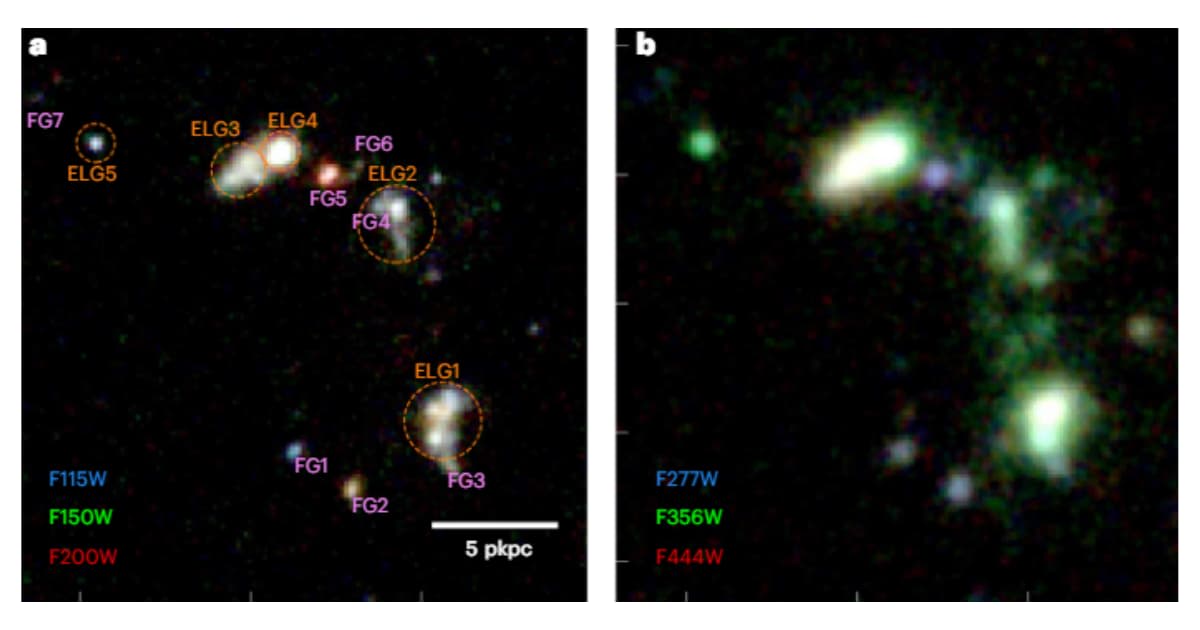
The 5 galaxies in the James Webb quintet (JQ) are labelled ELG1-ELG5 by large orange circles. Small purple labels represent 7 foreground galaxies at different redshifts. (Image source: NASA, ESA, CSA JWST, and STScI / Weida Hu et al.)

While galaxy mergers are a known phenomenon, they typically involve only two galaxies. This newly identified system, unofficially named "JWST's Quintet (JQ)," stands out for its sheer size, containing at least five galaxies and 17 star-forming clumps. According to Weida Hu, a postdoctoral researcher at Texas A&M University and the lead author of the study, finding a system of this complexity is "exceptionally rare," both in observational studies and in theoretical models.
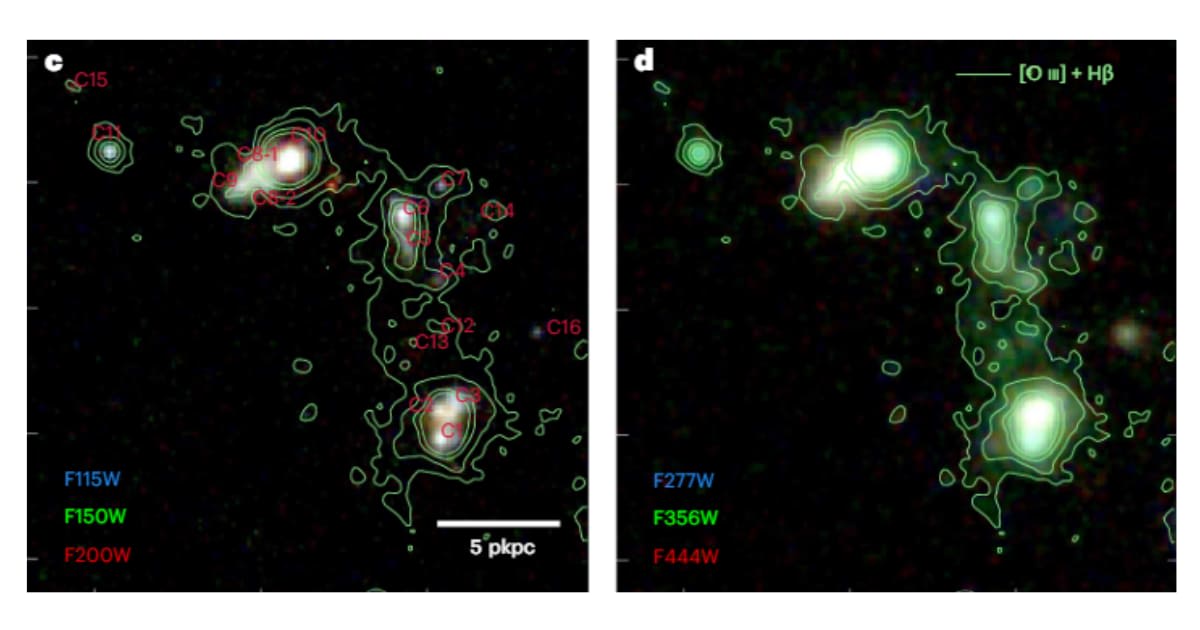
Same image of the five galaxies but with the foreground galaxies that were not associated with the JSWT Quintet removed. (Image source: NASA, ESA, CSA JWST, and STScI / Weida Hu et al.)

"The probability of detecting even one [multiple-galaxy merger] is quite low," Hu stated, suggesting the team may have been "lucky" to spot it so early in the universe's timeline. The study, published in the journal Nature Astronomy, credits the advanced capabilities of the James Webb Space Telescope (JWST) for confirming that the galaxies are physically connected.

The galaxies within the quintet are highly active, exhibiting prominent signatures of new star formation. Their combined stellar mass is estimated to be 10 billion times that of our Sun. Researchers believe this massive merger could eventually lead to the formation of a quiescent galaxy, a type of galaxy that stops forming new stars. This finding could help explain a long-standing mystery: how "dead" or quiescent galaxies formed so early in the universe's history. The quintet's future could provide a key piece of the puzzle, showing whether these systems evolve into less active galaxies or become dormant altogether.
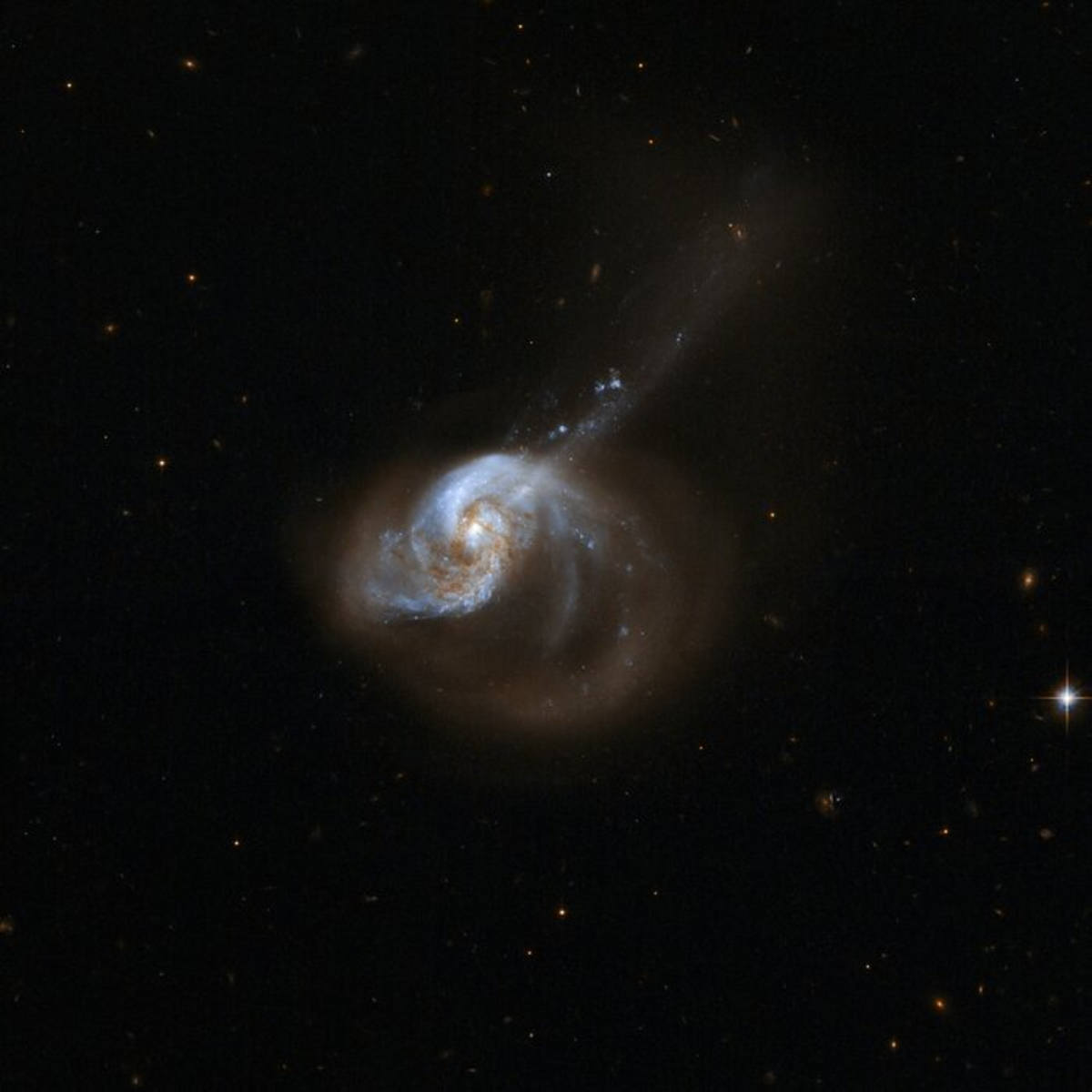
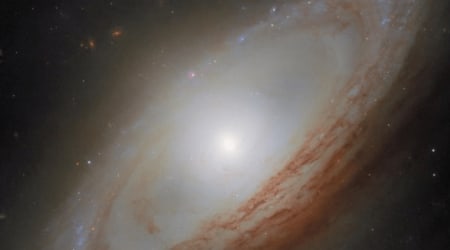
The galaxy system NGC 1614 has a bright optical centre and two clear inner spiral arms that are fairly symmetrical (Representative Image Source: NASA, ESA)

While the JWST’s images provided critical clues about the system’s structure, more detailed observations will be needed to understand its dynamics and composition fully. If more such systems are found, they could either confirm existing cosmological models or point to new, undiscovered mechanisms at play in the early universe.

The James Webb Space Telescope's groundbreaking observations continue to reshape our understanding of the early cosmos. Just as the discovery of JWST's Quintet provides a unique window into galaxy mergers, another recent finding challenges long-held theories on galaxy formation. A separate team of astronomers, also leveraging the JWST, has identified 300 unusually bright objects in the distant universe. These "candidate galaxies," as they're described in a study published in The Astrophysical Journal, are from a period when the very first stars and galaxies were just beginning to form.
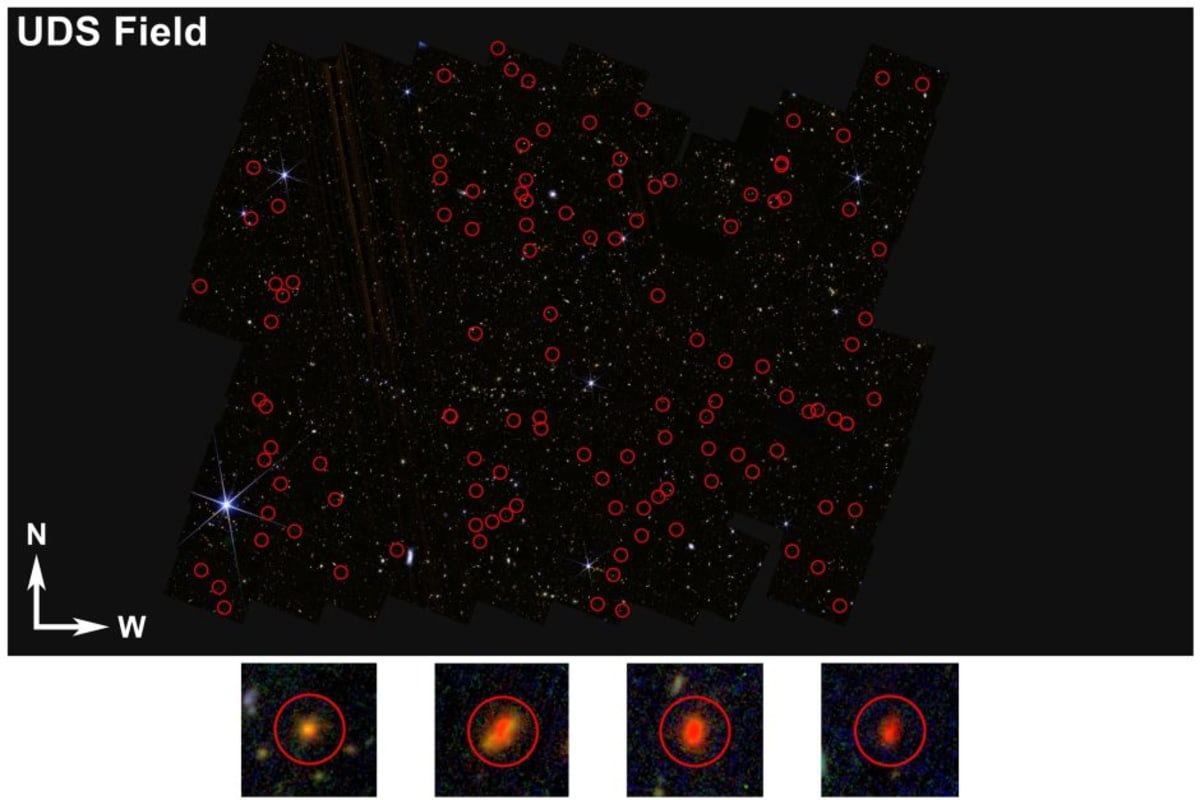
Using data from NASA’s James Webb Space Telescope, University of Missouri researchers identified 300 unusual early galaxy candidates (Image Source: University of Missouri | Bangzheng “Tom” Sun)

“If even a few of these objects turn out to be what we think they are, our discovery could challenge current ideas about how galaxies formed in the early universe," said Haojing Yan, a professor of astronomy at the University of Missouri and co-author of the study. The identification of these objects was made possible by the JWST's ability to detect the faint, stretched-out light from the most ancient parts of the universe.

More on Starlust

Webb Telescope spots 300 unusually bright 'mysterious objects' that could rewrite galaxy formation history

Webb Telescope discovers mysterious CO₂-rich disk with no water around a young star

NASA’s James Webb Telescope discovers evidence of a black hole formed without a supernova explosion
MORE STORIES

Smaller black holes tend to attract less material, making them naturally dimmer. Chandra would miss many of these faint objects.
17 hours ago
The data suggest this small, super-hot world is shrouded in a thick layer of gas, likely hovering above a planet-wide ocean of magma.
3 days ago
The region around black holes was not thought to be conducive to star formation, yet research proved otherwise.
3 days ago
The discovery, validated by a separate European team led by the University of Exeter, may offer fresh insight into interactions between planets and binary star systems.
3 days ago
During its 1986 observation of the planet in the first and only flyby, the spacecraft measured a surprisingly strong electron radiation belt.
5 days ago
Previously, the most ancient supernova ever confirmed dated back to when the universe was 1.8 billion years old.
5 days ago
NASA's Fermi telescope was the first to identify the highly unusual cosmic explosion.
5 days ago
An international team of astronomers conducted a ten-day observation of the NGC 3783 black hole using mainly the XRISM space telescope.
6 days ago
A nova is a massive, temporary star explosion caused when a dense white dwarf star pulls material from a nearby star, setting off an uncontrolled nuclear reaction.
7 days ago
A team of computational astrophysicists has developed a simulation that explains the behavior of matter around black holes.
Dec 5, 2025