Astronomers capture rare 'Cosmic Owl' as two ring galaxies merge in a dazzling display

An international team of astronomers has announced the rare detection of a merger between two similar ring galaxies, forming a structure that strikingly resembles an owl's face. This celestial event, officially dubbed the "Cosmic Owl," was detailed in a research paper published on the arXiv preprint server on June 11, as reported on Phys.org.

Galaxy mergers are fundamental to galactic evolution, influencing the distribution of gas, stellar motion, and overall galaxy shape, ultimately assembling stellar mass. While some mergers result in the formation of collisional ring galaxies (CRGs), these are uncommon, with only a few hundred identified in the local universe. CRGs form when a smaller galaxy directly collides with the disk of a larger one, pushing gas and stars outward into a distinct ring pattern. Led by Mingyu Li of Tsinghua University in Beijing, China, the research team serendipitously discovered this seemingly unique merger of two CRGs. The discovery was made using advanced instruments, including the James Webb Space Telescope (JWST), the Atacama Large Millimeter/submillimeter Array (ALMA), and the Very Large Array (VLA).

"Deep imaging and spectroscopy from JWST, ALMA, and VLA reveal a complex system of twin collisional ring galaxies, exhibiting a nearly identical morphology," the researchers posited. This remarkable merger was detected at a redshift of 1.14, indicating its significant distance from Earth. The images captured reveal that the Cosmic Owl is composed of two interacting galaxies, each forming almost identical collisional ring structures, with each ring spanning approximately 26,000 light-years in diameter.

Astronomers highlight that the striking symmetry of the Cosmic Owl's rings suggests a head-on collision between two galaxies of comparable mass and structure. They estimate the stellar mass of this colossal merging system to be around 320 billion solar masses. Furthermore, the black holes residing within these two galaxies are estimated to be approximately 67 million and 26 million solar masses, respectively.
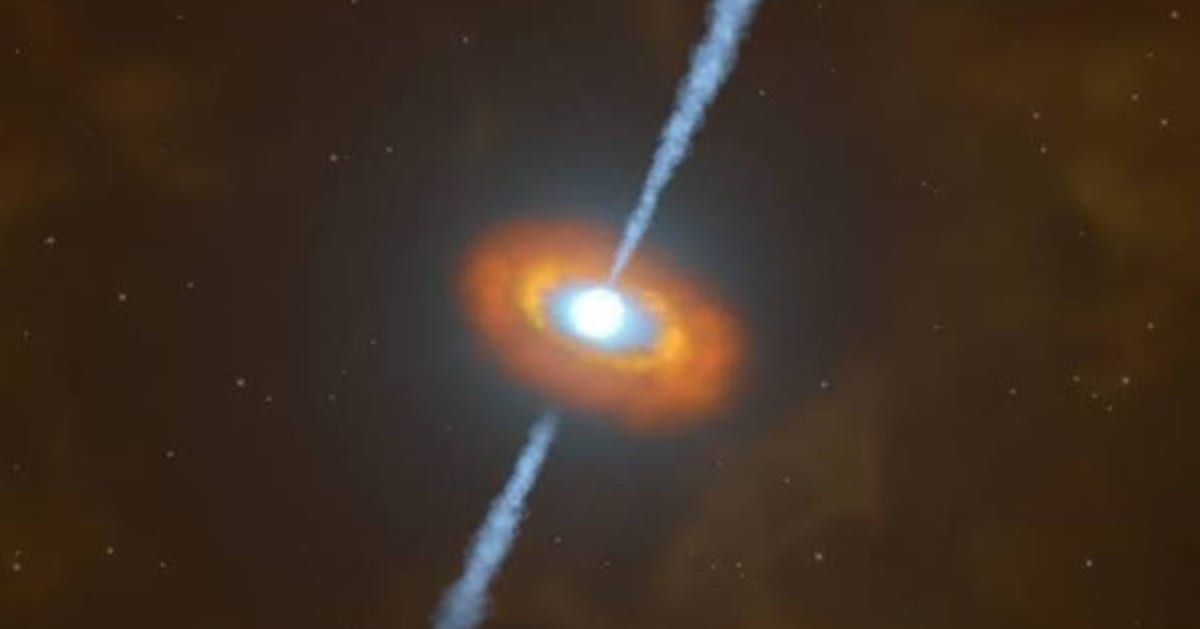
Visually, the Cosmic Owl lives up to its name. The images clearly show that the compact core of each galaxy forms an "eye", while a central region of intense star formation appears in blue, strikingly resembling a "beak" between them. In a further significant finding, the study revealed that each of the merging galaxies hosts an active galactic nucleus (AGN). Notably, the northwestern "eye" of the Cosmic Owl exhibits a bipolar radio jet. This jet appears to extend towards the "beak" region, triggering additional shocks in the collision front between the two galaxies.

The authors of the paper emphasized the truly one-of-a-kind properties of the Cosmic Owl. They concluded, "The simultaneous occurrence of a head-on merger, twin ring formation, dual AGN activity, and a jet-triggered starburst offers a detailed snapshot of the mechanisms that assemble stellar mass and grow supermassive black holes in the early universe."
The "Cosmic Owl" stands as a crucial astronomical find, offering an unprecedented opportunity to dissect the intricate processes that shaped galaxies in the universe's formative years. Galaxy mergers and interactions help us comprehend how galaxies form and evolve over cosmic timescales. In the prevailing cold dark matter cosmology, the hierarchical growth of dark matter halos leads to the subsequent merger of their visible, or baryonic, counterparts. This gravitational dance often results in the significant disruption of the galaxies at the heart of these halos.