What if time isn't real? Some physicists think it might just be in our heads
Is time real or is it just an illusion?
Most of us think that time is always moving forward and that's just how reality works. But physicists are now questioning if that’s really true. Some argue that what we experience as "time passing" is not common to the universe at all. Instead, it may come from physical processes or even from the way our brains interpret change happening around us.
This claim might sound strange, but it’s actually based on research on quantum mechanics and even Albert Einstein's theory of relativity. So, what exactly is time, and is it even real or just an illusion of our brain? Here’s what scientists say.
A new study links time to quantum entanglement
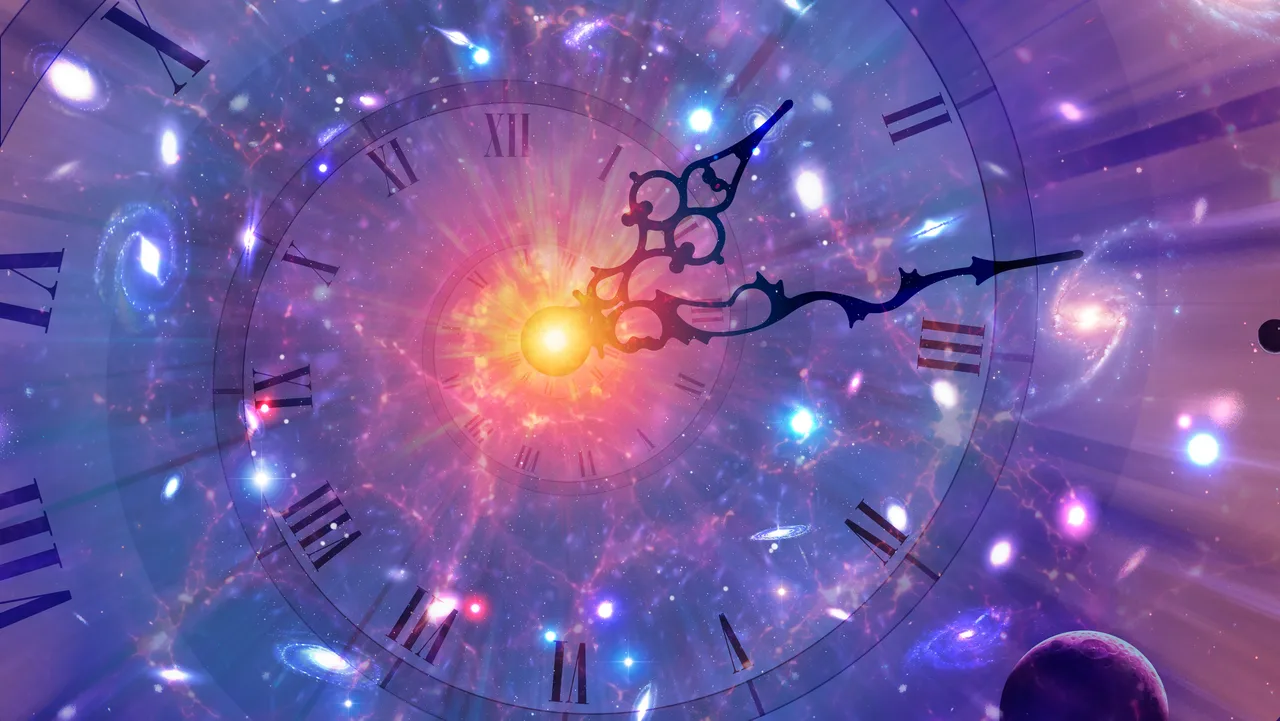
Physicist Alessandro Coppo and his colleagues published a paper in Physical Review A, and it suggests that time might arise from quantum entanglement. This is the effect where two particles become so interconnected that the state of one instantly influences the state of the other, no matter how far apart they are.
Their idea is that our sense of time only appears when something connects with what they call a reference clock. And without that entanglement, the universe would just appear completely frozen to an outside observer. In other words, time, as we experience it, wouldn't exist. "We believe that nature is genuinely quantum," Coppo said.
Why does physics have two conflicting ideas about time?
Part of what makes this idea so complicated is that time doesn't behave the same way across different areas of physics. For example, in Einstein's theory of relativity, time is woven into the fabric of space itself, and it bends and stretches depending on gravity.
In quantum mechanics, though, time doesn't change at all. Physicist Alessandro Coppo shared, "For centuries, time has entered physics as an essential ingredient that is not to be questioned. It is so deeply rooted in our conception of reality that people thought that a definition of time was not needed." “We believe that nature is genuinely quantum,” he added.
What if the past, present, and future are all happening right now?

But Cambridge philosopher Huw Price argues that the three things we associate with time (which are a special "now," a sense of flow, and a clear direction) actually come from our minds. For this, he points to the "block universe”. It’s a model in which time is treated as a fourth dimension alongside space.
This basically means that the past, present, and future are all equally real at the same time. To explain the idea, MIT physicist Max Tegmark compares it to a movie stored on a DVD. He notes that the story unfolds as you watch it, but the DVD itself "isn't changing in any way."
But not all scientists are convinced
Not all researchers agree with the idea, though. British physicist Julian Barbour argues that change is real, even if time isn't. According to him, reality is made up of a series of still snapshots that our brains stitch together into what feels like continuous motion.
Cosmologist Andreas Albrecht at UC Davis takes a more practical approach. He explained, "The essence of relativity is that there is no absolute time, no absolute space. Everything is relative. When you try to discuss time in the context of the universe, you need the simple idea that you isolate part of the universe and call it your clock, and time evolution is only about the relationship between some parts of the universe and that thing you called your clock.”