What if dark matter is just hiding in another dimension? Here’s what a new study says
What if the universe has another dimension?
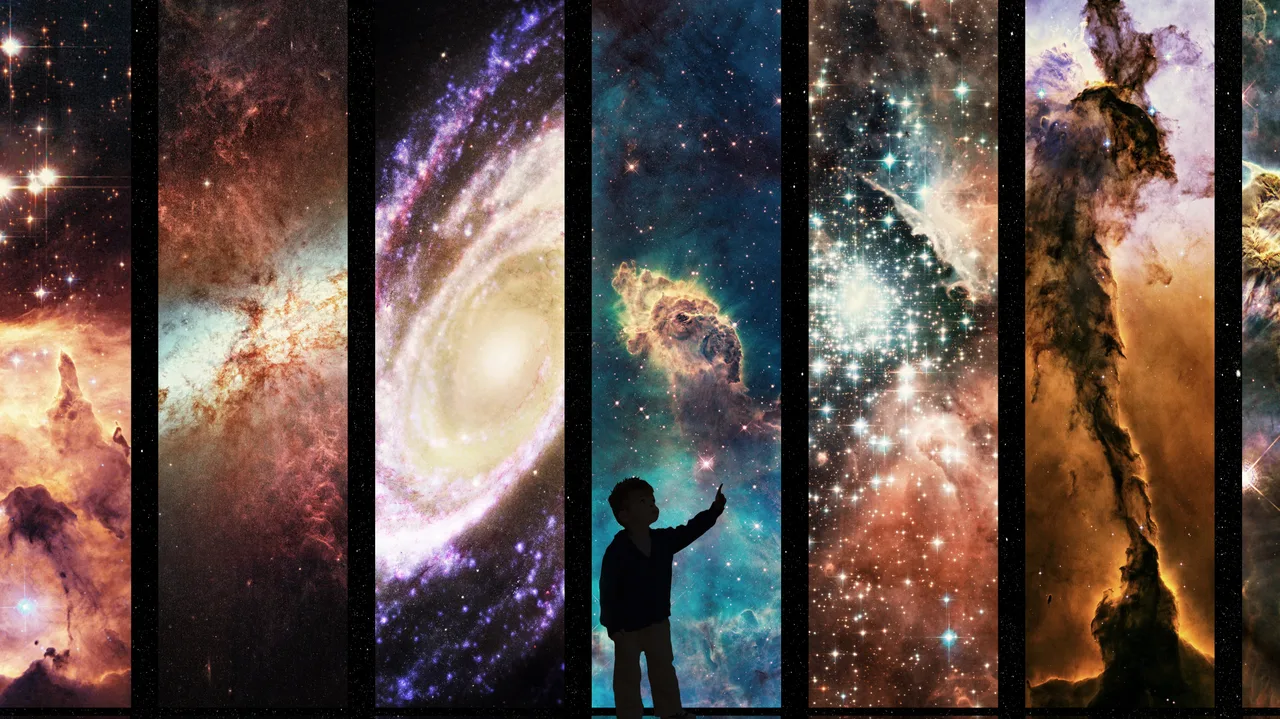
About 85% of all the mass in the universe is thought to be dark matter. But still, we have not found any direct evidence of it. Science only knows it’s there because of how gravity affects galaxies and how it leaves an imprint on the light that’s left over from the Big Bang.
At the same time, scientists have also questioned if there are more dimensions than the ones we are currently living in. Now, a team of scientists from the University of Sheffield argues that these two mysteries might be linked together.
The idea of a fifth dimension isn't new
Back in 1919, German mathematician Theodor Kaluza sent a paper to Einstein, in which he argued that there is a fifth dimension to space-time. His paper added that this way, it would be possible to prove that gravity and electromagnetism are the same force.
A few years later, Swedish theoretical physicist Oskar Klein suggested that this dimension could stay invisible by curling up on a microscopic scale and be too small for us to notice.
Meet the dark photon
In a new paper, Sheffield researcher Yu-Dai Tsai and his team bring in a hypothetical particle called a dark photon. The idea is that dark matter and dark photons both have access to this hidden dimension. But ordinary matter, us included, is stuck in the four dimensions we already know.
"Our research gives physicists clear new targets in the search for dark matter, while connecting two of the biggest ideas in fundamental physics: the mystery of dark matter and the existence of hidden dimensions," Yu-Dai Tsai of the University of Sheffield said in a statement.
And a hidden "resonance" ties it all together
The researchers say the shape of this fifth dimension locks the mass of a dark photon into a fixed ratio with the mass of a dark matter particle. They call this a "dark matter resonance.” Explaining this, Tsai said, "This resonance can make dark matter interactions much stronger at crucial epochs in cosmic history, such as in the early Universe."
This could solve two of the universe’s biggest mysteries
Scientists are still studying dark matter and actively searching for dark photons. If this study holds up, it would help scientists solve two of the biggest mysteries of the universe. And it would also mean that a hidden fifth dimension exists out there, beyond our reach.
The theory would then also explain why the Milky Way and Andromeda have fewer dwarf galaxies than models predict. The study's findings have now been published in Physical Review D.