Is a fourth dimension hiding right in front of us? Scientists think so
A dimension we can't see
Every day we move through three dimensions without even thinking twice. We move left-right, forward-backward, and up-down. But physicists think that the universe doesn't stop there. Instead, there could be an extra dimension somewhere in the fabric of space, maybe even right in front of us, but just hidden from our view. We just don’t have the sense to pick up on that.
So what would one of these hidden dimensions actually look like, and can we actually notice it?
What does a hidden dimension actually look like?
Columbia University string theorist Brian Greene says math suggests a possibility that there may be more dimensions than the ones we directly experience. In a Big Think video, he says, “So think about a garden hose that’s nice and long. Now from far away, the garden hose is going to look one dimensional because that’s the only part that you have the visual acuity to see because the circular part is just too small for your feeble eyes to detect.”
“But then if you take a pair of binoculars from a faraway vantage point, now you see that there is a circular dimension, a circular part that wraps around the garden hose that you missed when you just used your feeble senses,” he further added. As of now, physicists believe that there are at least 10 dimensions, and we just can’t perceive most of them.
So where exactly is this fourth dimension?
A fourth spatial dimension would be another direction that's separate from all three. Some physicists describe it as a direction that's perpendicular to a cube. That sounds simple enough until you try to picture it. Most of us can’t, because we've never experienced anything like it.
Just because we can't picture it doesn't mean it can't exist. Brian Greene explained, “According to the mathematics well-motivated by these attempts of realizing [Albert] Einstein’s dream of unified theory, the math suggests this as a real possibility that there may be more dimensions than the ones that we directly experience.”
The fourth dimension through Einstein's eyes
In his theory of special relativity, Einstein treated time itself as the fourth dimension. It’s a dimension that can't be pulled apart from the three spatial dimensions we already know. Together, they form what's called space-time. But time doesn't behave like the others.
We can move freely through space in any direction, yet time only ever pushes forward, which is why time travel to the past is considered close to impossible. Though there’s still hope for wormholes, which could connect distant points in space-time. But that remains theoretical.
What would a 4D object even look like?
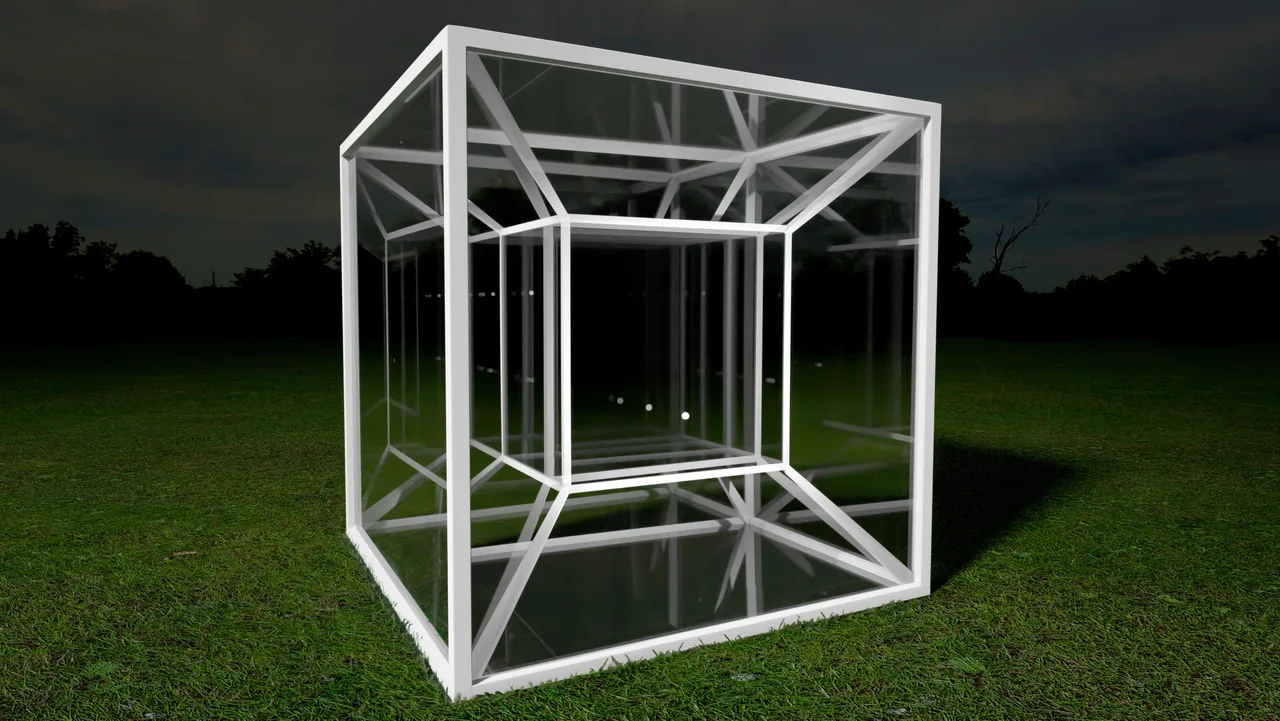
German mathematician and theoretical astronomer August Ferdinand Möbius was among those who explored what an extra spatial dimension might look like. One idea was that, in four dimensions, you could rotate a 3D object until it becomes its own mirror image, something that simply can't happen in our world.
To explain this, mathematicians came up with the tesseract, or hypercube. It's an extension of a cube into the fourth dimension. Even though no one can truly picture a tesseract, mathematicians use diagrams and models to better understand it. Later, Bernhard Riemann developed the math behind four-dimensional space, which eventually helped shape Einstein's theory of relativity. The above image is a model of a tesseract with glass panels that create internal reflections suggestive of multi-dimensional space.
What if aliens are hiding in the fourth dimension?
What if a fourth dimension exists and something could be living there completely undetected by us? Author and futurist Dr. Clifford A. Pickover has explored this idea on his research portal. He suggested that a being who could move through a fourth spatial dimension would have abilities that look impossible to us.
As he puts it in his research paper The Fourth Dimension, "A 4-D being would be a god to us. It would see everything in our world. It could even look inside your stomach and remove your breakfast without cutting through your skin, just like you could remove a dot inside a circle by moving it up into the third dimension, perpendicular to the circle, without breaking the circle."