What if the universe isn’t actually speeding up? Oxford physicist offers a new explanation
What if dark energy never existed?
Since the late 1990s, scientists across the world have believed that the universe wasn’t just expanding; in fact, it was expanding faster and faster. This idea was based on observations of exploding stars called Type Ia supernovae. This also led to the theory of dark energy, a mysterious force thought to be pushing galaxies apart. Dark energy has never been directly observed.
But now, researchers are questioning whether this acceleration itself might be a trick of the light. And if that’s true, that could also mean that dark energy never existed at all. Here’s what the researchers believe.
What if the universe isn’t actually accelerating?
Subir Sarkar, who’s a theoretical physicist at the University of Oxford, has long questioned whether cosmic acceleration is really happening. For this, he worked with Animesh Sah and Mohamed Rameez from the Tata Institute of Fundamental Research to re-examine supernova data from the Pantheon+ catalog. They focused on the age of the star system that created each explosion.
In a study published in Monthly Notices of the Royal Astronomical Society, Sarkar wrote, "It has been suggested that the cosmic acceleration inferred from Type Ia supernovae could be illusory, due to our being 'tilted' observers embedded in a bulk [cosmic] flow," adding, "The inferred acceleration should then be directed mainly along the local bulk flow," and he noted, it should die out at a certain distance.
The stars may not be as far away as they look
For their research, the team used an age correction developed by astronomers at Yonsei University. They found that supernovae from younger star systems look systematically fainter, even after standard adjustments. Since more distant supernovae formed from younger progenitors, they appear dimmer than expected. And this is what makes them seem farther away than they really are. This illusory distance is also what hints at acceleration.
In simple words, some of the “speeding up” that researchers detected might be a result of comparing stars of different ages as if they were identical.
The “acceleration” doesn’t look the same everywhere
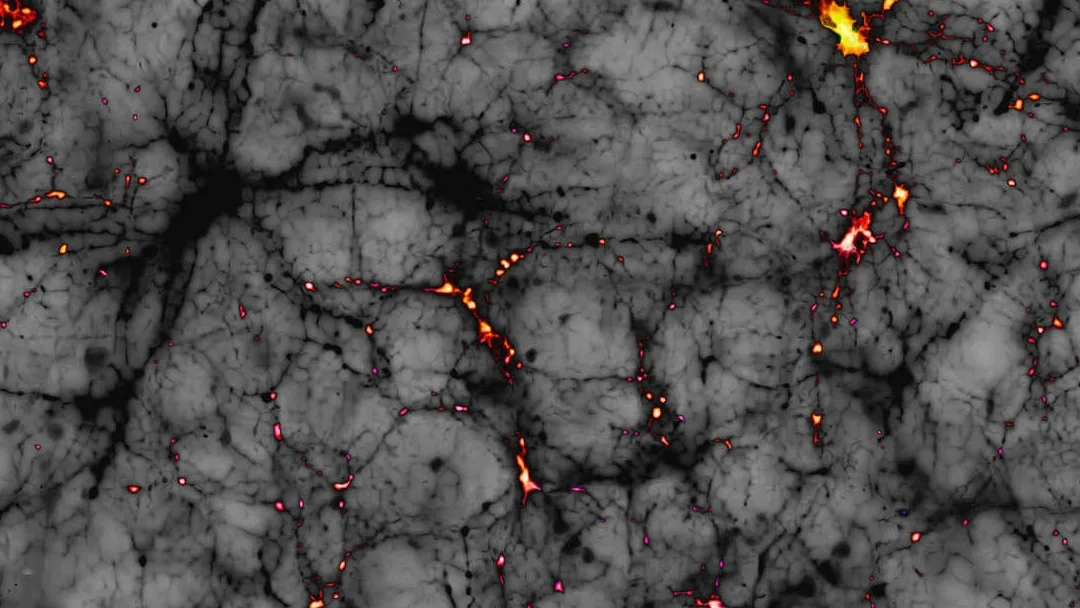
Also, if dark energy were real, researchers believed that it should look the same in every direction and at every distance. But the team found that this is not the case. In their analysis, the strongest apparent acceleration shows up as a directional effect that lines up roughly with the direction our own galaxy is already moving through space.
And importantly, this effect gets weaker as they look farther away, eventually fading out at relatively large distances. As the researchers put it, "There is thus no evidence for isotropic accelerated expansion of the Universe, which can be ascribed to either a Cosmological Constant or more general dark energy."
The universe may be slowing down, not speeding up
If Sarkar is right, it would mean that the universe is still expanding, but just not at an ever-increasing rate. Instead, the expansion could actually be decelerating. This would change our current standard model of cosmology, which assumes space is essentially the same in every direction on large scales.
“If you look at supernovae in only a small part of the sky, it would look like you had cosmic acceleration,” Sarkar says. “But we are saying that it is just a local effect, that we are non-Copernican observers. It has nothing to do with the overall dynamics of the universe and therefore nothing to do with dark energy.”