The first-ever green star: New study shows that stars don't necessarily have to blue, white, or orange
Going beyond the traditional stellar color palette

For a long time, astronomers believed that the color of a star was a marker of its temperature—generally speaking, we know cooler stars appear orange, stars like our Sun look white, while ultra-hot stars appear to glow in a pale blue color. This assumption extended to all categories of stars, locking white dwarfs—remnants of Sun-like stars—into these three shades. However, new research by the University of Warwick, which analyzed stellar temperatures and light spectra, has shattered this assumption, showing that white dwarfs can come in a variety of colors, ranging from the usual to shades of green, pink, and purple.
Extreme density changes the rules
White dwarfs are ultra-dense stars that pack the mass of a star into volumes comparable to that of Earth, making their surface pressures millions of times that of the Sun. In these extreme, crushing environments, trace elements like carbon, calcium, and sodium interact differently with the surrounding helium plasma, broadening light absorption bands and creating unexpected color spectra that are strikingly different from white, orange, and blue.
Meet WD J1330+6435, the first-ever green star
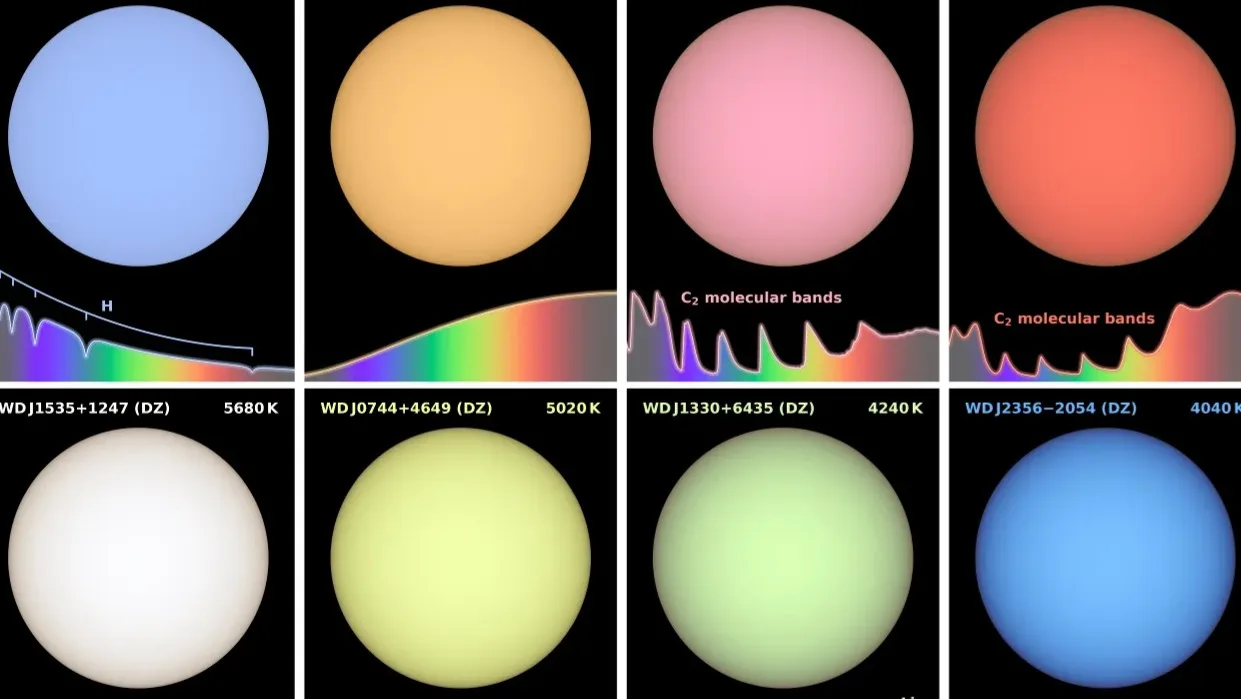
An example of the aforementioned phenomenon can be found in the white dwarf WD J1330+6435. Burning at roughly 4,000 degrees Celsius, this star is a zombie that is cannibalizing the rocky, planetary debris from its surrounding system. This feeding, the study says, has enriched the star's atmosphere with elements such as calcium, lithium, and sodium, giving it a "chartreuse green" appearance in the models used by the researchers. This, the study asserts, is the first known star—living or dead—that has been described as green.
"The traces of sodium in the atmosphere of this white dwarf absorb the orange part of the spectrum, leaving behind a ghostly green glow. Imagine standing on a planet and looking up at a green star. It feels like something out of science fiction," said Dr. Mark Hollands, who led the study.
It doesn't stop at green
However, the researchers also note that not all stars have to feed on planetary material to display exotic colors. Some white dwarfs possess deep convective zones that pull heavy carbon up from their cores into their outer, helium-dominated zones. These carbon molecules, in turn, absorb blue, green, and yellow light across the optical spectrum, and can give these stars vivid colors, from a deep salmon-pink to purple.
Does the name white dwarf even hold anymore?
That said, it should be noted that these colorful stars that deviate from the standard color-temperature rule are extremely rare, with researchers estimating that roughly one in 30 white dwarfs exhibit such characteristics. Hotter, bluish remnants of Sun-like stars still dominate sky surveys due to their sheer brightness, and to the best of our knowledge, white dwarfs still live up to their name, remaining predominantly white.