Is the bizarre hexagon on Saturn alien technology? Here's what NASA's images show
What is Saturn's hexagon?
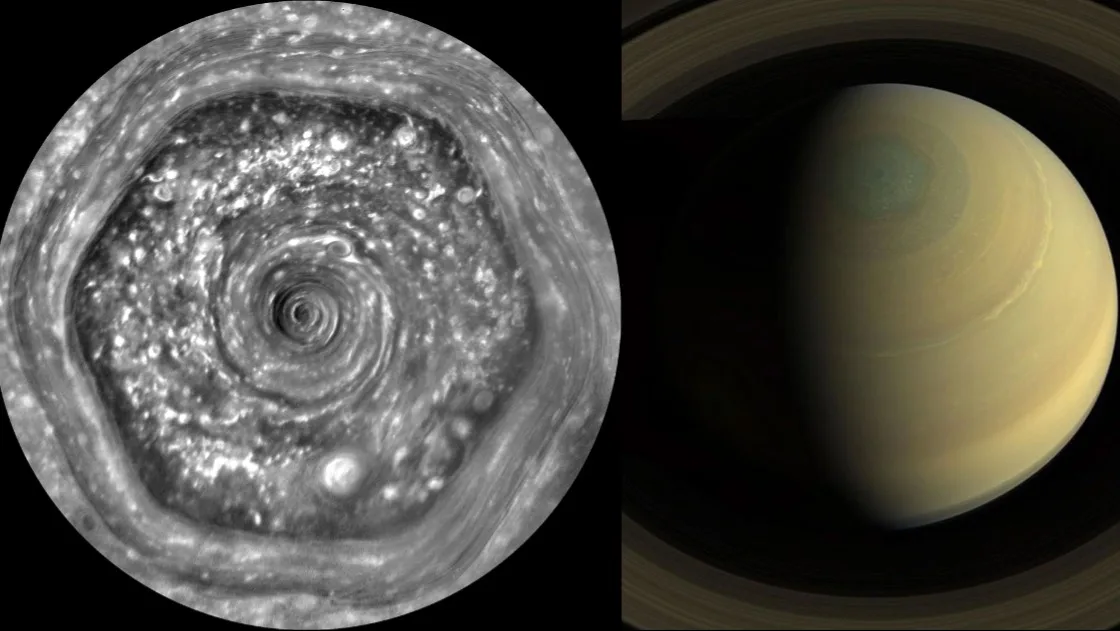
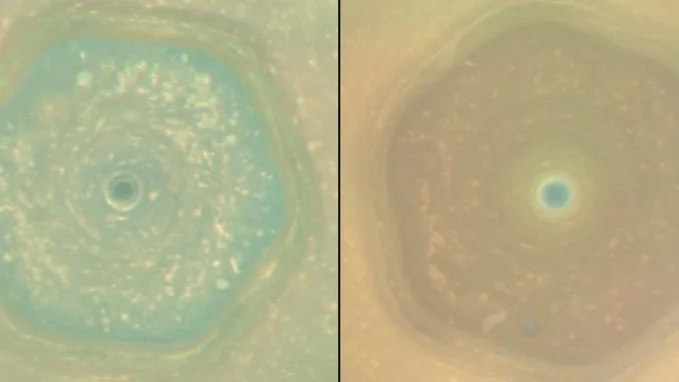
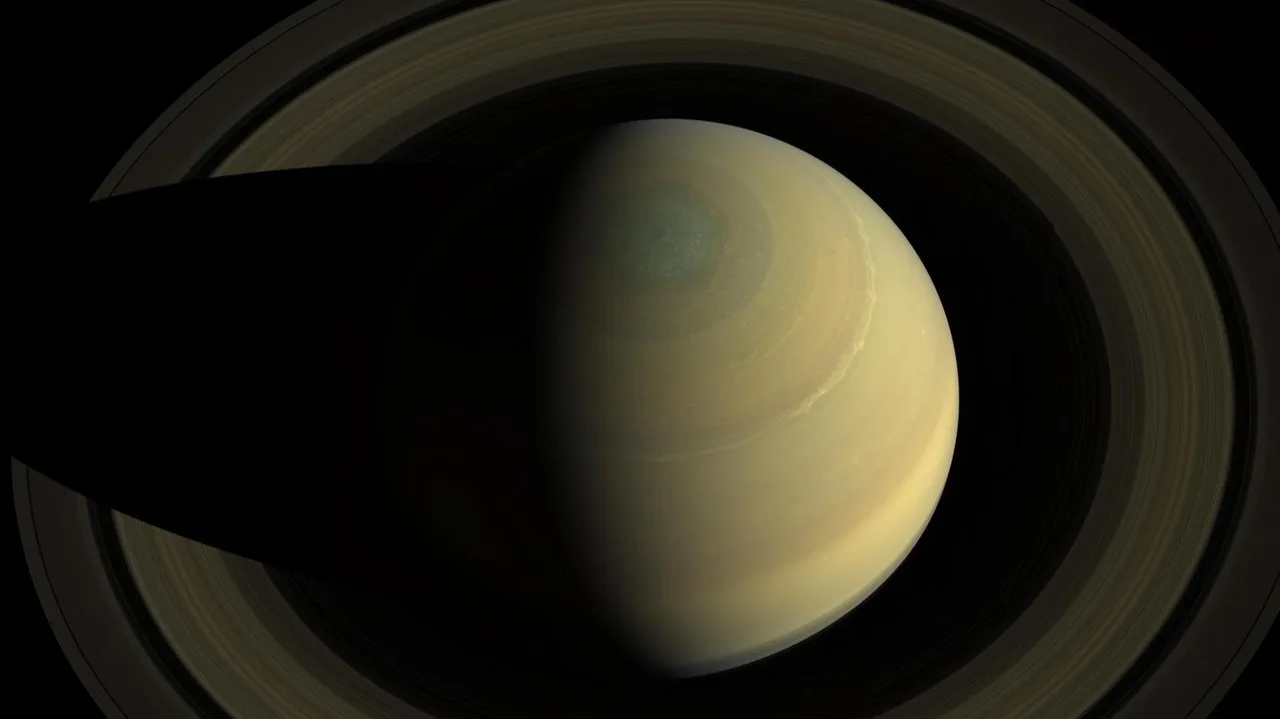
There’s a very bizarre feature at the north pole of Saturn, and it looks more like a six-sided pattern of clouds. It was first spotted in 1988, when scientists were reviewing data from the Voyager flybys of Saturn in 1980 and 1981. And it appears to be unlike anything ever observed on another world.
Some have even suggested that the hexagon could be an alien structure. Now, researchers might have an idea of what exactly is going on there.
How big is it, really?
According to NASA, the hexagonal structure is about 20,000 miles (32,000 kilometers) wide. The thermal data show that this feature extends nearly 60 miles (100 km) below Saturn’s upper atmosphere.
As Saturn spins, its six-sided feature rotates around the center at nearly the same pace. A jet stream, which is a fast-moving current of air like the ones on Earth, also blows eastward at up to about 220 mph (360 km/h) along a path that appears to follow the hexagon's outline.
What’s hiding at the heart of Saturn’s hexagon?
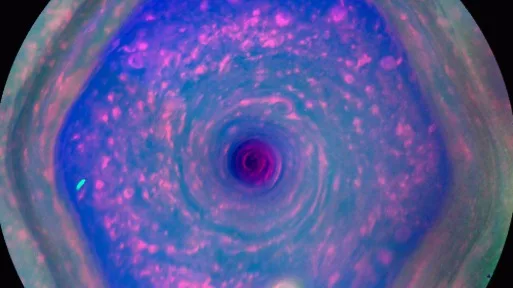
At the hexagon's center sits a vortex, which is a large spinning storm. Its eye is about 50 times larger than a typical Earth hurricane's, and its top wind speed is roughly double that of our strongest cyclones.
Kevin Baines, a planetary scientist at NASA's Jet Propulsion Laboratory, said, “This is the belly button of Saturn.” He added, “But it does have at least the structure of a hurricane, what we call the classic vortex.” He also noted that it's still “one of the biggest mysteries of the dynamics of Saturn.”
The strange storms inside Saturn’s hexagon
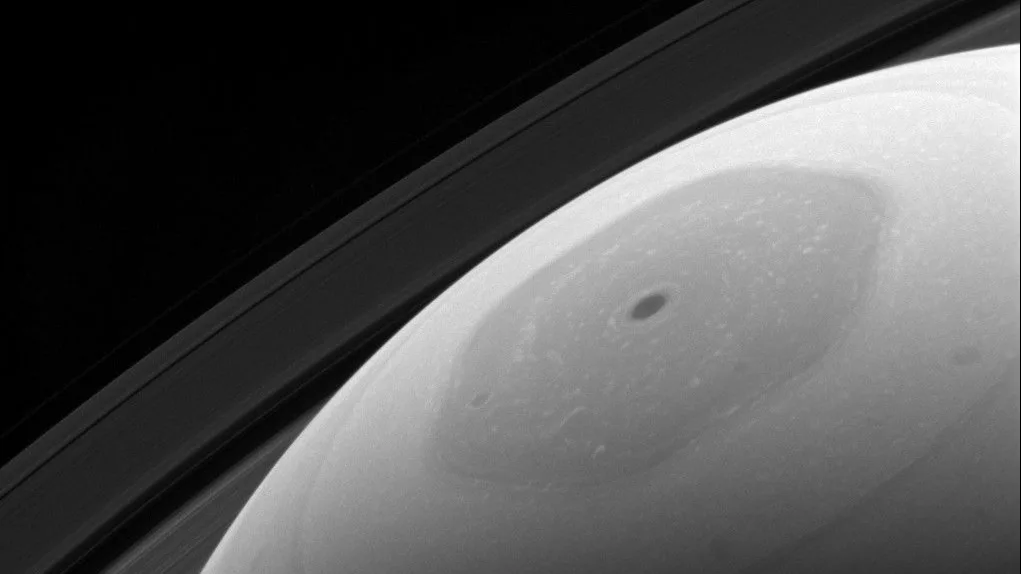
In late 2012, Cassini began swinging over Saturn's poles and gave us our best views yet of the hexagon. The images revealed many smaller vortices, which appear as reddish ovals. Some spin clockwise, while the hexagon and the central storm spin counterclockwise.
Some of these small storms get swept along by the jet stream, as if on a racetrack. The largest, a whitish one near the lower right corner, spans about 2,200 miles (3,500 kilometers).
And scientists still can’t explain it
For reasons unknown, Saturn has a hexagonal jet stream only in the north and not in the south. And although scientists have reproduced the shape in a lab, they don't know why it lasts so long.
Andrew Ingersoll, a Cassini imaging scientist at the California Institute of Technology, noted that similar weather features are usually turbulent and unstable. “A hurricane on Earth typically lasts a week, but this has been here for decades and, who knows, maybe centuries.”