How will the universe end? From the Big Freeze to the Big Crunch, theories you need to know
The universe has a finite life
All things come to an end, and so must the universe. However, how exactly the cosmos will meet its end remains a matter of scientific debate, with multiple theories existing on the subject. Here, we take a look at some of the most prominent hypotheses about the end of the universe.
The Big Freeze
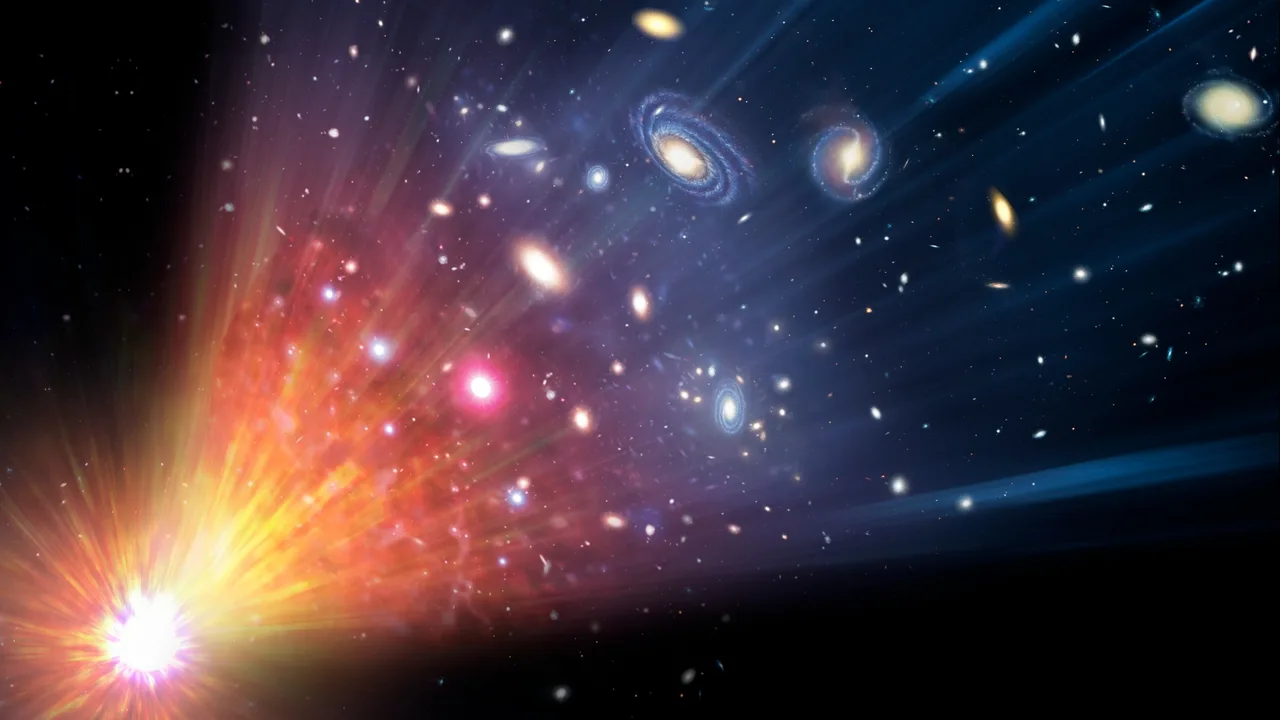
Space, time, matter, and everything we know all came from the Big Bang. While the universe began with a momentous explosion, physicists believe that it might die with a whimper—a theory known as the Big Freeze or the heat death of the universe. Since the Big Bang, the cosmos has been continuously expanding, and this expansion itself is accelerating, driven by a mysterious force called dark energy. As this expansion continues for billions and trillions of years, matter and energy will get farther and farther away from each other, spreading out and becoming incredibly thin. Over eons, stars, too, will burn all their fuel and stop shining, leaving the universe a cold, dark place. The remnants of the universe's life, black holes, too, will eventually evaporate, making the universe approach absolute zero, reaching a state of maximum entropy where no usable energy or heat is left for any cosmic activity.
The Big Rip
This theory is also based on the expansion of the universe, but the outcome it suggests is very different from that of the Big Freeze. In this scenario, often called the Big Rip, dark energy accelerates the expansion of the universe uncontrollably, eventually overpowering gravity itself and pulling galaxies apart first. Then, as this expansion continues, dark energy starts tearing solar systems, stars, and planets apart. Eventually, in the final moments of the universe, even microscopic structures such as atoms are ripped apart, leaving nothing but elementary particles.
The Big Crunch
Another theory about the universe's end, the Big Crunch answers the hypothetical question: what would happen if the influence of dark energy weakens? In such a scenario, gravity would become the villain, stopping the expansion of the universe initially. Then, the cosmos would begin to contract, with increasingly greater clumps of matter exerting even more gravitational power. This would cause galaxies to merge, driving up the temperature of the universe, and in its final moments, the cosmos would collapse back into itself, with everything we know compressed into a single point, mirroring the conditions right before the Big Bang.
The Big Bounce
Taking the idea of the Big Crunch a step further, the Big Bounce theory, rooted in quantum mechanics, suggests that the end of one universe is the beginning of another. This theory holds that our universe didn't start from nothing but was rather a phase in an unending cycle of cosmic expansion and contraction. Under this model, our universe is currently in an expansionary phase, and will eventually reach a point where gravity begins to pull everything together, like in the Big Crunch. However, unlike the Big Crunch, the Big Bounce holds that the universe will not be crushed into an infinitely dense final point, but will rather resist it because of the laws of quantum mechanics. Hence, instead of ending as a point, the extreme density at the end of the contraction phase will result in a cosmic rebound—or a bounce back, hence the name—causing the universe to expand again and creating a new Big Bang.