Expedition 74 cosmonauts complete 279th spacewalk in support of ISS—here’s everything they did
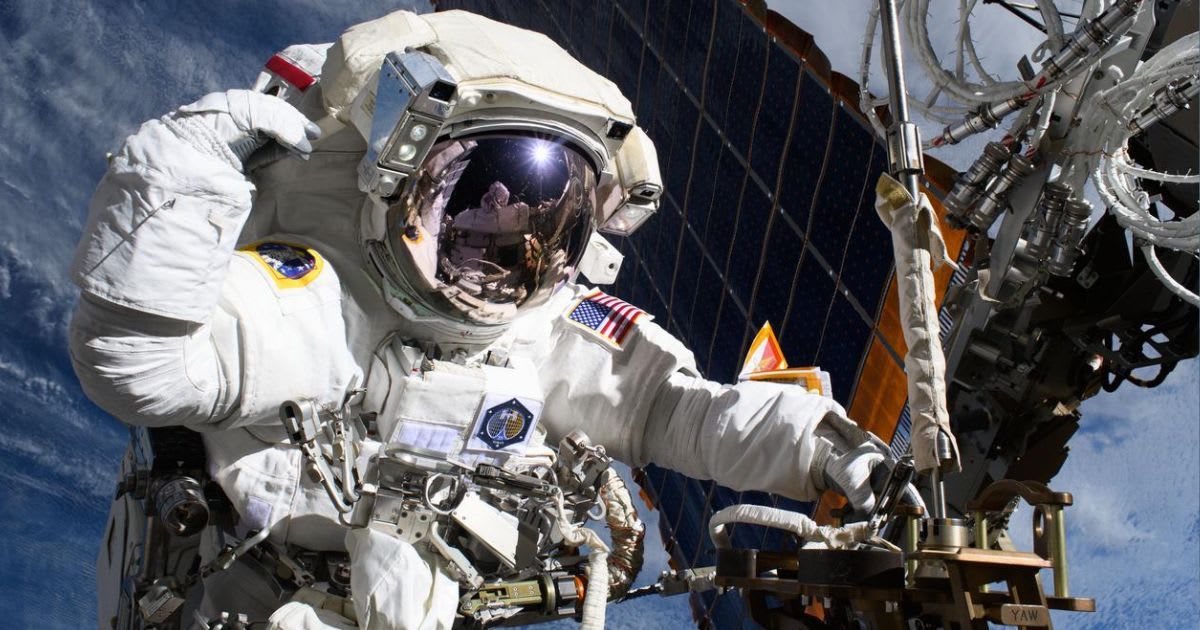
At 10:18 a.m. EDT on Wednesday, May 27, 2026, Expedition 74 Russian cosmonauts Sergey Kud-Sverchkov and Sergei Mikaev suited up and stepped out of the International Space Station (ISS) for a spacewalk that lasted 6 hours and 5 minutes. They had a full to-do list, and they got through all of it, even when things did not go as planned.
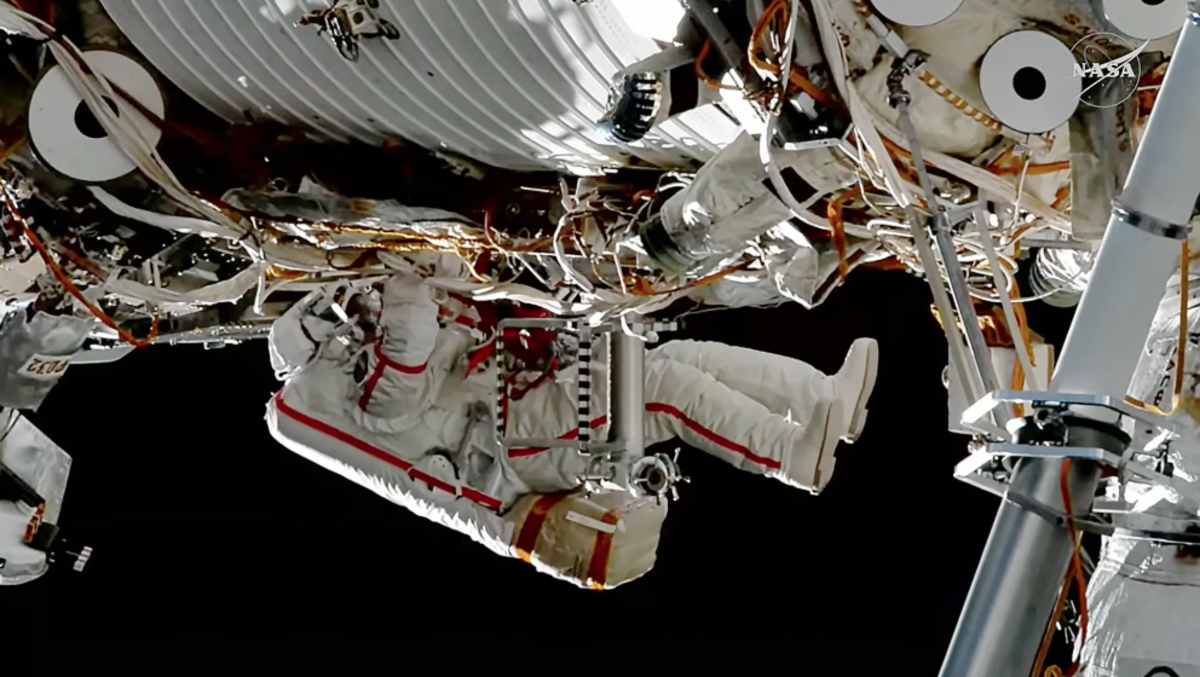
The headline task of the day was installing a telescope called Solntse-Teragerts on the exterior of the ISS's Zvezda service module. The instrument is designed to watch the Sun and record data on powerful solar flares, which are essentially massive bursts of energy that the Sun shoots out periodically. When the Sun releases powerful bursts of energy, it can disrupt GPS signals, interrupt satellite communications, and affect power grids on Earth. To better predict these events, scientists rely on continuous data from space-based observatories. The telescope in question is expected to stay active until 2028.

This was the second spacewalk of Kud-Sverchkov's career and the first for Mikaev. It brings Kud-Sverchkov's total time working outside a spacecraft to 12 hours and 11 minutes. It was also the 279th spacewalk conducted in support of the ISS since the station's assembly began in 1998.
They rode a 40-foot robotic arm and retrieved a science experiment
The cosmonauts also traveled to the Nauka module (Russian lab module on the space station) by riding at the end of the European Robotic Arm (ERA). It is a robotic limb attached to the station that stretches about 40 feet long. Their destination was a materials science experiment called Ekran-M, which had been running outside the station. The experiment uses gallium arsenide to grow extremely thin, extremely pure films with layers so delicate they can only form properly in the near-weightless environment of space. The cosmonauts retrieved a cassette holding samples from the experiment to bring back inside the station for further study.
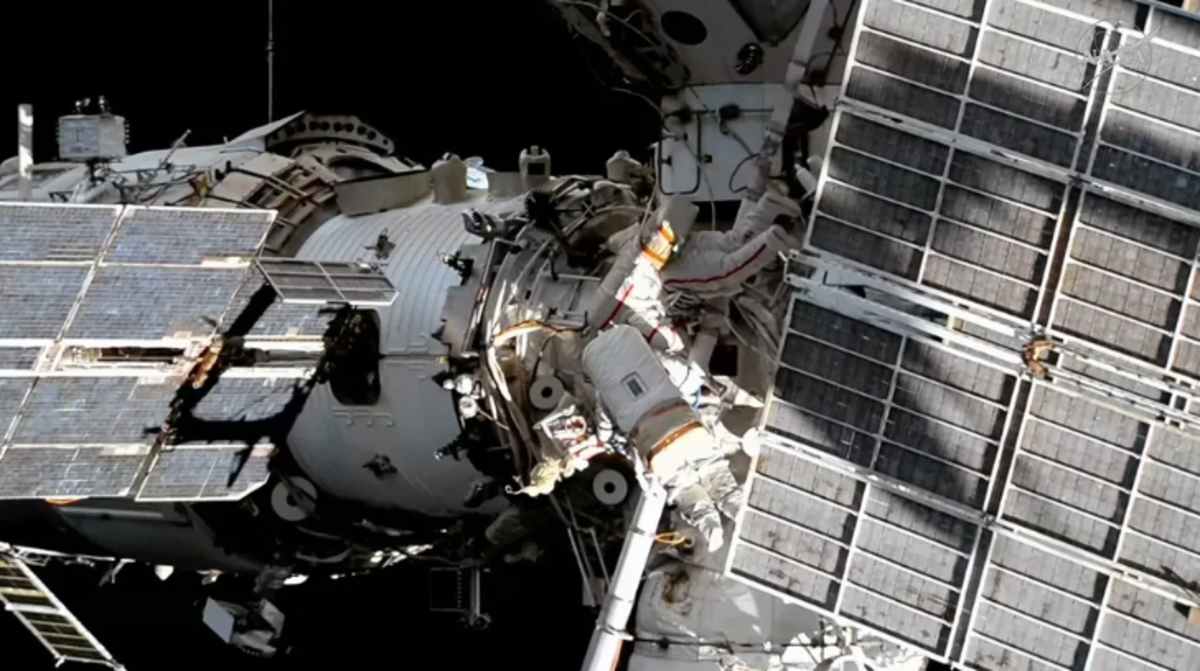
However, the retrieval did not go completely smoothly. The cosmonauts lost a pair of pliers during the operation, which floated off into space (as tools sometimes do during spacewalks). On top of that, commands sent up from the ground to move the experiment’s internal mechanisms did not respond as expected. They worked through it anyway and successfully collected the sample.
The cosmonauts inspected an antenna, collected experiments, and marked anniversaries
Back in March 2026, a Russian cargo spacecraft called Progress 94 was launched to the ISS. One of its Kurs rendezvous antennas, meant to assist with docking, did not deploy correctly after lift-off. This led to Kud-Sverchkov manually piloting Progress via a control panel inside the Zvezda Service module. During this spacewalk, Kud-Sverchkov and Mikaev made their way to the Poisk module to inspect, photograph, and secure that antenna. Another item on the to-do list was retrieving a container from the Biorisk experiment that housed samples of bacteria, seeds, and other organisms.
LIVE: Watch two cosmonauts go on a spacewalk. They'll install a solar radiation experiment, remove other science hardware, and if time allows, inspect and photograph an antenna on the Progress 94 cargo spacecraft. https://t.co/mZN2olg218
— NASA (@NASA) May 27, 2026
During the spacewalk, the pair took a moment to hold up a commemorative card celebrating the 80th anniversary of RSC Energia, the Roscosmos design bureau established in 1946, and posed for photographs. There was also an unscripted moment mid-spacewalk. Kud-Sverchkov asked Mikaev if he knew what day it was. "The 27th," Mikaev replied. "Today is the birthday of St. Petersburg," said Kud-Sverchkov. "So, congratulations to all of the residents of St. Petersburg, on the day of the city. Our northern capital of Russia." At the end, to close out the outing, they jettisoned a bundle of used window cleaners from the station before climbing back inside.
More on Starlust
NASA’s permanent Moon base could span hundreds of square miles: 'We'll not slow down'
Who are the astronauts for Artemis III? NASA is going to reveal the names on this date