Does time actually move slowly in space than on Earth? Here's what Einstein's theory says
In March 2016, when now-retired NASA astronaut Scott Kelly came back from his one-year stay aboard the International Space Station, he found out that his identical twin, Mark, was a little older than he was supposed to be. Mark, who was also a NASA astronaut before retiring in 2011, was born six minutes before Scott. However, after Scott's 2016 mission, he was six minutes and five milliseconds older than his brother. He had evidently aged faster than his younger brother. So, does that mean time actually slows down in space? Well, yes, it kind of does.
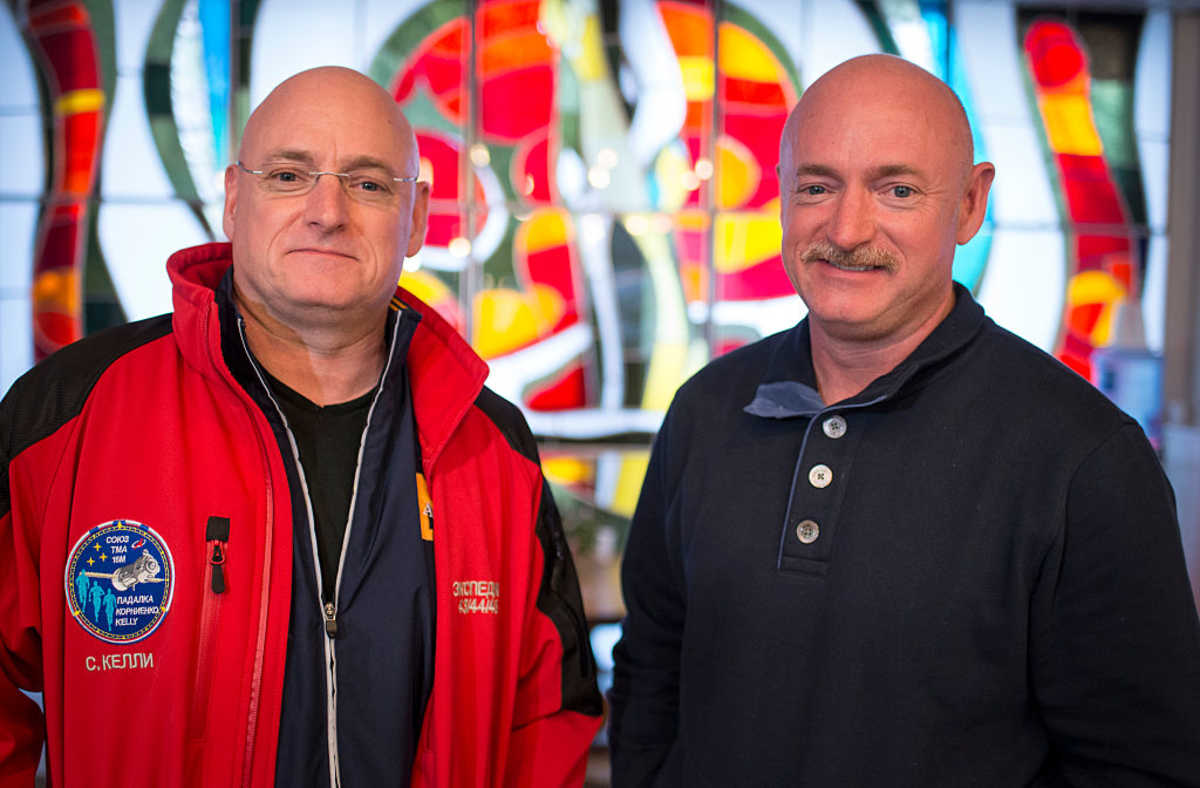
The Kelly brothers were participants in NASA's famous Twins Study and stand as prominent examples of a phenomenon called "time dilation." Albert Einstein proposed in his theory of special relativity that time is not universal; it is relative to the observer. Objects moving fast experience time more slowly than those at rest. In the case of the Twins study, not only did Scott Kelly spend a year in space, but during his stay there, he was zooming around Earth at 17,500 miles per hour (28,160 kilometers per hour).

Of course, one can always argue that five milliseconds is not exactly a lot. And it's true—it's not. That's because Scott wasn't moving at light speed. In fact, it can even be argued that Scott's aging had accelerated, given the amount of radiation he was exposed to during his one-year stay in space. However, at speeds closer to that of light, the effects of time dilation would be more pronounced. If you have seen the 2022 film Lightyear, you may be able to recognize a good example there. Stranded on a planet 4.2 million light-years away from Earth, Buzz Lightyear and his friends decided that they must develop a fuel that will allow them to travel very fast. And they do. But when Buzz comes back from his first flight, he finds that, while it has only been minutes for him, the others stranded on the planet have aged several years.
Then there is the effect of gravity on the passage of time, something that Einstein incorporates in his general theory of relativity. The further you are from the gravitational pull of massive objects, like our own Earth, the faster time will move for you. Arguably, the greatest effect of this phenomenon would be felt if you were falling into a black hole. You wouldn't really notice any difference in your immediate surroundings, but if you could look outside the black hole at the rest of the universe, you would see things speeding up. A really powerful telescope would even allow you to look at the future of our species on Earth. Wouldn't that be swell? Of course, all this would only be possible if you could, by some miracle, save yourself from the black hole's immense gravity turning you into space pasta.

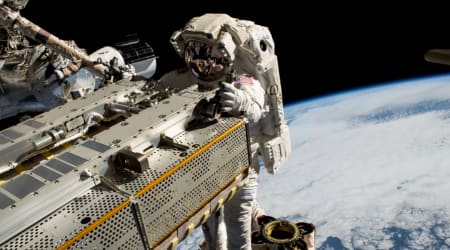
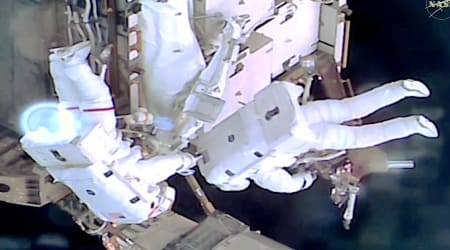
Astronauts on the International Space Station are, in fact, affected by both kinds of time dilation. But in their case, the speed of the orbiting laboratory has a greater effect on them than their distance from Earth of about 250 miles. So if you want to age slower, you should probably consider becoming an astronaut. And it's a pretty good time to do that as well, considering we are planning to set up camp on the Moon and travel to Mars.
More on Starlust
What would happen if a black hole appeared near Earth?
What would happen if you walked on Mars without a spacesuit?