NASA astronauts Anil Menon, Jessica Meir complete 96th U.S. spacewalk outside the ISS
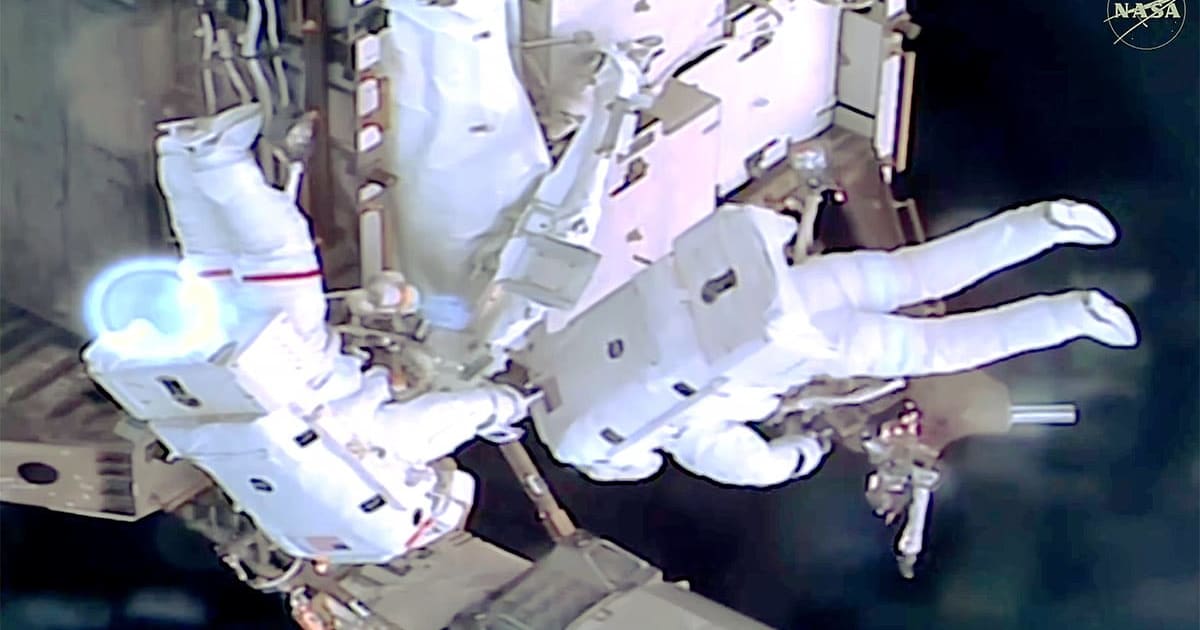
NASA astronauts Anil Menon and Jessica Meir have successfully completed their tasks as a part of the 281st spacewalk outside the International Space Station (ISS). U.S. Spacewalk 96 began at 8:33 am EDT on August 6, 2026, lasting six hours and 27 minutes. The main item on their agenda was to install the necessary hardware to set up a future attachment of a new solar array to the station. Designated as crew member 1, Meir performed her sixth extravehicular activity (EVA) wearing the suit with the red stripes. Menon was crew member 2 in what was his very first spacewalk, 23 days into his first trip to the ISS.
.@NASA astronauts Jessica Meir and Anil Menon completed their spacewalk at 3 p.m. EDT today after installing hardware on the station for future power system upgrades. More... https://t.co/Ml3iHBcjn6 pic.twitter.com/2vohwx1AeC
— International Space Station (@Space_Station) August 6, 2026
Prior to the spacewalk, the pair suited up and were stationed inside the equipment lock of the station's Quest airlock. They were then made to go through pre-breathe exercises that involve pumping pure oxygen into the suits to give time for the astronauts' blood vessels to be flushed of nitrogen. This is done so as to prevent decompression sickness--a phenomenon similar to the bends that divers experience, where gases bubble up inside one's tissues when the outside pressure changes rapidly. While this went on, mission controllers at the Johnson Space Center in Houston worked together with astronauts Jack Hathaway of NASA and ESA (European Space Agency) astronaut Sophie Adenot, who were aboard the station, to tick all boxes for a safe passage into the vacuum of space. The supporting cast also installed the SAFER (Simplified Aid for EVA Rescue) units to the EVA suits as an emergency jetpack system designed for self-rescue should an astronaut become untethered, and made sure there were no leaks. The astronauts were then moved inside the crew lock, and its pressure was dropped to allow them to open the hatch to the outside.
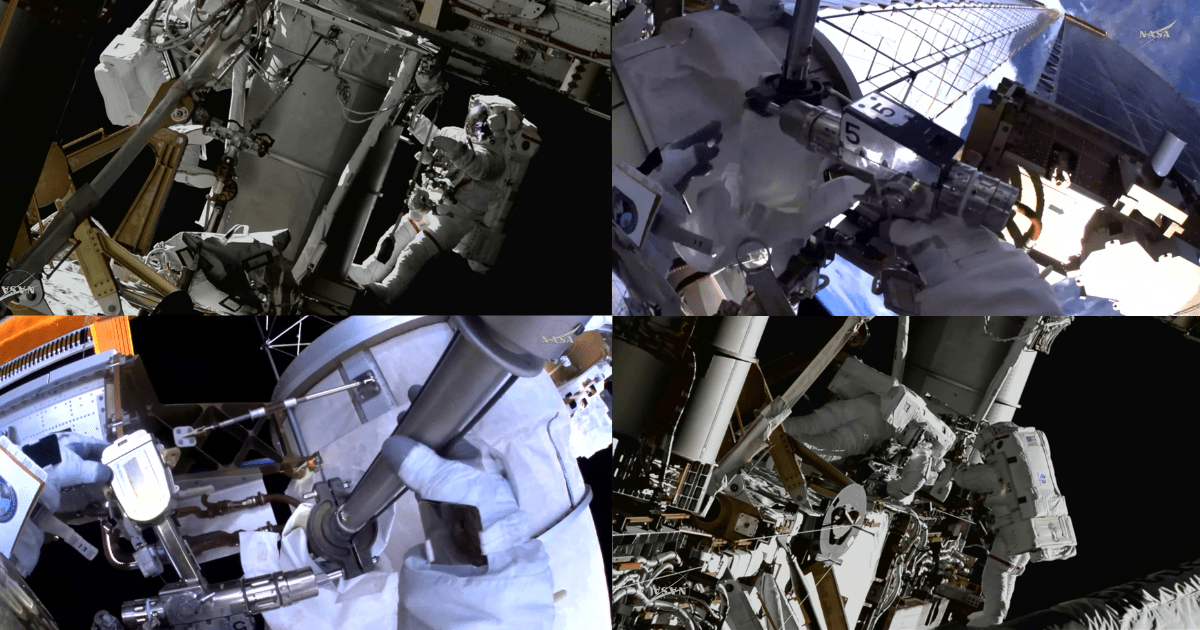
Meir and Menon then proceeded with their task of installing what is known as the 3B Mod kit to the 3B Mast Canister. At certain places on the ISS, there are fixtures that allow for the installation of solar arrays. 3B is one of those power channels, where the new ISS Roll Out Solar Array (IROSA) was set to be attached. To do so, the pair carried an eight-foot-long bag containing six struts and components of a mounting bracket with them, which wasn't easy to maneuver due to the inertia from its mass of over 300 pounds (136 kilograms) on Earth. The bracket was assembled by Meir and Menon from start to finish using pistol-grip tools they were armed with. Once the fitting was complete, the pair had to also route cables for completing the electrical power supply from what will be the seventh IROSA at the space station. The said IROSA will arrive via SpaceX's 35th Commercial Resupply Services mission to the station.
Once their task was complete, Meir and Menon headed back into the crew lock at 3 pm EDT, followed by repressurization of the airlock and subsequent post-spacewalk procedures. Meir, who became the latest commander of the orbital laboratory on July 25 before the recent return of the Soyuz MS-28 crew, not only had EVA experience of over 40 hours but also performed a very similar task during U.S. spacewalk 94 in March this year. Back then, working alongside Chris Williams of NASA, she helped prepare the 2A power channel of the ISS, which hasn't been reported to have had an IROSA attached to it yet. Perhaps, future spacewalking astronauts will also tend to 2A besides the 3B power channel.
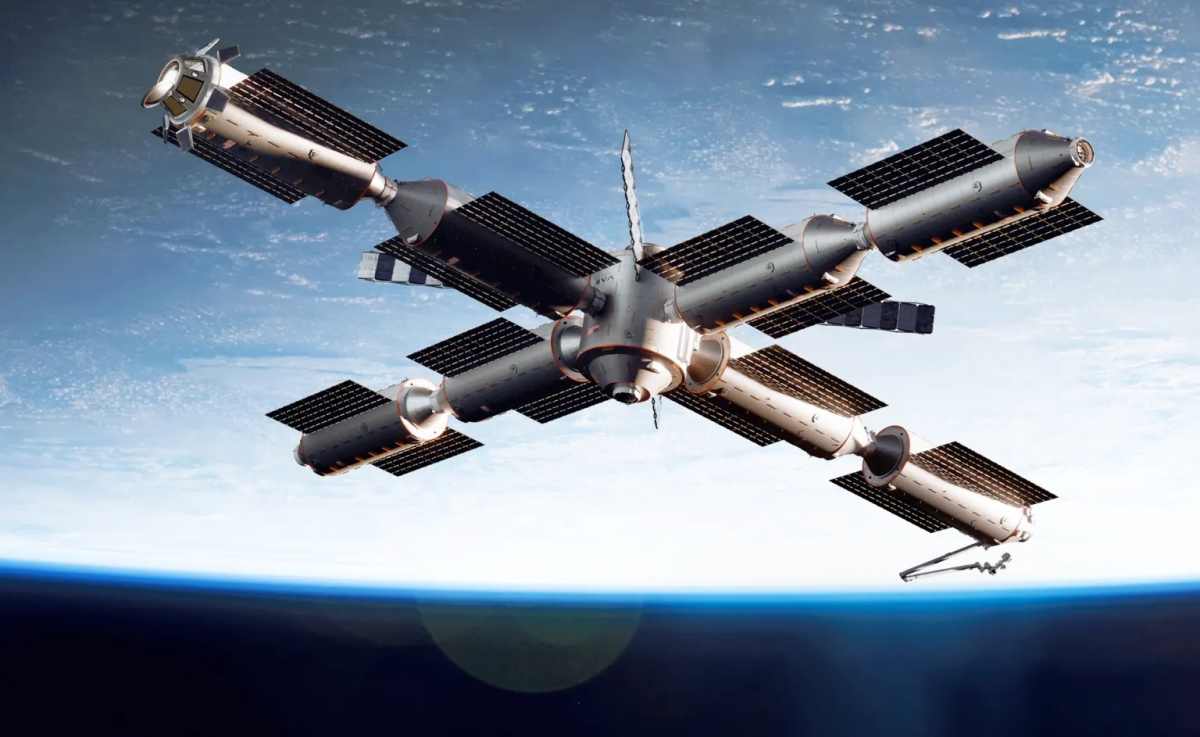
The upcoming weeks are set to be a busy time for the Expedition 75 crew members, with the next U.S. spacewalk planned for August 13 at 8:35 am EDT. These efforts are part of the constant upgrades and repairs that are needed to keep the ISS functioning as one of humanity's outposts in space (the other being China's Tiangong space station). According to NASA, these new solar arrays will not only be more efficient in supplementing the space station's power demands, but will also be important to manage the progression towards its end of operations. Planned for the early 2030s, the ISS will be made to re-enter the atmosphere--soon to be replaced by a host of commercial spacecraft and space stations.
More on Starlust:
US Spacewalk 95: NASA astronauts Jessica Meir and Chris Williams replace faulty Canadarm2 on ISS
Expedition 74 cosmonauts complete 279th spacewalk in support of ISS—here’s everything they did