Crashed SpaceX's Starlink satellite photographed by Vantor's WorldView-3 spacecraft in orbit
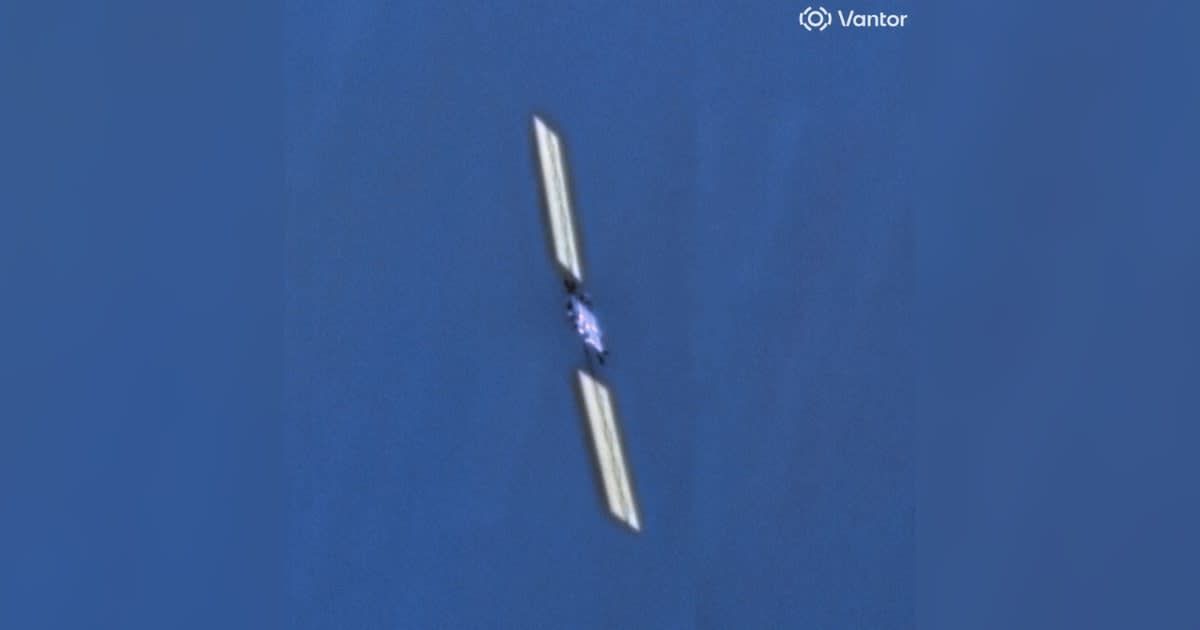
The fall of a SpaceX Starlink satellite in orbit was imaged by Vantor's WorldView-3 spacecraft on December 18, 2025. The image provided a closer look at the orbital phenomenon that knocked out the satellite 35956 from its place. Vantor, known before as Maxar Intelligence, partnered with SpaceX to rapidly image the satellite after the reported on-orbit anomaly, according to the company's statement on LinkedIn. They used the WorldView Space capability to capture a 12 cm non-Earth image of the satellite. It provided visual intelligence on the condition of the doomed satellite and showed it to be mainly intact.
WorldView-3 was located 150 miles away from the Starlink when the satellite was imaged, and SpaceX will use the visual for further analysis. “Our Collection Planning team responded within hours to an urgent commercial customer request to gain visual intelligence on a satellite that had lost communications,” said Todd Surdey, the EVP and general manager of Enterprise and Emerging Products. The statement highlighted that this was a testament to “how responsive space operations can deliver actionable insights,” particularly in events that are time-sensitive.
Imagery collected by Vantor’s WorldView-3 satellite about 1 day after the anomaly shows that @starlink Satellite 35956 is largely intact. The 12-cm resolution image was collected over Alaska from 241 km away. We appreciate the rapid response by @vantortech to provide this… https://t.co/8OcTZsk5Gx pic.twitter.com/1PafjFwuRP
— Michael Nicolls (@michaelnicollsx) December 20, 2025
The Starlink satellite lost communication with the ground, and its propulsion tank experienced an unscheduled venting on December 17, 2025. The satellite is falling into Earth’s atmosphere and will disintegrate in a matter of weeks. The WorldView-3 Earth-observing satellite was deployed for action on December 18, 2025, according to Space.com. The image was taken when it was soaring over Alaska and had a resolution of 4.7 inches, providing key insights. Data indicated that the satellite released some debris objects as a result of the unexpected anomalies.
These fragments and the satellite itself will not be a hindrance to other spacecraft in low Earth orbit (LEO). Michael Nicolls, the vice president of Starlink engineering at SpaceX, expressed gratitude through an X post. "We appreciate the rapid response by Vantor to provide this imagery. Additional data suggest that there is a small number of trackable debris objects from the event, and we expect the satellite and debris to reenter and fully demise within weeks," read the post.
On December 17, Starlink experienced an anomaly on satellite 35956, resulting in loss of communications with the vehicle at 418 km. The anomaly led to venting of the propulsion tank, a rapid decay in semi-major axis by about 4 km, and the release of a small number of trackable…
— Starlink (@Starlink) December 18, 2025
Starlink-35956 was launched on November 23, 2025, and was at an altitude of 260 miles when the communication stopped. The sudden drop in fuel tank pressure was followed by a 2-mile decrease in the semi-major axis of its orbit. The accident was not the result of a collision with space debris, but had internal causes, likely from the fuel tank leak. Starlink is the largest satellite constellation ever assembled, with 9,300 active spacecraft. The Starlink constellation comprises 65% of all the operational satellites in Earth orbit.

Though the image was used to confirm the nature of the satellite and to show that the satellite was largely intact, Starlink-35956 was a lost cause. The internal damage was masked by the external figures, which failed to reflect that the satellite was doomed. It was spinning uncontrollably into the atmosphere, to be lost soon, and any control over the instrument had been lost. The only thing to do is witness its uncontrollable journey through the atmosphere, as Starlink devices are designed to disintegrate in the atmosphere, accounting for any fall events, as per Universe Space Tech.
More on Starlust
A SpaceX Starlink satellite is tumbling toward Earth after a rare mishap
SpaceX explains what caused the Starlink–Chinese satellite near-collision last week