A SpaceX Starlink satellite is tumbling toward Earth after a rare mishap

Lately, the skies around Earth have gotten a lot more crowded. Companies and countries alike are rushing to launch tens of thousands of satellites. That's why a bunch of space policy officials and industry leaders keep pushing for stricter rules on orbital traffic. They want clearer ways to handle dodges and deployments, especially between big players like the U.S. and China, per Reuters. This push for better coordination gained fresh urgency this week after SpaceX revealed an in-orbit anomaly affecting one of its Starlink satellites. On December 18, the company shared a detailed update about the incident involving satellite 35956.
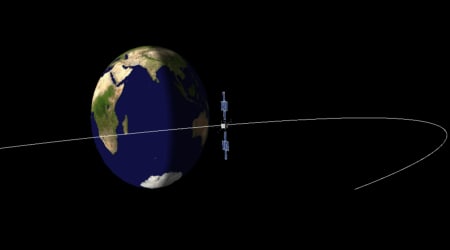
The problem occurred the previous day, when operators lost contact with the satellite while it was at an altitude of 418 kilometers. According to the statement shared on X, the "anomaly led to venting of the propulsion tank, a rapid decay in semi-major axis by about 4 km, and the release of a small number of trackable low relative velocity objects." SpaceX quickly coordinated with the U.S. Space Force and NASA to track those fragments.
On December 17, Starlink experienced an anomaly on satellite 35956, resulting in loss of communications with the vehicle at 418 km. The anomaly led to venting of the propulsion tank, a rapid decay in semi-major axis by about 4 km, and the release of a small number of trackable…
— Starlink (@Starlink) December 18, 2025
Fortunately, the satellite remains mostly intact, though it now tumbles uncontrollably. It will enter Earth's atmosphere but will burn up within weeks. Moreover, its path keeps it well below the International Space Station, so there is no threat to the crew or the outpost itself. SpaceX emphasized its focus on orbital safety in the post: "We take these events seriously. Our engineers are rapidly working to root cause and mitigate the source of the anomaly and are already in the process of deploying software to our vehicles that increases protections against this type of event."

This rare failure comes after SpaceX avoided a mishap a few days ago. Michael Nicolls, who's the vice president of engineering at Starlink, called out a pretty scary close shave on December 12. A freshly launched satellite had come uncomfortably near one of theirs. It was one of the nine satellites that had blasted off on a Kinetica 1 rocket back on December 9 from the Jiuquan Satellite Launch Center out in the Gobi Desert. It zipped by Starlink-6079 at around 560 kilometers up, getting as close as about 200 meters.
When satellite operators do not share ephemeris for their satellites, dangerously close approaches can occur in space. A few days ago, 9 satellites were deployed from a launch from the Jiuquan Satellite Launch Center in Northwestern China. As far as we know, no coordination or…
— Michael Nicolls (@michaelnicollsx) December 13, 2025
Nicolls said that, as far as they could tell, nobody had coordinated ahead of time with the operators already up the He argued that most orbital risks stem from limited sharing of trajectory data, or ephemeris, among operators. Without it, dangerous encounters become more likely. CAS Space, the Chinese company that operates the rocket, later responded, stressing that its launches follow protocols to avoid collisions.
If confirmed, this incident occurred nearly 48 hours after payload separation, by which time the launch mission had long concluded. CAS Space will coordinate with satellite operators to proceed. This calls for re-establishing collaborations between the two New Space ecosystems. https://t.co/bsuFLeguxo
— CAS Space (@cas_space) December 13, 2025
It stated the launch mission had concluded well before the close pass. Such near-misses are not uncommon in low Earth orbit, where thousands of active satellites now operate alongside debris. Yet experts often caution that without stronger global norms, the risks could grow. Events like the recent anomaly serve as reminders. While this one appears contained, with quick reentry expected and minimal debris, it underscores the challenges of managing mega-constellations responsibly.
More on Starlust
Spot Starlink and other satellites in the night sky: Easy tips for stargazers
SpaceX is developing Starship launch complex at Cape Canaveral after approval from Air Force