What is the Extremely Large Telescope and what makes it special? All about the most powerful telescope ever made

On a mountaintop more than 3,000 meters high in Chile's Atacama Desert, the world's largest optical and near-infrared telescope is slowly and steadily coming together, with first light targeted for the end of the decade. Known as the Extremely Large Telescope (ELT), this gigantic eye on the sky represents a generational leap in humanity's observational capabilities. Here's everything you need to know about it.

What is the ELT?
A project of the European Southern Observatory (ESO), the ELT is being constructed on the top of the Cerro Amazones mountain, at an elevation of 3,046 meters. While the project kicked off in the mid-2000s, site clearing began in 2014 after funding was secured, and as it stands, construction is in its advanced stages.

What sets the ELT apart is its enormous 39-meter primary mirror, the largest of any telescope ever made by far. It was no small task constructing this gigantic mirror: since a single glass slab this big would warp under its own weight, the ELT uses 798 individual glass ceramic segments, each measuring 1.45 meters wide and 50 millimeters thick. To maintain optical cohesion across this massive mirror, the ELT also uses extremely accurate sensors to track segment drift, while 2,394 actuators continuously realign individual segments to account for winds and temperature variance. Interestingly, while the mirror uses 798 segments, the ESO produced a total of 949 segments to create a 133-segment buffer. This will allow the ELT to have a rotating maintenance pool, and individual segments can be recoated without shutting down the telescope for maintenance.
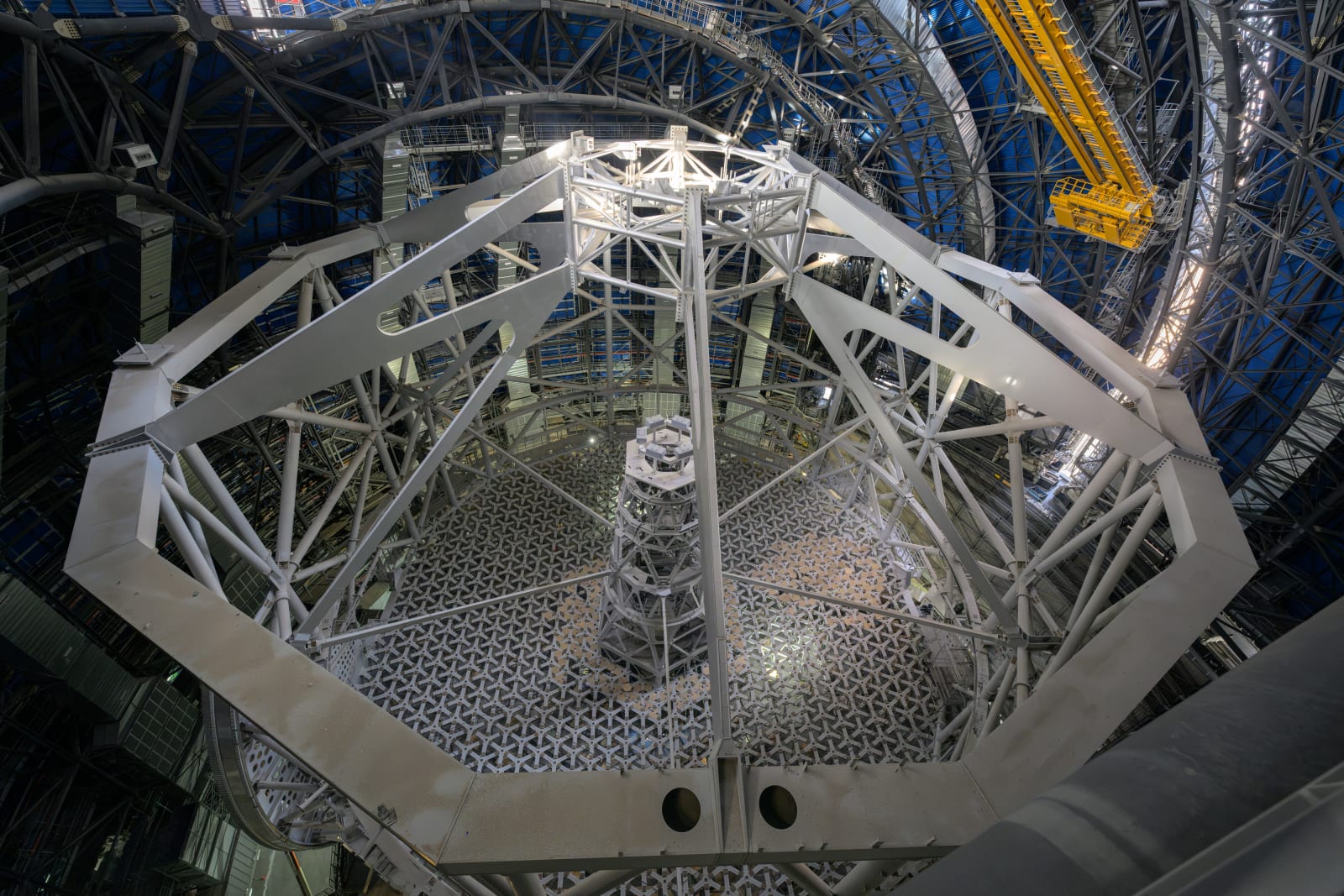
In addition to its primary mirror, the ELT also has a 4.25-meter convex secondary mirror and a 3.7-meter concave tertiary mirror, with the former being the largest convex mirror ever made by humankind. Further, the ELT features two atmospheric correction mirrors to flatten distorted light waves and provide image stabilization.
How powerful is the ELT?
To call the ELT a powerful telescope would be an understatement, and true idea of its capabilities can only be illustrated through comparison. Upon reaching operational status, the ELT will be able to collect 100 million times more light than the human eye is capable of gathering—over 13 times more light than the world’s largest optical telescopes operating today. The ELT will also outclass both Hubble and the James Webb Space Telescope (JWST), and will be capable of yielding images up to 15 times sharper than Hubble and 6 times sharper than JWST in near-infrared wavelengths. In comparison to the telescope used by Galileo Galilei, the ELT's light-gathering capabilities are 8 million times superior.
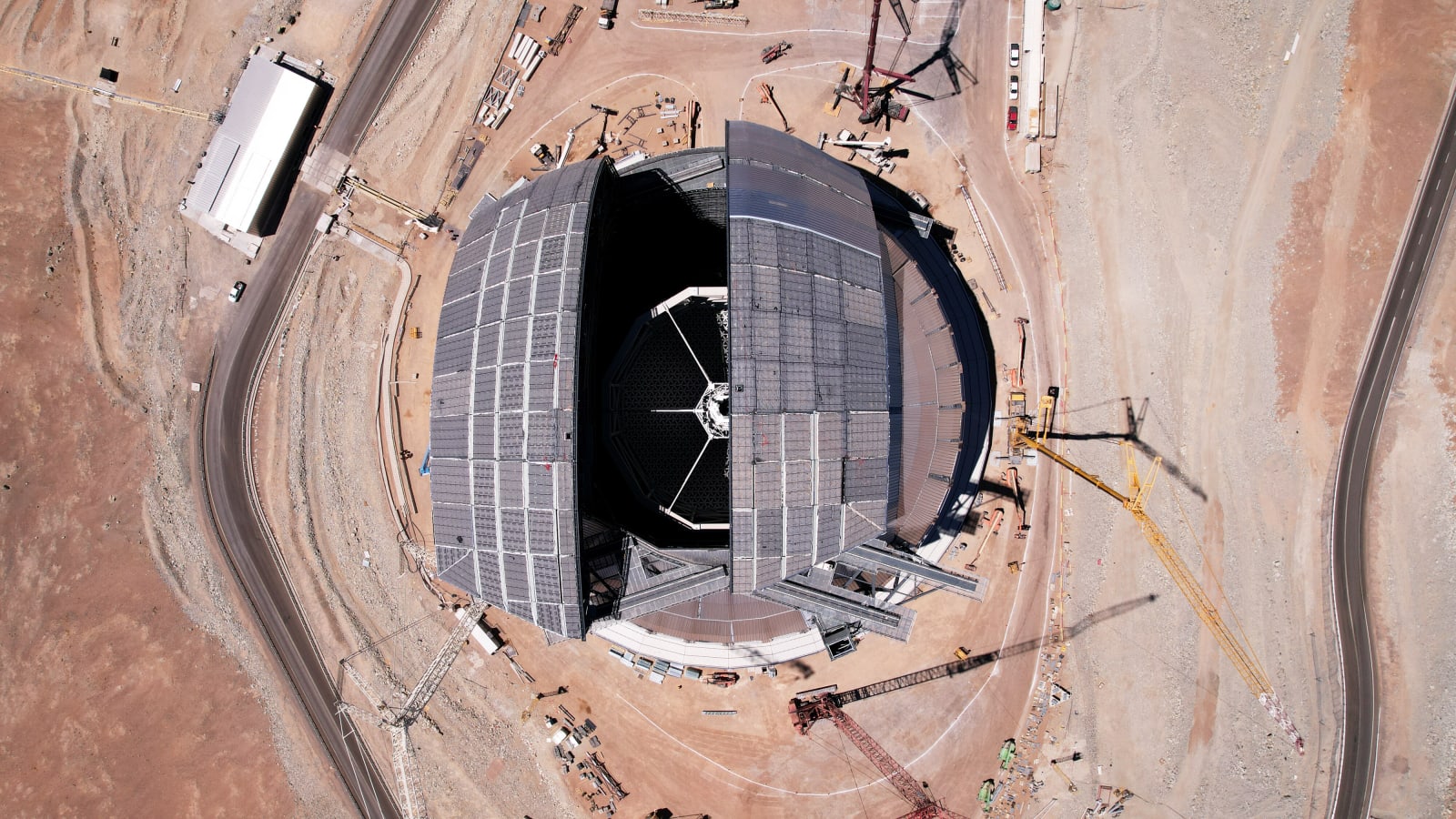
The total light collecting area of the ELT will be close to a kilometer—978 square meters to be exact. For perspective, the second largest ground-based telescope in the world, the Large Binocular Telescope (LBT) in Arizona, U.S., has a total light collecting area of 111 square meters.
What capabilities does the ELT have?
Given the unprecedented size of its mirror, the ELT will usher in a new era in astronomy, allowing scientists high-resolution images unlike any other.
In terms of capabilities, the ELT will be able to directly image terrestrial exoplanets in the habitable zones of nearby stars, while its spectrographs will be capable of analyzing the atmospheres of these exoplanets to hunt for biosignatures—telltale chemical signs that could indicate the presence of life.

The ELT will also enable astronomers to detect stars and galaxies formed shortly after the Big Bang, allowing them to map the cosmic epoch of reionization. The ELT will also directly track the expansion rate of the universe, and provide unprecedented insights into the environments that surround supermassive black holes.

Cost, construction, and first light
The total cost of the ELT project, as per 2023 figures by the ESO, is 1.45 billion euros ($1.67 billion at the time of writing this article). Once it is up and running, the ELT will have an operational cost of 50 million euros ($57.8 million) annually.
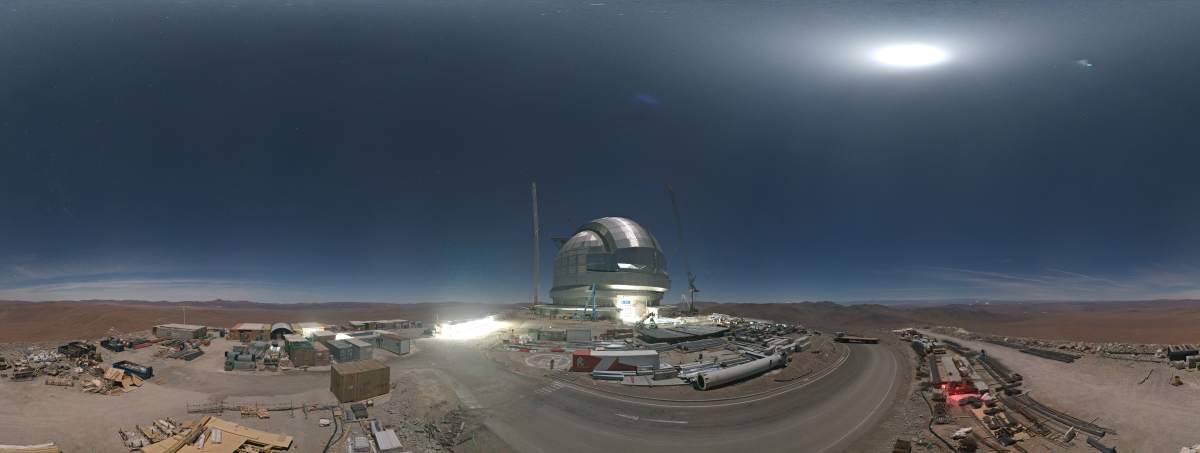
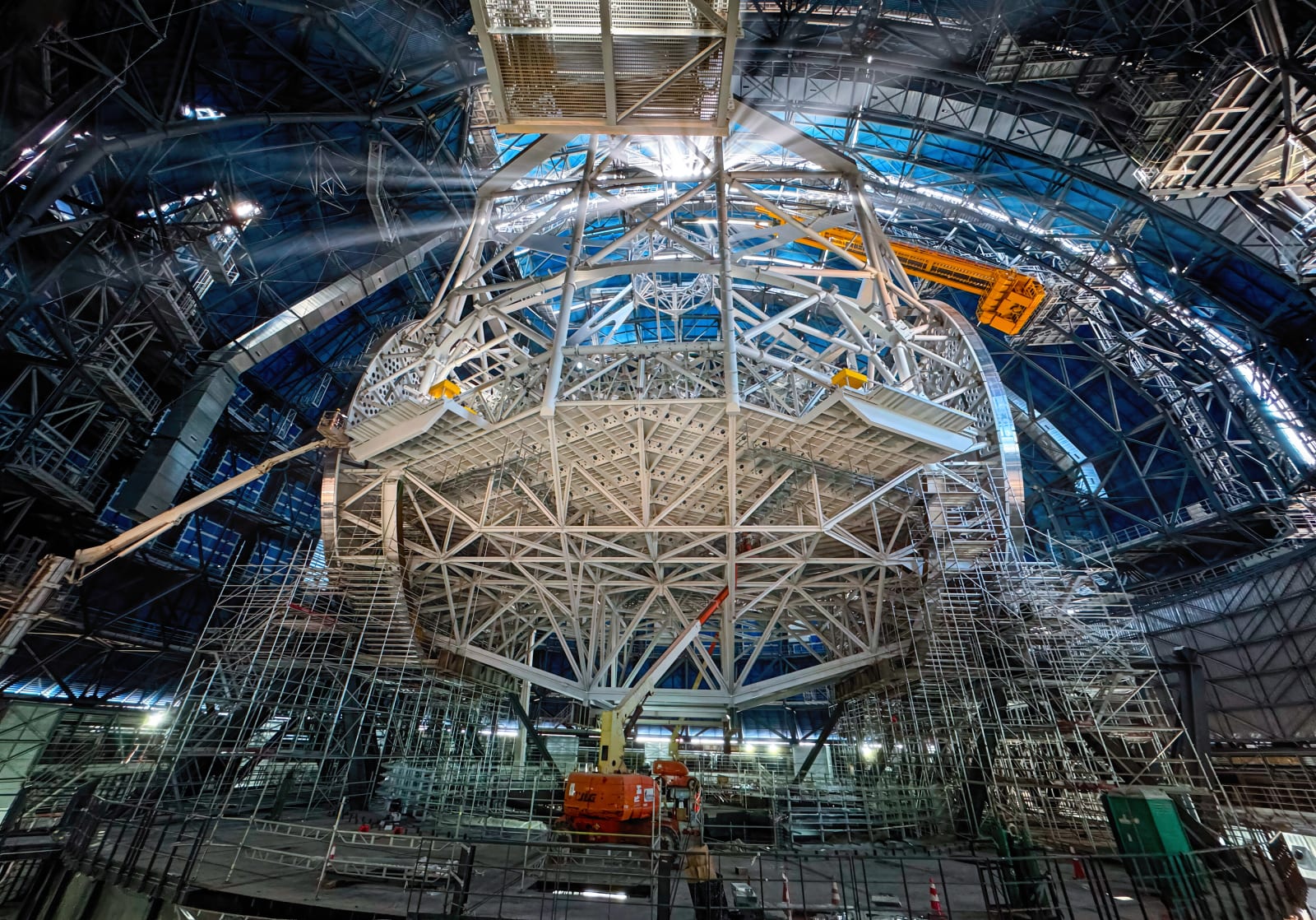
The gigantic structure, standing a whopping 80 meters (262.5 feet) tall and 93 meters (305 feet) in diameter, has roughly the same footprint as that of a football stadium, and constructing it required blasting away 220,000 cubic meters of rock to level the top of Cerro Armazones.

According to the timeline shared by the ESO, the ELT will see its secondary mirror completed this year, while the main structure of the telescope, its dome, and tertiary mirror are expected to be completed in 2027. The following year, 2028, will see the completion of its fourth and fifth atmospheric correction mirrors, as well as the installation of the 798 segments of the main mirror. Subsequently, the telescope is expected to achieve technical first light in 2029, before taking its first scientific observations in 2030.
More on Starlust:
ESA’s Plato, set to hunt Earth-like exoplanets, is now ready for launch after acing final tests
NASA’s Roman Space Telescope may finally reveal how the universe's first black holes formed